Why quad workouts matter for men
If you are serious about strength, athletic performance, or simply filling out your shorts, you cannot afford to skip a focused quad workout for men. Strong quadriceps are not only about bigger legs. They support your knees, power your squats and deadlifts, and make everyday movements like walking, bending, and getting up from a chair feel easier.
Research in the Journal of Physical Therapy Science and The Journal of Rheumatology links consistent quad training to better knee stability and a lower risk of knee osteoarthritis and injury, which pays off long after you leave the gym behind each day. In other words, your quads are a long term investment in both performance and joint health.
Many men still rush leg day, cut sets short, or skip it entirely. You can set yourself apart by committing to a structured, effective quad routine and focusing on quality reps instead of ego lifting.
Understand your quad muscles
To program an effective quad workout for men, it helps to know what you are actually training. Your quadriceps are a group of four muscles on the front of your thighs:
- Rectus femoris, runs down the middle and also crosses the hip
- Vastus lateralis, the outer quad that adds width to your thighs
- Vastus medialis, the inner quad, often seen as the teardrop by the knee
- Vastus intermedius, sits deep between the others
Together, they extend your knee and assist in hip flexion. That means they drive movements like squats, lunges, leg presses, and even getting up from the floor.
When your goal is size and strength, you want exercises and angles that make all four work hard. That is why you will see both squats and more targeted moves like leg extensions in a solid quad-focused plan.
Avoid common quad training mistakes
Before you add more weight or sets, it is worth fixing the habits that hold most men back in their quad training.
Cutting the range of motion short
One of the biggest mistakes is using half reps on leg presses, squats, hack squats, and leg extensions. You lower a few inches, bounce out, and repeat. This may let you pile on plates, but it does not fully load the quads where they grow best.
When you use a full, controlled range of motion, you create more tension across the entire muscle. That means better hypertrophy and stronger joints, especially around the knees.
Lifting too heavy for clean reps
Another common issue is going so heavy that your form breaks down. On moves like leg press or hack squat, you might find yourself doing shallow, shaky reps just to move the load.
It is more effective to use a weight that lets you perform 8 to 12 clean reps with full depth. Evidence based guidance suggests that most of your hypertrophy work should happen in this rep range, with sets taken close to failure rather than relying on maximum loads for minimal reps. Quality beats quantity and it definitely beats ego.
Skipping unilateral work
If you only ever squat with both legs at once, small strength differences between your left and right side can grow over time. Unilateral exercises like lunges and split squats help even out these imbalances so your quads develop more evenly. This is especially important if you notice one knee bothering you more than the other or one leg feeling weaker.
Key principles for quad growth
You do not need a complicated program to build impressive quads. What you need is a handful of clear guidelines and the discipline to follow them consistently.
Train quads with enough volume
Research based recommendations point toward performing around 3 exercises per muscle group with 5 to 10 sets per week as a solid starting point for growth. Going beyond 12 to 20 sets per week tends to deliver diminishing returns, especially if recovery, sleep, or nutrition are not dialed in.
For most men, training quads twice per week works well. Aim for at least two quad-focused exercises per session, with about 3 to 4 sets each. According to evidence cited in a 2024 Gymshark guide, this setup helps you hit the minimum of roughly 10 hard sets per week while still allowing 48 hours of recovery between sessions.
Use the right rep range and intensity
For quad hypertrophy, keep most sets in the 8 to 12 rep range. Select a weight that brings you 0 to 3 reps short of failure. That means your last rep should feel challenging but not completely sloppy. This sweet spot lets you apply enough mechanical tension and fatigue without wrecking your joints or nervous system.
Focus on knee flexion and extension
To really target the quads, choose exercises and techniques that increase knee bend while reducing the demand on your hips and glutes. That can mean:
- Bringing your stance a bit closer
- Keeping your torso more upright
- Positioning your feet lower on a leg press platform
- Elevating your heels in some squat variations
These adjustments shift more of the workload to your quads rather than your posterior chain.
If your glutes and hamstrings are doing most of the work on leg day, you are not running a true quad workout. Small changes in stance and setup can completely change which muscles carry the load.
Best quad exercises for men
The most effective quad workout for men blends heavy compound lifts with more targeted isolation and unilateral work. Here are core moves to prioritize and how they help.
Quad-focused squat variations
Barbell front squat
By positioning the bar in front of your body, you are encouraged to keep your torso more upright. This increases knee flexion and places greater emphasis on your quadriceps compared to a traditional back squat. It is one of the best moves to build overall quad thickness and strength.
Heel elevated goblet squat
Holding a dumbbell or kettlebell in front of your chest helps you stay balanced and keep your chest up. Elevating your heels on small plates or a wedge increases your range of motion and recruits more muscle fibers in the quads, especially the vastus medialis, the teardrop muscle by the knee. This is a great option if your lower back is sensitive or you are still refining your squat pattern.
Hack squat or sissy squat
Machine hack squats and bodyweight or assisted sissy squats both shift emphasis toward knee extension rather than hip extension. This means you lean more into the quads and less into the glutes. Start light and focus on slow, controlled reps to avoid straining your knees.
Unilateral quad builders
Bulgarian split squat
With your back foot elevated on a bench, you step out into a relatively short stance and keep your torso upright while lowering your hips. This position increases knee bend on the front leg and delivers a major quad stretch and pump. It is also excellent for ironing out side to side imbalances.
Front foot elevated lunge or split squat
Raising your front foot on a small step increases the total range of motion at the knee. Combine that with a controlled tempo and you will feel your quads working hard without needing very heavy loads. This setup appears in many quad dominant workouts that aim to maximize muscle fiber recruitment.
Isolation and bodyweight moves
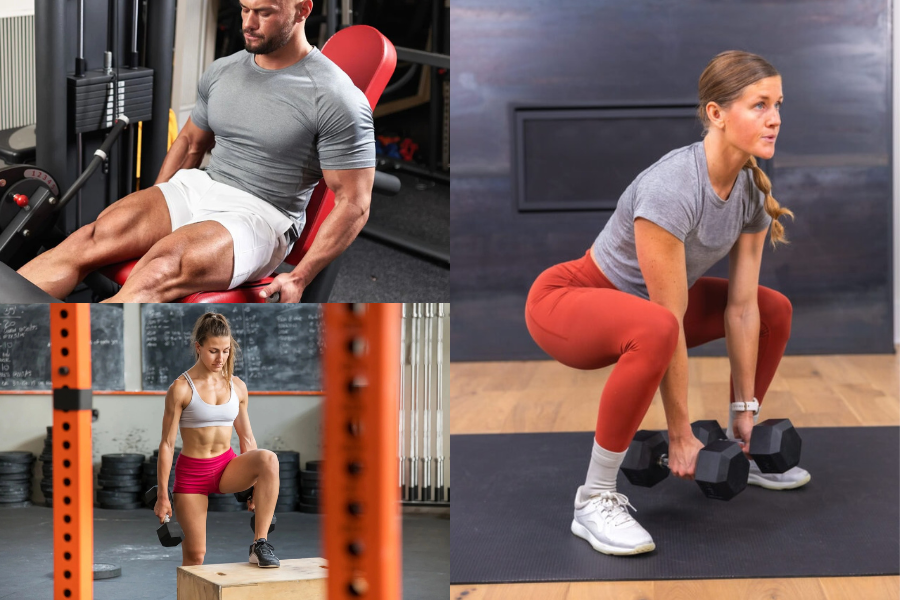
Leg extension
Leg extensions allow you to lock in on the quads with minimal help from other muscle groups. Because they create relatively low systemic fatigue, they are useful at the end of a workout when you want to push your quads to the limit without overloading your back or hips.
Goblet squat
For beginners, the goblet squat is one of the most user friendly quad exercises. Holding the weight in front makes it easier to sit back and down with good form and reduces strain on your lower back. A simple prescription is 2 sets of 10 reps with about 60 seconds of rest.
Wall sit
All you need is a wall. Slide down until your thighs are roughly parallel to the floor and hold. Start with 2 sets of 30 seconds, or as long as you can manage, with about 30 seconds of rest. This builds quad endurance and mental toughness with zero equipment.
Squat jump
If you want more power and coordination, squat jumps are a strong addition. You sit into a squat, hold briefly, then explode up. In mid air, pull your toes up to prepare for a soft landing. Two sets of 10 reps, resting 30 seconds between sets, can wake up your nervous system and build explosive quads.
Sample quad workout for men
You can start building stronger quads today with a straightforward routine. This sample session hits all four quadriceps muscles and blends bilateral, unilateral, and isolation work.
- Dumbbell or barbell front squat
- 4 sets of 8 to 10 reps
- Rest 90 to 120 seconds
- Focus on full depth with a controlled descent and powerful push through your mid foot
- Front foot elevated reverse lunge
- 3 sets of 8 to 10 reps per leg
- Rest 60 to 90 seconds between sets
- Keep your torso upright and drive through the front leg to emphasize the quads
- Heels elevated goblet squat
- 3 sets of 12 to 15 reps
- Rest 60 to 90 seconds
- Think slow lower, brief pause at the bottom, and then drive up without locking your knees hard at the top
- Leg extension
- 3 sets of 12 to 15 reps
- Rest 45 to 60 seconds
- Squeeze at the top of each rep for 1 to 2 seconds, then lower under control
This structure gives you about 13 hard sets for quads in a single workout. If you repeat a similar volume later in the week, you will land in the recommended 10 to 20 set range that supports muscle growth without overdoing it.
If you prefer a more condensed but intense option, you can also try a quad dominant circuit that has appeared in recent training articles: 5 rounds of 10 dumbbell front squats, 20 front foot elevated reverse lunges, and 30 heels elevated goblet squats, with 2 minutes rest between rounds. The total volume and short rests create serious quad fatigue and fiber recruitment in a relatively short session.
How often to train your quads
For most men, training quads twice per week is the sweet spot. You might place one session earlier in the week and another three or four days later. Each session should include at least two quad focused exercises and total around 5 to 10 sets.
According to guidelines cited in 2024, this twice weekly approach with at least 48 hours between hard quad sessions allows enough recovery while still giving you the frequency needed for optimal hypertrophy. If your legs are still extremely sore when your next session rolls around, scale back the sets slightly until your body adapts.
On non quad days, keep an eye on indirect leg volume. Heavy deadlifts or intense conditioning can also tax your quads. Adjust as needed so that your total weekly workload remains challenging but sustainable.
Putting it all together
An effective quad workout for men does not rely on advanced tricks or fancy equipment. It relies on:
- Consistent training, at least twice per week
- Smart exercise choices that emphasize knee flexion and extension
- Full range of motion and good technique
- Working close to failure in the 8 to 12 rep range
- A mix of squats, unilateral work, and isolation
Pick one change you can make right away, such as adding front squats to your next leg day or elevating your heels during goblet squats. As your form and confidence improve, layer in more sets or a second weekly session. Over the coming weeks, you will notice not just bigger quads in the mirror, but stronger, more stable legs in everything you do.
About the Author