Calf workouts are one of the simplest ways to get stronger, move better, and protect your ankles and knees, all without leaving your living room. With a few bodyweight moves and simple household items, you can build a routine that makes running, walking up stairs, and jumping feel easier and more powerful.
Below, you will find calf workouts you can do at home right now, plus tips to warm up, stretch, and recover so you avoid injury and stay consistent.
Why your calf workouts matter
Your calves are more than a cosmetic muscle. The gastrocnemius and soleus, along with the smaller plantaris, form the triceps surae. Together, they help you push off the ground, stabilize your ankle, and maintain balance when you walk, run, or jump.
Research and coaching experience suggest that:
- Strong calves help protect your shins, calves, and Achilles tendons, and can reduce stress on these tissues when you run or jump. Sports medicine physician Jordan D. Metzl, MD, recommends calf strength training two to three times a week to prevent common running injuries and keep you moving longer without pain, as featured in Runner’s World.
- Weak calf muscles increase stress on the Achilles tendon and can contribute to issues like shin splints and stress fractures by disrupting your biomechanics.
When you build a habit of targeted calf workouts at home, you are not just chasing definition. You are improving power, stability, and long term joint health.
Warm up your calves before you train
A good warm up makes your calf workouts feel easier and helps you avoid strains. Dynamic stretching is more effective than holding long static stretches before you exercise, because it wakes up your muscles and improves activation.
You can try a short routine like this before every calf session:
-
Leg swings
Stand near a wall for balance. Swing one leg forward and back in a comfortable range 10 to 15 times, then switch sides. This loosens your hips and gently engages your calves and hamstrings. -
Walking lunges
Step forward into a lunge, then push off the back foot and bring it through to the next lunge. Aim for 10 to 12 lunges per leg. Your calves work each time you push away from the floor. -
High knees
March or jog in place, lifting your knees toward your hips. Keep it light and bouncy for 30 to 45 seconds. This increases blood flow to your lower legs and preps your ankles for more intense work.
Save long, static stretches for after your workout, when your muscles are warm and more receptive to flexibility work.
Core calf exercises you can do anywhere
You do not need a gym to train your calves effectively. Your body weight, a step or sturdy book, and a chair are enough. To build strength and size, most evidence based programs use a mix of rep ranges, usually from about 5 to 30 reps per set, with most sets in the 10 to 20 rep range. Heavier, low rep sets can be useful, but for many people they are more fatiguing and not necessarily better for growth.
Below are staple exercises you can plug into your home calf workouts.
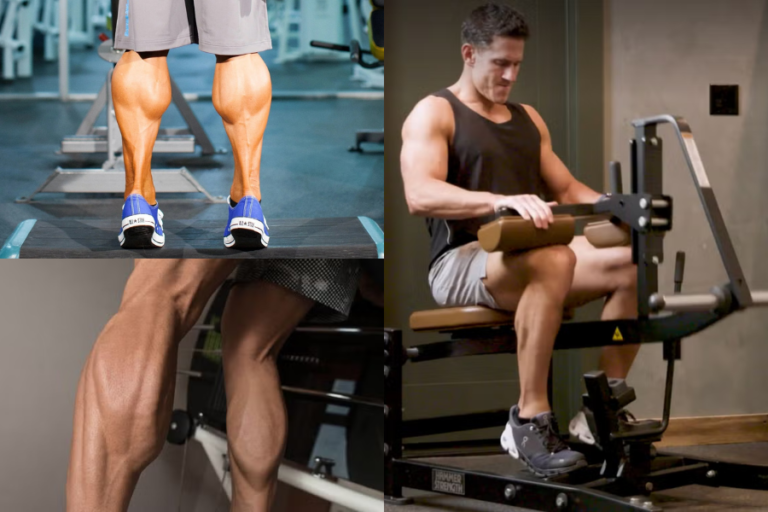
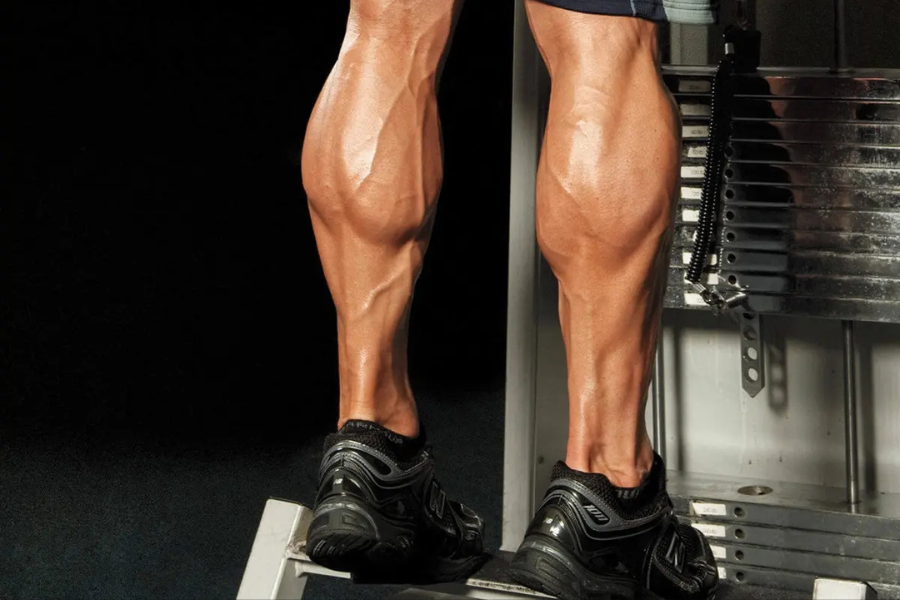
Standing bodyweight calf raises
Standing calf raises are simple and effective, and they work the gastrocnemius and soleus together.
How to do them:
- Stand tall with your feet hip width apart and your hands lightly resting on a wall or chair for balance.
- Press through the balls of your feet and lift your heels as high as possible.
- Pause briefly at the top, then lower your heels slowly until you feel a stretch in your calves.
You can make these more effective by standing on a step, a sturdy book, or a thick plate so your heels can drop below your toes. This deeper stretch at the bottom, held for up to about 2 seconds, is linked to better muscle growth and can also make training safer over time because your calves get used to that extended range. Start with lower volume until you know how much soreness you get, since this extended stretch can cause intense delayed onset muscle soreness at first.
Single leg calf raises
Single leg calf raises increase the challenge and help you address imbalances between sides.
To try them:
- Stand on one leg on the floor or on a step. Hold on to a wall or chair as needed.
- Press through the ball of your standing foot and raise your heel as high as you can without wobbling.
- Lower your heel slowly into a deep stretch and repeat.
A common prescription is 2 sets of 15 reps per leg with about 30 seconds of rest, although you can increase sets as you get stronger. When bodyweight feels too easy, hold a dumbbell, backpack, or heavy household item in the hand on the same side as the working leg.
Seated calf raises
Seated calf raises target the soleus, which does a lot of work during walking and running, especially at slower speeds. They are easy to set up at home.
How to set up:
- Sit on a sturdy chair with your knees bent at 90 degrees and your feet flat on the floor.
- Place a heavy book, backpack, or weight on your thighs near your knees.
- Raise your heels as high as possible, pause, then slowly lower into a stretch.
You can also raise your toes on a low block or book for more range of motion. Keep your knees stacked over your feet to protect your joints.
Eccentric calf raises
Eccentric work focuses on the lowering phase of the movement and is especially helpful for building strength and resilience in the calf and Achilles.
A simple version looks like this:
- Stand on a step with both feet, rise up onto your toes using both legs.
- Shift your weight to one foot at the top.
- Slowly lower that heel down for a count of three to five seconds.
- Put the other foot back on the step and repeat.
This variation is intense, so begin with low volume and increase reps or sets only when soreness is manageable.
Tiptoe farmer’s carry
This exercise combines calf strength with balance and core engagement.
- Hold a weight in each hand, such as dumbbells or grocery bags.
- Rise up onto the balls of your feet.
- Walk forward in a straight line, keeping your heels off the ground.
Start with 20 to 30 seconds of walking, then rest and repeat. As you get comfortable, increase the time or the weight you carry.
How to design simple calf workouts at home
You do not need a long, complicated plan to see progress. In fact, many strength coaches suggest using between 1 and 3 calf exercises in a single session, and about 2 to 4 different exercises per week. Fewer total variations help you stay consistent and avoid needless changes before your body has time to adapt.
Here are two sample home workouts to try. Choose one and repeat it 2 or 3 times per week, or alternate them.
Tip: Calves tend to recover quickly between sets, so you may only need to rest until the burning subsides. For many people, this can be as short as about 10 to 30 seconds, as long as you can still complete quality reps.
Beginner calf workout
Ideal if you are just starting or coming back from time off.
- Standing bodyweight calf raises
- 3 sets of 12 to 15 reps
- Short rest between sets
- Seated calf raises
- 3 sets of 15 to 20 reps
- Focus on slow lowering and a full stretch
- Wall calf stretch
- After your sets, hold a gentle calf stretch for 20 to 30 seconds per side, 2 times each
Intermediate calf workout
Use this once basic bodyweight work feels comfortable.
- Single leg calf raises on a step
- 3 sets of 10 to 15 reps per leg
- Use a deep stretch at the bottom
- Eccentric calf raises
- 3 sets of 8 to 10 slow lowers per leg
- Tiptoe farmer’s carry
- 3 rounds of 30 to 45 seconds walking on your toes
You can train calves 2 to 3 times per week to encourage growth and improved performance. Some lifters and runners can comfortably train them more often, even up to 3 to 6 sessions per week, but that higher frequency works best when you monitor your recovery and adjust volume accordingly.
Small tweaks that make your calf workouts better
Once you are comfortable with the basics, a few simple adjustments can help you train your calves more completely.
Change your knee angle
Different knee positions emphasize different muscles:
- Straight or nearly straight knees, as in standing calf raises, work the gastrocnemius more.
- Bent knees, as in seated calf raises, shift more work to the soleus.
Ideally, your weekly plan includes at least one exercise in each position, so both muscles get enough attention.
Play with foot position
You can slightly shift focus within the gastrocnemius by changing your foot angle:
- Toes pointed forward mainly work both heads together.
- Toes pointed slightly inward emphasize the lateral head.
- Toes pointed slightly outward emphasize the medial head.
One simple approach is to do 4 sets of a given exercise with 2 sets toes forward, 1 set toes in, and 1 set toes out. The changes are subtle but can help your calves grow more evenly.
Pick smart rep ranges
Calves are predominantly slow twitch, which means they respond very well to higher volume and lower loads. You do not have to chase very heavy weights to see results. As a general guideline:
- Most of your sets can live in the 10 to 20 rep range.
- Some lighter sets can go up to 20 to 30 reps, especially on bodyweight or lighter exercises.
- Heavier sets in the 5 to 10 rep range can have a place, but for many people they are more tiring and do not always provide better results than moderate reps with good effort.
If you reach the top of your rep range and still feel like you have a lot left in the tank, add a few more reps next time or increase the difficulty slightly.
Stretching and recovery for healthy calves
Good recovery habits are what let you repeat your calf workouts often without feeling stiff or sore all the time. Tight calves are a frequent cause of discomfort and can increase your risk of strain.
You can include the following after training or on rest days:
-
Wall calf stretch
Place your hands on the wall, step one foot behind you, and keep the back heel down. Lean forward until you feel a stretch in the back calf, then hold for 20 to 30 seconds and switch sides. -
Bent knee calf stretch
From the same position, bend your back knee slightly while keeping your heel down. This targets the deeper soleus. -
Foam rolling
Sit on the floor with your calves on a foam roller. Lift your hips slightly and roll from your ankles up to the back of your knees for about 1 minute per side. This helps loosen tight areas and keeps the muscle tissue supple.
Over time, these habits improve ankle flexibility and mobility, which play a big role in running faster, jumping higher, and moving more comfortably throughout the day, as highlighted in a 2026 overview by Muscle & Fitness.
Stay injury free while you build strength
Pushing hard is part of progress, but more is not always better. You can reduce your risk of calf strain and overuse issues with a few simple guidelines:
-
Listen to fatigue
If your calves are very sore, tender to the touch, or feel weak, take an extra rest day. Overtraining can show up as persistent tightness or a decline in performance. -
Choose supportive footwear
Shoes that provide good support for your feet and lower legs spread forces more evenly and reduce stress on your calves, especially during high impact activities. -
Progress gradually
Increase only one variable at a time: either a bit more weight, a few more reps, or an extra set. Jumping too quickly in volume or intensity is a common trigger for calf problems. -
Balance your body
Runners in particular benefit from strengthening not just their calves, but also their hips and core. Dr. Jordan Metzl notes that weak calves and unstable hip and core muscles can negatively affect biomechanics and contribute to shin splints and stress fractures. A well rounded routine supports better alignment from the hips down.
With smart progression, most people find it is actually hard to truly overtrain their calves, and consistent, targeted exercises bring steady improvements in both appearance and performance.
Putting it all together
You do not need a gym membership or machines to build strong, reliable calves. A practical home plan could look like this:
- Warm up with dynamic moves like leg swings, walking lunges, and high knees.
- Pick 1 to 3 calf exercises per session, such as standing calf raises, single leg raises, or seated raises, and train them mostly in the 10 to 20 rep range with a deep stretch.
- Include both straight leg and bent knee variations each week, and occasionally adjust your foot angle for more complete development.
- Finish with a bit of stretching and foam rolling to keep your calves loose and your ankles mobile.
- Train calves 2 to 3 times per week to start, and add more only if you are recovering well.
Choose one exercise today, for example standing bodyweight calf raises on the edge of a step, and perform a few focused sets. You will feel the difference every time you walk, climb stairs, or pick up the pace on your next run.
About the Author