High rep calf workouts can feel like punishment while you are doing them, but they are one of the fastest ways to finally see your lower legs grow. If your calves have ignored every program you have tried so far, shifting to higher reps with smart structure can make a real difference in muscle size, strength, and endurance.
Below, you will see how and why high rep calf workouts work, how to use them without wrecking your joints, and a simple plan you can plug into your current routine.
Why your calves resist growth
Your calves work all day. Every step you take, from roughly 3,000 to 10,000 steps or more, asks your lower legs to handle small, repetitive efforts. Because of this, your calves are used to low intensity work and adapt quickly to it. To grow, they need a stimulus that is clearly different from walking or climbing stairs.
The calf complex is also built to handle both sprinting and endurance. The gastrocnemius, the larger visible muscle, has a near 50/50 mix of fast and slow twitch fibers, so it responds to both heavy and lighter, higher rep training. The soleus under it is mostly slow twitch, so it is especially responsive to high volume, lower load work that burns but does not feel brutally heavy.
If you only hit calves once per week, use the same exercise, and stop every set as soon as it starts to hurt, your body has no reason to grow new muscle. High rep calf workouts change that.
How high rep calf workouts build muscle
High rep calf training usually means working in the 20 to 30 rep range. Current evidence suggests that this range is very productive for calf growth. For most lifters, sets of 20 to 30 reps can be just as effective as traditional 10 to 20 rep sets when you push close to failure and keep your technique honest.
A review of hypertrophy training summarized that calves grow well across a broad spectrum of reps if the effort is high and you reach a similar level of fatigue by the end of each set. High rep calf workouts help you rack up more total work, create a strong pump, and challenge the endurance-focused fibers that are often under-stimulated by a few heavy, low rep sets.
Research highlighted by Gymshark notes that calf muscles are predominantly slow-twitch and respond best to high volume, low load training rather than always chasing heavy weights. They also cite a 2020 study by Brad Schoenfeld and colleagues, which found that muscle thickness changes occurred similarly regardless of training load as long as sets were taken near failure. In other words, effort matters more than how heavy the stack looks.
This is exactly what you do with high rep calf workouts. You pick a weight you can move with control for 20 to 30 reps, then you work close to your limit while using a full range of motion.
Ideal rep ranges for calf growth
High rep sets are powerful, but you will get even better results if you mix them with moderate and heavy sets through the week.
A practical breakdown looks like this:
- Roughly 50 percent of your weekly calf sets in the moderate 10 to 20 rep range
- The other 50 percent split between heavy 5 to 10 reps and light 20 to 30 reps
This mix takes advantage of all fiber types, reduces boredom, and limits overuse issues. High rep calf workouts fit perfectly into the “light” part of that structure. You can place them later in the week when your joints and nervous system are more fatigued, and reserve heavier work for earlier sessions.
Some coaches recommend starting the week with heavier sets of 5 to 10 reps, then moving to 10 to 20 midweek, and finishing with 20 to 30 rep sets later in the week. That sequencing helps manage fatigue and reduce injury risk while still letting you attack your calves with high rep work when you are warm and practiced.
Training frequency that actually works
If you only train calves once a week, you are leaving easy progress on the table. Your calves recover faster than big muscle groups like your quads or back, so they can handle more frequent sessions.
High-frequency programs of 3 to 6 calf sessions per week are possible as long as you keep weekly volume within a reasonable range for you. You do not need maximal volume every time you train. You simply want enough total hard sets spread across the week to challenge the muscles without beating your ankles and knees into the ground.
For most people, a solid starting point looks like this:
- 3 calf sessions per week
- 3 sets of standing calf raises and 3 sets of seated calf raises each session
- 10 to 20 reps on some days, 20 to 30 reps on others
As you adapt, you can experiment with additional sets or an extra day of training, but always let your recovery, soreness levels, and joint comfort guide those jumps.
Key form cues for high rep sets
If your form slips during high rep calf workouts, you lose much of the benefit. Two mistakes in particular hold back growth:
First, skipping the hard contraction at the top of each rep. When you bounce through the movement and never pause at the top, your calves are not fully shortening, and you miss out on that powerful mind muscle connection.
Second, ignoring the stretch at the bottom. Cutting your range of motion short reduces tension on the muscle. Over time, this habit adds up to smaller calves, not bigger ones.
A simple form checklist for every high rep set:
- Start from a full stretch, with your heels dipping as far as your ankle mobility safely allows. If you are standing on the floor, place your toes on a small plate or edge to increase the stretch.
- Drive up controlled, then pause and squeeze your calves at the top for a solid second. Imagine trying to show off the muscle.
- Lower slowly until you feel that stretch again, then repeat.
- Keep reps smooth and continuous. Do not let momentum or bouncing take over.
You also want enough weight to challenge you, but not so much that your heels barely move. A good rule of thumb is to pick a load that lets your heels rise at least an inch or more off the ground on every rep, with solid control.
If your ankles barely move, or you are only feeling the exercise in your Achilles, your weight is too heavy or your range is too short. Lighten the load, fix your form, and your calves will feel the difference quickly.
Balancing standing and seated calf work
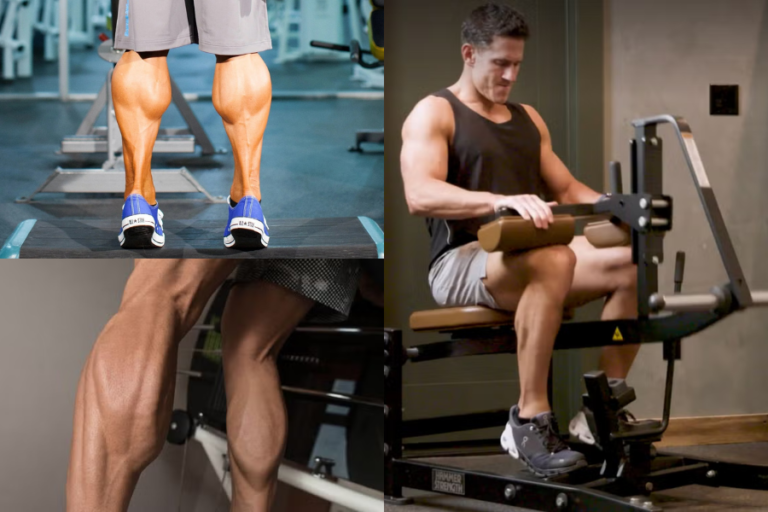
To fully develop your lower legs, you need to target both the gastrocnemius and the soleus. That means including both standing and seated positions in your high rep calf workouts.
- Standing calf raises work primarily with a straight knee and hit the gastrocnemius harder. These add shape to the upper part of your calf and carry over well to sprinting and jumping.
- Seated calf raises use a bent knee, which shifts more of the load to the soleus. This deep muscle is crucial for posture and endurance and is rich in slow twitch fibers that love high volume work.
If you only ever do standing raises, your calves adapt quickly, and progress slows. Add in seated work, and consider some variety like single leg raises, leg press calf raises, or stair calf raises. Alternating exercises across sessions can also reduce repetitive stress on the same tissues, which is especially important if you are training calves three or more times each week.
Simple high rep calf workout you can start today
Here is a straightforward routine that blends high rep calf workouts with moderate rep work. You can add this to the end of your usual leg or full body sessions.
Day 1: Moderate reps, strength focus
- Standing calf raise, 4 sets of 10 to 15 reps
- Seated calf raise, 3 sets of 12 to 15 reps
Focus on control, full stretch and squeeze, and gradually add weight over time.
Day 2: High rep, volume focus
- Standing calf raise, 4 sets of 20 to 30 reps
- Seated calf raise, 4 sets of 20 to 30 reps
Use a weight that lets you keep clean form for the first 15 to 20 reps. The last 5 to 10 should be tough, but not sloppy. The Gymshark guide suggests 4 sets of 25 to 30 reps with different foot positions to fully target the calves, such as toes forward, in, and out.
Day 3: Mixed rep ranges
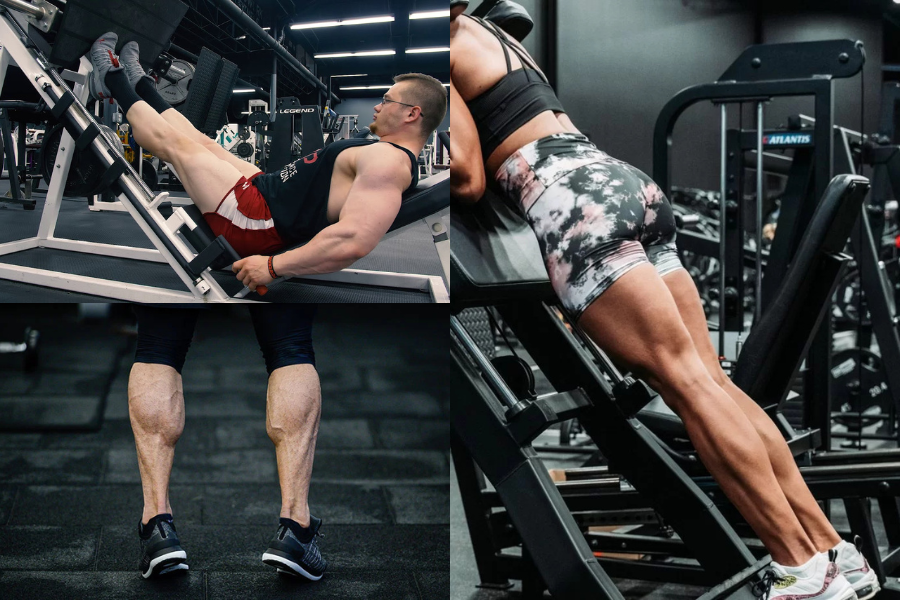
- Leg press calf raises, 3 sets of 8 to 12 reps
- Seated calf raises, single leg, 3 sets of 15 to 20 reps each side
Here you touch some heavier work in the 8 to 12 rep range and then finish with a slightly higher rep burner to keep both fast and slow twitch fibers challenged.
You can keep this structure for 4 to 6 weeks. As you progress, increase weight when you can hit the top of your target rep range for all sets with solid form. This steady, progressive overload, across 5 to 30 reps, is a reliable way to grow your calves.
Recovery, stretching, and injury prevention
High rep calf workouts can leave your lower legs tight and pumped. That feels great in the short term, but you still need to think about recovery and long term joint health.
Between sets, lightly stretch your calves for 15 to 30 seconds. After the workout, do a few longer stretches and some gentle ankle mobility. This helps maintain range of motion and may support better muscle shape and pump.
Some physiotherapy approaches also use high rep calf raises as a progression in rehab. Gradually increasing from 3 sets of 10 to higher rep ranges, and eventually adding hopping drills, builds endurance and strength in the calf complex without overloading you too early. That same gradual, high rep approach is useful in normal training too, especially when you are increasing frequency to 3 to 6 sessions per week.
To avoid overuse:
- Rotate exercises across the week
- Sequence your heavy work earlier, high rep sessions later
- Back off volume for a week if your Achilles, ankles, or knees start to feel cranky
Putting it all together
High rep calf workouts give you something your daily steps never will: challenging, focused, near failure sets that target both major calf muscles through a full range of motion. When you train in the 20 to 30 rep range, keep your technique tight, and combine that work with moderate and heavier sets, you finally give your calves a reason to grow.
Start by adding two to three dedicated calf sessions per week, use both standing and seated variations, and commit to full stretches and hard squeezes on every rep. With a few weeks of consistent high rep calf workouts, you will feel a stronger push off the ground and start to see more shape in your lower legs whenever you look down.
About the Author