Understand what makes an advanced chest workout
If you lift consistently and want your chest to grow, you need more than random heavy sets. An effective advanced chest workout targets all regions of your pecs, uses smart exercise choices, and balances load with recovery.
Your pectoralis major has fibers that run in different directions. In simple terms:
- Upper chest (clavicular head)
- Mid chest (sternal head)
- Lower chest (abdominal or costal fibers)
Each region responds best when the arm path lines up with its fibers and works hard against gravity. That means you will press and fly at different angles, not just bench flat every Monday.
An advanced plan also respects fatigue. More sets are not automatically better. Progress comes from quality overload across weeks, not from destroying your chest in one marathon session and then stalling.
Dial in your chest pressing mechanics
Before you load heavy, clean up your technique. This is where many advanced lifters quietly limit their own growth.
Use a smarter arm path
Australian bodybuilding coach Eugene Teo recommends a 45 to 60 degree elbow tuck with a close to neutral grip for most chest presses. This often means:
- Upper arms not flared straight out to the side
- Elbows not pinned tightly to your ribs
- Palms slightly turned toward each other on dumbbells
This arm path usually lines up better with your chest fibers, helps you feel your pecs do the work, and reduces the front delt and triceps taking over.
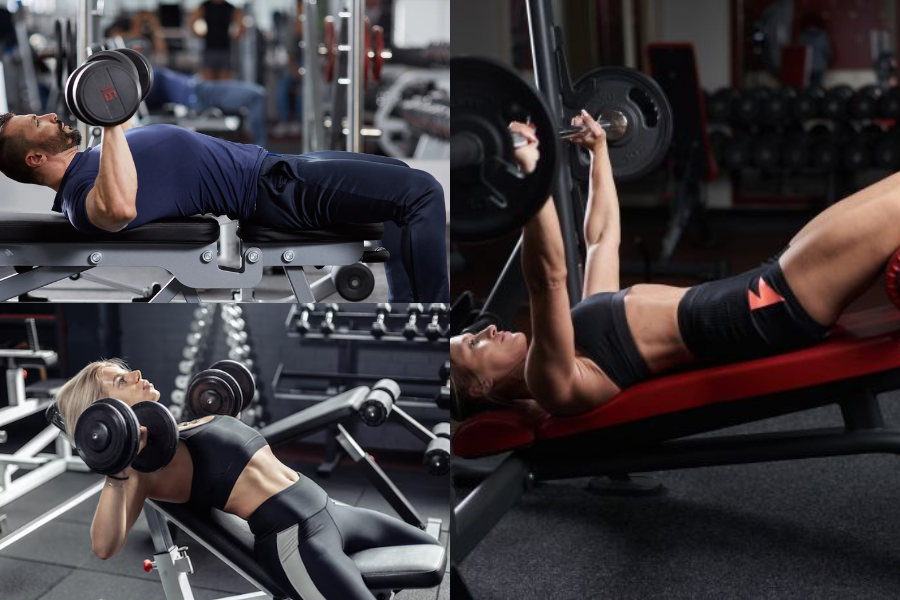
Choose effective bench angles
Incline angle strongly affects which fibers you hit most.
Eugene Teo suggests:
- Around 30 to 60 degrees for incline pressing
- The exact angle depends on your rib cage, sternum angle, and shoulder mobility
Too steep and you turn it into more of a shoulder press. Too flat and you drift back toward mid chest. Aim for an angle where the upper chest is roughly perpendicular to gravity during the press.
For a simple rule of thumb:
- Upper chest focus: low to moderate incline
- Mid chest focus: flat or very slight incline
- Lower chest focus: slight decline or dips
Adjust your grip for better pec activation
Grip width and orientation change what you feel:
- Wider barbell grip
- More emphasis on lower pecs
- More stress on shoulders
- Closer barbell grip
- Greater range of motion
- More triceps involvement
- Neutral grip dumbbells
- Elbows naturally tuck
- Often more shoulder friendly
Experiment inside these ranges, not at the extremes, and keep the goal the same: you want your chest to be the limiting factor.
Target all three chest regions
A good advanced chest workout does not guess. You deliberately train upper, mid, and lower fibers every week.
Upper chest: build the clavicular head
When you want upper chest, you need more shoulder flexion. That is why incline variations work so well. According to work summarized by Muscle & Strength in 2024, incline angles that bring your arms higher relative to your torso make the clavicular portion work harder.
Useful upper chest options:
- Incline barbell bench press
- Incline dumbbell press
- Low to high cable fly
- Decline push up (feet elevated) at home
Keep angles moderate so the load still feels like a chest press, not a shoulder press.
Mid chest: overload the main mass
The sternal portion makes up most of your pec major. Heavy horizontal pressing is ideal here. Classic options still work, as long as you do not rely on them alone:
- Flat barbell bench press
- Flat dumbbell press
- Weighted push ups
- Mid height cable fly across your torso
The research notes that overreliance on barbell bench alone can overdevelop your lower region relative to your upper. Mid chest is important, but it should not be the only thing you target.
Lower chest: train the neglected costal fibers
Lower or costal fibers often get skipped, which can leave the area near your upper abs flat. Eugene Teo recommends dips and decline pressing to hit this region.
Good lower chest choices:
- Weighted chest dips, leaning forward
- Decline barbell or dumbbell press
- High to low cable fly
- Incline push ups (hands elevated) at home
Think of any movement where your arms travel diagonally down and inward across your torso.
Use tools that keep tension on your chest
Advanced lifters do not just think about exercises. You also think about how tension behaves through each rep.
Make free weights your mainstay
Historically, the best chests were built with free weights, not machines. The research notes that excessive dependence on machines can reduce potential chest growth, in part because you often lose the need to stabilize and control the weight yourself.
Strong options:
- Barbell: high load, good for strength
- Dumbbells: larger range of motion and more natural path, often better chest activation and shoulder comfort
Add cables for continuous tension
Dumbbell flyes and presses are useful, but they lose tension in some parts of the range. Cables help you keep tension where free weights tend to go light.
Cable work is especially helpful for:
- Warm ups, to pump blood into the pecs
- Finishers, to chase metabolic stress
- Midline work, since you can pull your hands across your body
Cable fly variations:
- Low to high
- Mid to mid
- High to low
Choose the angle that matches the region you want to emphasize.
Use bands and chains to load the lockout
As Teo highlights, the top portion of the press, where your arms converge and lock out, is often undertrained. Variable resistance fixes that by making the top heavier than the bottom.
Useful options:
- Bands attached to barbell bench
- Chains draped over the bar
- Band plus dumbbell presses or band plus push ups
These tools increase tension where your pecs reverse from stretch to squeeze, which is a powerful growth trigger for experienced lifters.
Avoid common advanced chest mistakes
If your bench is strong but your chest is not progressing, you might be running into the same issues seen in the research.
Mistake 1: Only chasing more volume
One lifter with a 100 kg (225 lb) max bench pressed with very high volume for weeks:
- Over 6 sets of bench plus warm ups
- High rep work followed by multiple sets to failure at descending weights
- 7 sets of dumbbell presses
- 3 to 4 sets of dips
- 3 sets of cable crossovers to failure
Recovery started taking 3 to 4 days, and there was no progress in personal records. When intensity dropped, recovery improved to 2 days. The takeaway is simple: too much can stall you.
Mistake 2: Letting everything except chest do the work
Common patterns:
- You bounce the bar or use momentum
- Triceps lock the weight out while your pecs coast
- Front delts dominate every incline press
The research describes this as “working the weight, not the muscles.” Slow your eccentrics, control the weight, and focus on feeling the pecs shorten and lengthen.
Mistake 3: Ignoring upper chest
If you skip incline and converging movements, your upper chest lags. Visually, this makes your torso look longer and less connected to your delts and traps.
You solve this by:
- Putting incline work earlier in your session
- Keeping some form of upper chest exercise in every chest workout
- Not letting flat bench be the entire session
Structure a heavy advanced chest workout
Below is a sample heavy advanced chest workout that hits all regions. Adjust volume based on your recovery.
Sample gym session (strength first, then volume)
- Incline barbell bench press
- Sets: 3 to 4
- Reps: 5 to 8
- Focus: upper chest overload, moderate incline
- Rest: 2 to 3 minutes
- Flat dumbbell press
- Sets: 3
- Reps: 8 to 12
- Focus: mid chest, deeper stretch than barbell
- Rest: 90 to 120 seconds
- Weighted chest dips
- Sets: 3
- Reps: 8 to 12
- Focus: lower chest, lean forward and keep elbows slightly flared
- Rest: 90 to 120 seconds
- Low to high cable fly
- Sets: 3
- Reps: 12 to 15
- Focus: upper chest and peak contraction across midline
- Rest: 60 to 90 seconds
- Push up finisher with bands or bodyweight
- Sets: 2
- Reps: close to failure, leave 1 to 2 reps in the tank
- Focus: full chest burn and pump
Across the workout:
- Start with heavier compound lifts
- Move to moderate load work with more total reps
- Finish with isolation and metabolic stress
Advanced intensity methods you can rotate
You do not need every advanced method in every session. Think of them as tools you plug in sparingly.
-
Post Activation Potentiation (PAP)
-
Do 1 to 2 very heavy reps on a press, above your usual working weight
-
Rest, then drop to your normal working set
-
This can prime your nervous system for stronger sets afterward, as outlined in a 2024 advanced program
-
Rest pause sets
-
Take a set near failure
-
Rest 30 seconds or take around 10 deep breaths
-
Continue with the same weight for mini clusters
-
Great for flyes or machine presses
-
The research specifically warns against using rest pause on heavy barbell bench due to fatigue and safety
-
Controlled eccentrics and pauses
-
Lower for 3 to 4 seconds
-
Pause briefly near the chest
-
Press powerfully but under control
-
Excellent for improving mind to muscle connection and technique
Use these methods on one or two exercises per session, and cycle them across weeks to avoid burnout.
Train your chest effectively at home
You can build an advanced chest workout at home with just bodyweight, dumbbells, or bands.
Bodyweight focused plan
- Decline push ups (feet elevated)
- Upper chest emphasis
- Flat push ups
- Mid chest
- Incline push ups (hands elevated)
- Lower chest
- Eccentric dips on parallel bars or sturdy surfaces
- Lower chest overload, slow on the way down
Adjust difficulty by changing angles, loading with a backpack, or adding bands.
Dumbbells and band variations
If you have dumbbells or bands, include:
- Dumbbell floor or bench press
- Incline dumbbell press (use a bench or sturdy surface)
- Dumbbell flyes with a limited range, just enough to stretch the pecs without losing tension
- Single arm floor press, across body path to work across the midline
- Band presses anchored behind you to overload the lockout
The research notes that dumbbells give more freedom of movement and often better biomechanics than barbells, which is useful if your shoulders are tight or beat up.
Program your weekly chest training
You grow from what you can recover from. Advanced lifters need structure, not random punishment.
Choose a weekly frequency you can sustain
Most lifters can handle:
- 1 to 2 focused chest sessions per week if volume is high per session
- Up to 2 to 4 sessions if you split chest work into smaller doses and manage total volume
A simple approach:
- Day 1: Heavy and moderate pressing, lower volume of isolation
- Day 2: Slightly lighter pressing, more isolation and pump work
Rotate exercises between sessions. For example:
- Session A: barbell incline, dumbbell flat, dips
- Session B: dumbbell incline, machine or band flat press, cable flyes
This variation reduces overuse on the same joints and angles.
Use effective rep ranges
Research suggestions for chest hypertrophy:
- Heavy: 5 to 10 reps
- Moderate: 10 to 20 reps
- Light: 20 to 30 reps
You can aim for roughly:
- About half of your sets in the moderate range
- The rest split between heavy and light work
What matters most is that you keep sets close to, but not always at, failure, and that load or reps progress across weeks.
Plan for progression and deloads
Advanced training programs benefit from simple periodization:
-
Over several weeks (or a mesocycle)
-
Keep rep ranges consistent
-
Slowly increase weight
-
Let reps in reserve (RIR) shrink as you approach the end of the cycle
-
After a few hard weeks
-
Take a deload week with reduced volume or intensity
-
Let joints and connective tissue catch up
This style of progressive loading plus planned deloads is effective for managing fatigue and maintaining long term chest growth.
Support your chest training outside the gym
Your advanced chest workout is only as effective as the habits around it.
Key points from the research:
- Train chest about 1 to 2 times per week with proper overload across upper, mid, and lower fibers
- Aim for roughly 1 gram of protein per pound of bodyweight daily to support muscle growth
- Monitor recovery, if soreness and fatigue last too long, like 3 to 4 days after every session, you may be overdoing volume or intensity
Combine consistent nutrition with smart programming and controlled technique, and you give your chest the best chance to grow.
Put it all together
To build a bigger, stronger chest as an advanced lifter, you:
- Use a 45 to 60 degree elbow tuck and grip that centers tension in your pecs
- Press at different angles to hit upper, mid, and lower fibers
- Rely on free weights and cables as your main tools, with machines and advanced methods as support
- Avoid blind volume and momentum, and instead focus on contraction and control
- Program 1 to 2 intelligent heavy sessions per week, with planned progression and deloads
- Back it all with enough protein and recovery
Pick one or two changes to apply in your next chest workout, such as starting with incline presses or adding banded push ups for lockout tension, and build from there. Over a few focused training blocks, you will notice fuller pecs, stronger presses, and a chest that finally matches your effort.
About the Author