Understand your lateral shoulder muscles
If you want broader, stronger shoulders, lateral shoulder exercises should be near the top of your list. These movements target your lateral deltoids, also called side delts, which are mainly responsible for lifting your arm out to the side and helping with shoulder rotation. When your side delts grow, your upper body looks wider and more balanced, which creates more of a “V” shape through your torso.
Your lateral delts are relatively small muscles that fatigue quickly. You use them in many pressing and pulling exercises, so you do not need dozens of side delt movements. A few well performed exercises, done consistently and with good form, are enough to see progress.
What lateral raises actually work
Lateral raises of all kinds are key lateral shoulder exercises. They:
- Focus on the lateral head of your deltoid
- Add width to your shoulders and upper back
- Recruit helpful stabilizers like the middle and lower trapezius and the rotator cuff to keep your shoulder blades aligned
- Challenge your core to keep your torso steady as you lift
When you do them correctly, lateral raises build strong shoulders without putting excessive stress on your joints, which is especially helpful if you are cautious about your shoulders or coming back from minor issues.
Choose effective lateral shoulder exercises
You can build a solid shoulder routine with just a small toolbox of movements. Below are practical options you can plug into your workouts.
Dumbbell lateral raise
The dumbbell lateral raise is the classic side delt exercise. You can do it almost anywhere and easily adjust the weight.
How to do it
- Stand tall with a dumbbell in each hand, arms by your sides, palms facing in.
- Keep a slight bend in your elbows and brace your core.
- Raise your arms out to the sides until your hands are about level with your shoulders.
- Pause briefly at the top, then lower the weights slowly with control.
Form tips
- Keep your elbows just below or level with your wrists. Avoid letting the wrists travel higher than the elbows.
- Do not lift higher than shoulder height. Going higher starts to shift tension away from the side delts and into other muscles.
- Lead with your elbows, not your hands. Imagine your elbows are pulling the weight outward and up.
- Use a “thumbs up” or neutral hand position, not a “thumbs down” pour-the-pitcher position. The “thumbs down” posture can increase compression of your rotator cuff against the bony surfaces of your shoulder, which raises injury risk.
Machine or cable lateral raise
Lateral raises with a machine or cable help you keep constant tension on the side delt, especially near the top of the movement. They are also easier to control than swinging dumbbells.
How to do it
- For a cable raise, stand side-on to the weight stack and hold the handle with the outside hand. Start with the cable slightly behind your body, then raise your arm out to your side to shoulder height.
- For a machine lateral raise, follow the machine’s setup instructions and focus on moving only at the shoulder, not with momentum from your torso.
Because these versions are less fatiguing for your whole body than heavy free weights, you can use them for higher rep sets and shorter rests while still keeping good form.
Abduction row
The Abduction Row is a less common but very effective lateral shoulder exercise. It combines a row with an abduction movement to keep the focus on the middle delts while letting you use relatively heavier weights.
Why it works
- The rowing motion lets you control a heavier dumbbell without overloading your joints.
- The abduction angle minimizes help from your lats and rear delts and keeps the spotlight on your side delts.
Simple setup
- Hinge slightly at the hips and keep your spine neutral.
- Hold a dumbbell and row your elbow out and away from your body instead of straight back.
- Think “elbow to the side wall” rather than “elbow to the ceiling” to keep the emphasis on abduction.
If you want to challenge your side delts with heavier weights but standard lateral raises feel unstable, the Abduction Row is a smart choice.
Avoid common form mistakes
How you perform your lateral shoulder exercises matters more than how much you lift. A few technical errors can shift tension away from your side delts or irritate your shoulders.
Mistakes that reduce side delt activation
Try to avoid:
-
Excess external rotation
Turning your hands so your thumbs point strongly up or back while you raise can change the movement and reduce how much the lateral delt contributes. Aim for a comfortable, slightly “thumbs up” position instead of twisting through the whole rep. -
Leaning your torso to the side
If you lean your upper body to “help” the weight up, you turn a clean abduction movement into something else. Keep your torso relatively upright and let the shoulder do the work. -
Shrugging your shoulders
Elevating your shoulders to your ears pulls your upper traps into the exercise and takes stress off the side delts. Keep your shoulders “down and back” throughout the lift. -
Swinging the weights
Using momentum to throw the dumbbells up reduces muscle tension and increases injury risk. A slow, controlled tempo is more effective for growth and safer for your joints.
Positions that can stress your rotator cuff
The angle of your hand and arm matters. According to the Jacksonville Orthopaedic Institute, raising your arms with a “thumbs down” position can increase compression of the rotator cuff, which raises the chance of irritation or tendonitis.
To keep your shoulders happier long term:
- Use a neutral or “thumbs up” grip for most lateral raises.
- Keep your chest up, shoulders down, and spine neutral in all variations. Good posture helps your rotator cuff clear the bony structures of the shoulder more easily.
Adjust sets, reps, and weight
Once your form is consistent, you can start adjusting volume and intensity to match your goals and experience level.
Rep ranges that work for side delts
Side delts respond well to a mix of rep ranges, but higher reps are often more productive and easier on your joints:
- Heavy: 5 to 10 reps per set
- Moderate: 10 to 20 reps per set
- Light / high rep: 20 to 30 reps per set
Most people find the 10 to 20 and 20 to 30 rep ranges give a strong pump with manageable joint stress. Very heavy sets of 5 to 10 can work but are usually more demanding and a bit riskier for such a small muscle group.
How much weight to use
For dumbbell lateral raises, choose the heaviest weight that lets you:
- Keep your shoulders down and your torso still
- Lift to shoulder height without swinging
- Control the lowering phase for at least 2 to 3 seconds
If you are limited to lighter dumbbells, you can still progress. One option is to use cluster sets, such as 3 to 5 reps, rest for a short period, then repeat several times to build up effective volume while maintaining good technique.
Rest periods between sets
Rest depends on the exercise and how hard you are pushing:
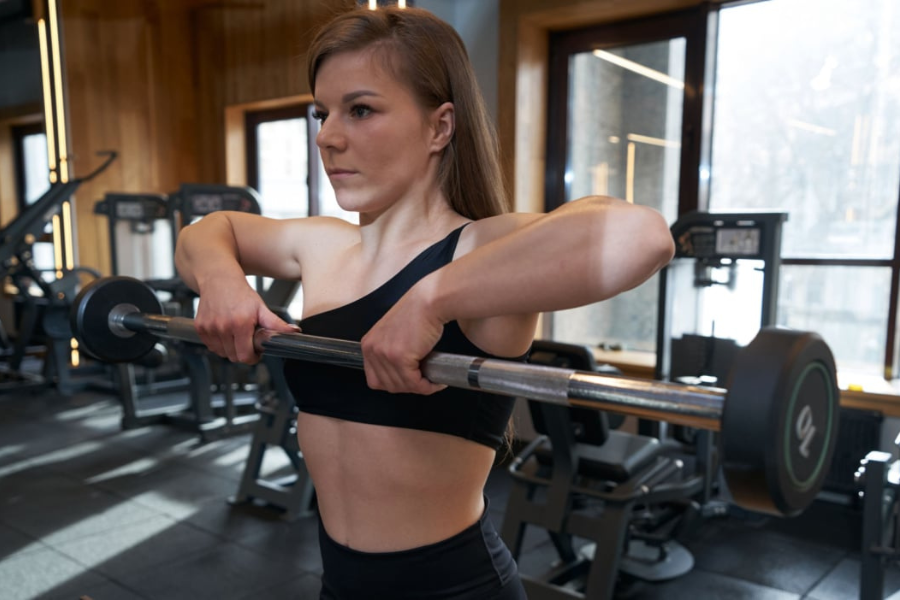
- For more demanding movements like barbell upright rows or heavy Abduction Rows, rest around 1 to 2 minutes so you can perform each set with good effort.
- For machine or cable lateral raises, you may only need short rests, sometimes under 15 seconds, especially if you are working in higher rep ranges and the exercise does not tax your whole body as much.
Aim to start each set feeling “ready” rather than still winded or shaky.
Plan your weekly shoulder training
You do not have to train your lateral delts every day to see growth. In fact, because they are small and involved in many compound lifts, they can easily be overworked.
How often to train lateral delts
Different approaches can be effective, but some general guidelines are:
- Many people do well training side delts 2 to 3 times per week.
- You can go up to 3 to 6 sessions per week if you manage volume carefully and recover well, but this is more advanced.
- It often works best to start with a lower frequency, such as twice per week, and increase slowly over time as you see how your shoulders respond.
Remember that compound movements, such as overhead presses, also hit your lateral delts, so account for that when planning your total workload.
How many exercises per session
You do not need a long list of lateral shoulder exercises in a single workout. For most people:
- 1 to 2 side delt exercises per session is plenty.
- Across an entire week, 2 to 5 different lateral exercises provide variety without overwhelming your shoulders.
For example, in one workout you might pair dumbbell lateral raises with an Abduction Row. In another, you might use a cable lateral raise alone for higher reps.
Sample lateral shoulder-focused workout
Here is a simple sample you can adapt to your routine. Adjust the weight so your last few reps are challenging while your form stays solid.
Workout example
- Dumbbell lateral raise
- 3 sets of 12 to 20 reps
- 60 to 90 seconds rest
- Cable or machine lateral raise
- 3 sets of 15 to 25 reps
- 30 to 60 seconds rest
- Pause for 1 to 2 seconds at the top of each rep to enhance muscle tension and pump
- Abduction Row
- 3 sets of 8 to 12 reps
- 60 to 120 seconds rest
You can place this session after your main pressing work on an upper body day or integrate one or two of the exercises into your existing split.
Train safely and protect your shoulders
Stronger shoulders are useful for almost everything you do in the gym and in daily life. To keep them healthy while you work on lateral shoulder exercises, remember:
- Warm up with light arm circles, band pull-aparts, or very light lateral raises before heavier work.
- Keep your shoulders down and back, chest up, and spine neutral whenever you perform lateral raises or rows.
- Use a comfortable “thumbs up” or neutral grip and avoid the “thumbs down” position that can pinch the rotator cuff.
- If you feel clicking or discomfort, lighten the weight and slow the tempo, for example, 2 to 3 seconds up and 4 to 5 seconds down, and consider single arm raises to better control your range of motion.
You do not have to overhaul your entire program to benefit from lateral shoulder exercises. Start by adding one well executed movement to your next upper body day, pay attention to your form, and notice how your shoulders respond over the next few weeks.
About the Author