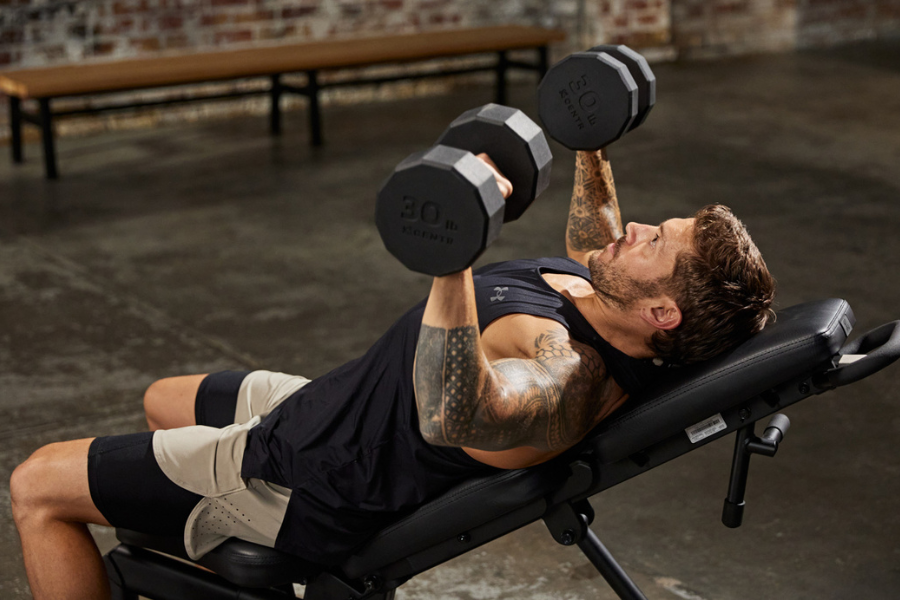
Understand what “high volume” really means
A high volume chest workout is not just a long list of random exercises. For hypertrophy, volume means the total number of hard sets and reps you do for your chest each week.
You create that volume by combining three types of movements in your high volume chest workout:
- Horizontal presses, like flat barbell or dumbbell bench, for overall chest
- Incline presses, for upper chest
- Isolation movements, like flyes or cable crossovers, to target the chest directly
Most lifters do well with:
- 2 to 5 different chest exercises per week
- No more than 1 to 3 different chest exercises in a single session
That way you get enough total work without grinding your joints into dust or stalling your progress.
Set smart training volume and frequency
Before you jump into a huge chest session, decide how often you want to train chest and how much you can realistically recover from.
For most people:
- Chest frequency: 2 to 4 sessions per week
- Weekly exercise variations: 2 to 5 chest exercises total, rotated between days
- Per session: 1 to 3 chest exercises, 3 to 5 hard sets each
Training chest just once a week with a marathon workout can work, but very high volume in one day can drain your energy and lengthen recovery. When that happens, you might only give your chest one real growth stimulus every 7 days.
If you split that volume across 2 or 3 days, you can get 104 to 156 quality chest workouts per year instead of 52. That is a lot more chances to send your body the “grow” signal.
Choose effective chest exercises
To build size with a high volume chest workout, you want a small set of highly effective movements that you can repeat and progress on.
Horizontal pressing for overall chest
Horizontal presses are your main chest builders. These should be the first lift on most chest days.
Good options include:
- Barbell flat bench press
- Dumbbell flat bench press
- Machine chest press
Tips for better form and less shoulder stress:
- Keep your upper arms at about a 45 degree angle to your torso, not flared straight out
- Retract your shoulder blades and keep them tight against the bench
- Avoid pushing your shoulders forward at the top of the rep
This setup lets you use more weight, protects your shoulders, and keeps tension on your pecs instead of your joints.
Incline pressing for upper chest
Incline presses emphasize the clavicular fibers of your pecs and help you build that upper chest shelf.
You can use:
- Barbell incline bench press
- Dumbbell incline bench press
- Incline machine press
The most common mistake is turning incline press into a shoulder press. When your forearms drift away from vertical and the bar or dumbbells move toward your face, your shoulders take over.
Aim to:
- Set the bench at a moderate angle, usually about 30 degrees, not nearly upright
- Keep your forearms perpendicular to the floor throughout the movement
- Lower the bar or dumbbells roughly to the upper chest, not the neck
This keeps the work on your upper chest instead of your front delts.
Isolation work to finish the chest
Isolation movements let you pile on extra volume without the same joint stress you get from heavy pressing.
Great choices:
- Cable flyes or cable crossovers
- Pec deck machine flyes
- Dumbbell flyes on flat or incline benches
These are perfect later in the session when you are already somewhat fatigued. Focus on control and range of motion more than load.
Use the right rep ranges for hypertrophy
A high volume chest workout is not only about how many sets you do. The rep ranges also matter for balancing growth and recovery.
For chest hypertrophy, you can build muscle with reps anywhere from 5 to 30 per set, as long as the sets are challenging.
A useful weekly mix is:
- Heavy sets, 5 to 10 reps
- Moderate sets, 10 to 20 reps
- Light sets, 20 to 30 reps
A solid guideline is:
- About 50 percent of your weekly sets in the moderate range, 10 to 20 reps
- About 25 percent in the heavy range, 5 to 10 reps
- About 25 percent in the light range, 20 to 30 reps
This approach gives you a strong growth stimulus while limiting injury risk and excessive fatigue.
Structure a sample high volume chest week
Here is an example of how you might organize a high volume chest workout split that hits your chest two to three times per week. Adjust sets and exercises to match your experience and recovery.
Option 1: Two chest days per week
Day 1, strength and moderate volume
- Barbell flat bench press
- 4 sets of 5 to 8 reps, heavy
- Rest 2 to 3 minutes between sets
- Incline dumbbell press
- 3 sets of 8 to 12 reps
- Rest 90 to 120 seconds
- Cable flyes
- 3 sets of 12 to 15 reps
- Rest 45 to 60 seconds
Day 2, moderate and high reps
- Incline barbell press or machine press
- 3 to 4 sets of 8 to 12 reps
- Rest 90 to 120 seconds
- Dumbbell flat bench press
- 3 sets of 10 to 15 reps
- Rest 60 to 90 seconds
- Pec deck flyes
- 3 sets of 15 to 20 reps
- Rest 45 to 60 seconds
This gives you a good blend of angles, rep ranges, and total sets without piling everything into one exhausting day.
Option 2: Three smaller chest touches per week
If your schedule allows, three shorter high volume chest sessions can work very well for hypertrophy.
Day A
- Flat barbell bench, 3 sets of 5 to 8
- Cable flyes, 3 sets of 12 to 15
Day B
- Incline dumbbell press, 3 sets of 8 to 12
- Pec deck flyes, 3 sets of 15 to 20
Day C
- Machine chest press, 3 sets of 10 to 15
- Push ups to near failure, 2 to 3 sets
Each session is fairly quick, but the total weekly volume adds up and your chest gets a frequent growth signal.
Manage rest periods for performance and pump
Your rest times should match the type of exercise and the goal of the set.
For most high volume chest workouts:
- Heavy compound presses, like barbell bench
- Rest 2 to 3 minutes between sets to maintain strength
- Moderate compound work, like dumbbell presses
- Rest about 90 seconds
- Isolation movements, like cable crossovers or pec deck
- Rest 45 to 60 seconds
If you shorten rest too much on heavy presses, your performance will drop quickly. Very short rests are better reserved for lighter sets or finishing pump work.
Avoid common high volume mistakes
More chest work is not automatically better. Certain choices can easily push you from productive volume into wasted effort or even overuse injuries.
Doing too many exercises in one session
Stacking flat bench, incline bench, decline bench, dumbbell presses for each angle, flyes, and dips all in the same workout might feel “hardcore,” but it often backfires.
You are better off choosing:
- 1 horizontal press
- 1 incline press
- 1 isolation move
Per session, that is usually enough. Save some variations for later in the week or for the next training block.
Adding endless sets to chase fatigue
Very long high volume chest workouts can look impressive on paper, like:
- 6 heavy sets of bench, plus warm ups
- 7 sets of dumbbell presses at different angles
- 3 to 4 sets of dips
- 3 sets of cable crossovers to failure
Routines like this can leave you sore for 3 or 4 days and still not move your bench press personal record forward. If you are constantly exhausted, not progressing in strength, and dreading chest day, your volume is probably too high.
Training with ego instead of control
In high volume programs, form breaks down quickly if you pick weights that are too heavy. When that happens:
- Your shoulders and triceps take over
- Your elbows flare out to 90 degrees
- You arch or twist to grind out reps
- You lose tension in your chest
This does not help you grow. Use loads that let you control every rep and feel your pecs doing the work.
Learn from popular high volume methods
You have probably seen or heard of extreme high volume workouts used by advanced bodybuilders or specialty programs. These can teach you a lot, but they are not always the right match for your current level.
Super high volume bodybuilder style
For example, Steve Kuclo has used a very demanding high volume chest workout while preparing for a major contest. His plan reportedly included:
- Four exercises for chest
- Five sets of 10 reps for each exercise
- Only 10 seconds of rest between sets, roughly 3 to 4 breaths
He trained each body part twice a week, which meant around 40 fatiguing sets per muscle group. This is a specialized approach for an elite athlete using all the recovery tools available.
If you try to copy this without the same training history or recovery capacity, you will likely burn out or stall.
German Volume Training for chest
German Volume Training (GVT) is another famous high volume method. For chest, it usually means:
- 10 sets of 10 reps on a single compound movement
- Using about 60 percent of your one rep max
- Rest periods from 60 seconds to 3 minutes, depending on the movement and your condition
If you cannot complete all 10 reps on a set, you lower the weight by about 2.5 to 5 percent. GVT is often run once per week for each body part, for cycles of about 3 to 6 weeks, then you may increase the prescribed weight by 5 to 10 pounds and repeat.
This can be very effective for short bursts but is extremely demanding. If you try it, keep your other training and life stress under control and pay close attention to your joints, sleep, and performance.
Balance chest with back for joint health
A big part of training your chest at high volume is making sure your shoulders and posture do not suffer.
You can do this by:
- Including enough back work, like barbell rows or other rowing variations, in your weekly plan
- Keeping your upper arms at roughly a 45 degree angle during presses to reduce shoulder stress
- Retracting your shoulder blades instead of letting them round forward on the bench
Training your back along with your chest helps maintain shoulder health and keeps you from developing a hunched look as your pecs get stronger.
Warm up and use good technique
Before every high volume chest workout, take time to prepare your joints and muscles. Cold muscles have a limited range of motion and are more prone to strains and tears.
A simple warm up could include:
- 5 to 10 minutes of light cardio, like a brisk walk or easy bike
- Dynamic movements for shoulders and chest, such as arm circles and band pull aparts
- Two or three lighter warm up sets on your first pressing exercise
During your main sets:
- Keep your shoulder blades squeezed together on pressing movements
- Lower with control and avoid bouncing the bar or dumbbells
- Press through a full, safe range of motion that you can maintain consistently
These habits help you get more from every rep and protect you across all that volume.
Add intensity methods carefully
If you already recover well from your current high volume plan, you can sometimes amplify the stimulus with intensity techniques. Used sparingly, methods like:
- Drop sets, where you reduce the weight mid set and keep going
- Partial reps near the end of a set
- Pauses during the eccentric (lowering) or contraction phase
can increase muscular tension and pump. Save these for your last one or two sets of an exercise rather than every set in the workout.
Recover properly from a high volume chest workout
Your chest grows between sessions, not while you are lifting. So recovery is a central part of making a high volume chest workout actually work for hypertrophy.
Key areas to focus on:
Protein intake
For most lifters, consuming roughly 1.6 grams of protein per kilogram of body weight per day is enough to maximize muscle growth. The International Society of Sports Nutrition suggests a range of about 1.4 to 2.0 grams per kilogram per day for building and maintaining muscle mass, which supports recovery from intense sessions.
Spread your protein across the day and make sure each meal includes a solid protein source.
Hydration
Hard training sessions can result in significant fluid loss through sweat. To rehydrate, a common guideline is to drink about 1.5 liters of fluid for every kilogram of body weight lost during exercise, which is roughly 3 cups per pound lost. This helps prevent dehydration that can interfere with muscle repair.
Sleep
Sleep is when your body does much of its deep repair work. For very intense training, some athletes may benefit from up to around 10 hours of sleep or more. Sleep deprivation can harm the hormones that support muscle growth and can blunt your body’s inflammation response after tough high volume chest workouts.
If you cannot extend your sleep a lot, protect the quality: a regular bedtime, a cool dark room, and limited screens before bed go a long way.
Creatine and supplements
Creatine monohydrate is one of the most researched supplements and has been shown to improve muscular strength when combined with resistance training. Some research also suggests it may reduce muscle damage and inflammation, which can be helpful when you are pushing chest volume hard.
If you choose to use creatine, take it consistently and drink enough water throughout the day.
Find your personal high volume “sweet spot”
The right high volume chest workout for hypertrophy is not the same for everyone. To dial yours in:
- Start with moderate volume and frequency
- Track your performance, soreness, and energy
- Increase or decrease weekly sets slowly, not all at once
- Rotate exercises every few weeks to manage joint stress and keep progress moving
If you are getting stronger over time, feeling your chest work, and recovering well between sessions, you are close to your ideal volume. If you feel beat up, dread chest day, or see your numbers flatten for weeks, consider pulling volume back slightly and focusing on quality of effort.
With a smart mix of horizontal pressing, incline pressing, and isolation work, matched to your recovery and lifestyle, your high volume chest workout can drive the hypertrophy you are looking for without breaking you down.
About the Author