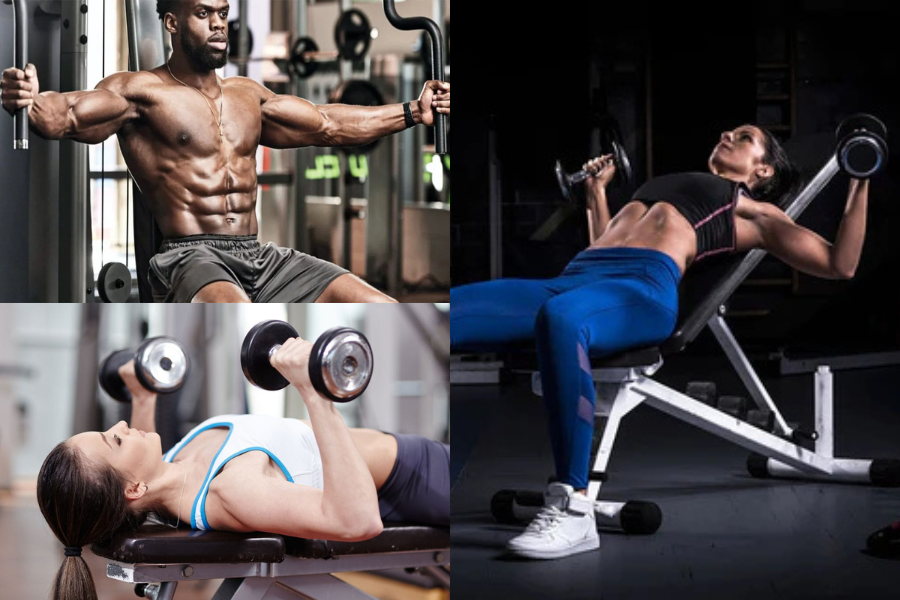
Understand your chest muscles
If you want an effective home gym chest workout, it helps to know which muscles you are targeting. Your chest is mainly made up of two muscles:
- Pectoralis major: The large, fan-shaped muscle you see on the front of your chest. It controls most pushing movements and helps move your arms across your body and up or down.
- Pectoralis minor: A smaller muscle that sits underneath the pectoralis major. It helps stabilize your shoulder blade and supports pressing and reaching movements.
When you train your chest at home, you are not just working these muscles. Many chest exercises also involve your triceps, shoulders, and core, which boosts overall energy expenditure and supports your metabolism. That is one reason regular chest training can help with both strength and body composition over time.
Warm up before you start
Even if your home gym chest workout only uses bodyweight, warming up protects your shoulders and helps you get more from each set.
Simple warm up routine
Spend 5 to 10 minutes on:
-
Light cardio
March in place, do easy jumping jacks, or walk up and down your hallway. -
Dynamic upper body moves
-
Arm circles, forward and backward
-
Big hugs across your chest, alternating which arm is on top
-
Shoulder shrugs and rolls
If you plan to use dumbbells, do 2 warm up sets of your first exercise with very light weight before moving to your working sets. Research on beginner chest programs suggests this is a smart way to prepare your muscles and joints without tiring them out first.
Start with bodyweight chest exercises
You can build an impressive home gym chest workout with nothing more than the floor and a stable surface. Push ups in particular are powerful. Studies comparing push ups and the bench press in trained men found similar hypertrophy and strength outcomes when training volume was matched, which makes push ups a practical substitute when you do not have a bench or barbell.
Why push ups work so well
A standard push up typically requires you to lift about 64 percent of your body weight. That is a meaningful load for your chest, triceps, and shoulders. Push ups also engage your core and even your glutes, turning a simple move into a full body strength exercise.
Over time, you can grow by:
- Adding more reps or sets
- Reducing rest time
- Slowing down the movement to increase time under tension
All of these are forms of progressive overload, which is essential for muscle growth and strength gains even when you are training at home.
Core push up variations for home
The following push up variations let you build an effective home gym chest workout with different angles, difficulty levels, and muscle emphasis.
Standard push ups
What they target: Middle chest, triceps, shoulders, core
How to do them:
- Place your hands slightly wider than shoulder width.
- Keep a straight line from head to heels.
- Lower your chest toward the floor, keeping elbows at about a 45 degree angle.
- Press back up until your arms are straight.
Sets and reps: 3 to 4 sets of 8 to 15 reps, resting 30 to 60 seconds.
Incline push ups
Incline push ups are ideal if you are a beginner or coming back from a break. They are easier than floor push ups because you press a smaller percentage of your body weight.
What they target: Lower portion of the pectoral muscles, plus triceps and shoulders
How to do them:
- Place your hands on a stable chair, bench, or countertop.
- Walk your feet back to form a straight line from head to heels.
- Lower your chest toward the edge, pause briefly, then press back up.
Sets and reps: 3 to 4 sets of 8 to 15 reps.
Decline push ups
Decline push ups ramp up the difficulty and shift more work to the upper chest.
What they target: Upper pectorals, shoulders, triceps, and core
How to do them:
- Place your feet on a sturdy chair or bench and your hands on the floor.
- Brace your core and keep your body straight, avoiding sagging at the hips.
- Bend your elbows to lower your chest, then press up with control.
Sets and reps: 3 to 4 sets of 5 to 15 reps, depending on your strength.
Diamond push ups
Diamond push ups are challenging and place extra emphasis on the inner chest and triceps.
What they target: Pectoralis major, triceps, shoulders, and upper back
How to do them:
- Place your hands under your chest with thumbs and index fingers touching to form a diamond shape.
- Keep elbows close to your body as you lower your chest toward your hands.
- Press back up smoothly.
Sets and reps: 3 to 4 sets of 8 to 15 reps, resting 30 to 60 seconds between sets.
Plyometric (explosive) push ups
Plyometric push ups are an advanced move that increases power and engages the entire chest with maximum contraction force.
What they target: Whole chest, triceps, shoulders, and fast twitch muscle fibers
How to do them:
- Start in a standard push up position.
- Lower your chest toward the floor.
- Explosively push off the ground so your hands leave the floor. You can clap if you are comfortable.
- Land softly with slight elbow bend and go into the next rep.
Sets and reps: 3 to 4 sets of 8 to 15 reps with 45 to 60 seconds rest.
Deficit push ups
Deficit push ups increase your range of motion, which can enhance hypertrophy by recruiting more muscle fibers. Use caution and avoid these if you have shoulder issues.
What they target: Chest through a deeper stretch, triceps, shoulders
How to do them:
- Place each hand on a low, stable object like blocks or handles so your hands are slightly elevated off the floor.
- Lower your chest between your hands to a comfortable depth.
- Press back up steadily.
Focus on slow, controlled reps, especially at the bottom of the movement.
Build a full bodyweight chest workout
Here is a sample no equipment home gym chest workout you can do three times per week, as long as your joints feel good and you recover well.
Perform 3 rounds of the following:
- Regular push ups: 8 to 15 reps
- Incline push ups: 8 to 15 reps
- Decline push ups: 5 to 12 reps
- Diamond push ups: 8 to 12 reps
- Plyometric push ups: 6 to 10 reps
- Star jumps: 20 seconds, to keep heart rate up
- Rest 60 to 90 seconds between rounds
Adjust reps based on your fitness level. Your last 2 or 3 reps should feel challenging while still allowing good form.
If you are a beginner, you can start with:
- 3 sets of push ups (on knees or incline)
- 3 sets of incline push ups
- 3 sets of gentle dips using a chair
Then slowly progress to the full routine.
Add dips for extra chest work
If you have parallel bars or a dip station in your home gym, dips are a powerful way to build chest size and strength. They require your stabilizer muscles to work hard, which makes them a comprehensive upper body movement.
Parallel bar dips
What they target: Lower chest, triceps, shoulders, and stabilizers
How to do them:
- Grip the bars and support your body weight with straight arms.
- Lean your torso slightly forward to emphasize the chest.
- Bend your elbows and lower your body until your upper arms are about parallel to the floor.
- Press back up until your arms are straight.
Start with low reps, focus on control, and avoid going too deep if it bothers your shoulders.
Bench or chair dips
If you do not have dip bars, you can use a sofa, chair, or low surface at home. This variation hits the triceps heavily but also recruits your lower chest more when you keep your hips slightly forward.
How to do them:
- Sit on the edge of a sturdy surface and place your hands beside your hips.
- Walk your feet out and slide your hips off the edge.
- Lower your body by bending your elbows to about a 90 degree angle.
- Press back up without locking your elbows forcefully.
Keep shoulders down and away from your ears throughout.
Use dumbbells for more variety
If your home gym includes dumbbells or even filled water bottles, you can create a more comprehensive chest workout. Dumbbells let each side work independently, which helps correct imbalances and allows for a larger range of motion.
Flat dumbbell chest press
What it targets: Overall chest, triceps, front shoulders
How to do it:
- Lie on a flat bench or the floor, holding a dumbbell in each hand.
- Start with elbows bent at about 90 degrees, dumbbells by your chest.
- Press the weights up until your arms are straight but not locked.
- Lower slowly, keeping your elbows slightly below shoulder level.
Sets and reps: 2 to 4 sets of 8 to 15 reps.
Incline dumbbell press
Incline work emphasizes your upper chest and front shoulders.
How to do it:
- Set your bench to a moderate incline.
- Lie back with dumbbells at chest level.
- Press up and slightly back, following the angle of the bench.
- Lower under control.
You can also simulate a small incline by propping your upper back against a sturdy stack of pillows on the floor if you do not have an adjustable bench.
Dumbbell flyes
Flyes focus on stretching and contracting the chest through a wide arc. They are especially helpful for feeling the chest muscles work, even when chest size is still developing.
How to do them:
- Lie on a flat or incline surface with dumbbells held above your chest, palms facing each other.
- With a slight bend in your elbows, open your arms out to the sides like a wide hug.
- Lower until you feel a comfortable stretch in your chest, then bring the weights back together over your chest.
Use lighter weights and keep the motion smooth to protect your shoulders.
Sample beginner dumbbell chest routine
If you are new to weight training, you can follow a simple beginner plan similar in spirit to popular chest programs that include 3 main exercises and 7 total sets per session.
Try this once per week at first:
- Flat dumbbell press
- 2 warm up sets, very light, 12 to 15 reps
- 3 working sets of 8 to 12 reps
- Incline dumbbell press
- 2 to 3 sets of 8 to 12 reps
- Dumbbell flyes
- 2 sets of 10 to 15 reps
Rest 60 to 90 seconds between sets. As you get stronger, you can add one more set to your main press exercise or slowly increase the weight.
Use simple chest machines at home
If your home gym includes machines, you can use them to isolate the chest and focus on good form. Machines provide a controlled path of movement and reduce the load on stabilizer muscles, which can be helpful for beginners or for targeted hypertrophy work.
Chest press machine
A chest press machine mimics the bench press and targets both the pectoralis major and minor.
How to use it:
- Adjust the seat so the handles are roughly in line with the middle of your chest.
- Grip the handles and press forward until your arms are almost straight.
- Pause, then return slowly to the starting position.
This is suitable for all levels, as you can very precisely set the weight.
Pec deck or chest fly machine
The pec deck focuses on the inner chest and helps with definition.
How to use it:
- Sit with your back against the pad, feet flat on the floor.
- Place your forearms or hands on the pads or handles.
- Bring the handles together in front of your chest in a smooth arc.
- Slowly return to the starting position.
Concentrate on squeezing your chest at the midpoint of each rep.
Incline chest press machine
An incline chest press machine shifts more emphasis to your upper chest.
How to use it:
- Adjust the seat so the handles line up with your upper chest or just below your collarbone.
- Press the handles forward and slightly upward.
- Lower back with control, keeping your shoulders down.
Using a mix of flat and incline angles across your week creates more balanced chest development.
Tips for safe machine training
For any chest machine in your home gym:
- Adjust the seat and handles before you start
- Use slow, controlled reps, especially at the bottom of the movement
- Add weight gradually to apply progressive overload without sacrificing form
This approach helps maximize muscle growth and reduces injury risk.
Try popular home chest equipment
There are also compact pieces of equipment designed specifically for home chest workouts.
Twister arm trainers
Twister arm trainers are portable devices that provide variable resistance when you squeeze them inward. Many models offer multiple resistance levels, for example from around 20 lbs up to roughly 440 lbs, so you can match the load to your strength.
Features often include:
- Adjustable resistance levels for gradual progression
- Ergonomic, anti slip handles for comfort
- Detachable parts for easy storage
- Included workout posters for exercise ideas
These trainers mainly hit your chest, shoulders, arms, and forearms. They are a good option when you want a simple, space saving tool to complement your push ups and dumbbell work.
Home chest press benches
Some home benches, like those with adjustable flat and incline positions and high weight capacities, allow you to mimic a gym style bench press. A sturdy bench with a solid frame gives you room to progress with heavier weights over time while still training safely.
Push up racks and multifunction tools
Foldable push up racks or handles help you:
- Reduce wrist strain compared to flat palm push ups
- Increase your range of motion for more chest activation
- Keep a stable hand position to support good form
Multifunction kits that combine a chest twister, ab wheel, and resistance bands can turn a small corner of your home into a full body training area suitable for regular chest workouts and more.
Apply progressive overload at home
You do not need a full commercial gym to keep making progress. To continue building muscle and strength with a home gym chest workout, focus on progressive overload using these methods:
-
Increase volume
Add more reps or an extra set once your current routine feels manageable. -
Reduce rest time
Shorter breaks between sets increase intensity without any extra equipment. -
Increase time under tension
Slow down the lowering phase of each rep to make your chest work harder. -
Use harder variations
Move from incline to standard push ups, then to decline, diamond, or deficit versions as you get stronger.
Track your sessions in a notebook or app so you can see your improvements over time.
Protect your shoulders and joints
Chest training should not cause sharp or persistent shoulder pain. If you notice discomfort, especially during:
- Flat, incline, or decline presses
- Deep dips
- Wide grip push ups
consider these adjustments:
- Bring your elbows closer to your body rather than flared straight out
- Reduce range of motion slightly, especially at the bottom of presses and dips
- Use push up handles or dumbbells so your wrists and shoulders can find a more natural angle
- Swap uncomfortable moves for friendlier ones, for example replace heavy decline bench with incline push ups
If pain continues or worsens, it is wise to seek professional guidance to assess your technique and joint health before pushing harder.
Benefits of regular home chest training
Making a home gym chest workout part of your weekly routine does more than build muscle definition. Consistent chest training can:
- Improve posture by balancing the muscles around your shoulders
- Enhance shoulder stability and reduce the risk of everyday strains
- Boost functional strength for pushing, lifting, and carrying tasks
- Support long term health by encouraging regular strength training habits
Whether you use only bodyweight, add a pair of dumbbells, or invest in a few compact machines, you can create a chest workout that fits your space, schedule, and experience level. Start with a few variations that feel good, focus on solid form, and build gradually, and your home gym can deliver serious chest results.
About the Author