Why core strength matters
If you are searching for the best ab exercises, you probably want a stronger, more defined core. A good core workout does much more than work your “six pack.” Your core includes the muscles in your abdominals, lower back, hips, and pelvis. Together they support balance, posture, and almost every movement you make.
A strong core helps you:
- Stand and sit taller with less effort
- Protect your spine when you lift, twist, or bend
- Move more efficiently in sports and daily life
- Lower your risk of back pain and injuries
The exercises below focus on safe, effective movements that build real core strength, not just tired hip flexors or a sore neck.
How to use this ab workout guide
Before you dive into the 10 best ab exercises, set yourself up for success.
- Aim for 10 to 15 minutes
- Use a mat or soft surface
- Move slowly and with control
- Stop if you feel sharp pain, especially in your lower back or neck
A beginner friendly core workout can look like this:
- Do each exercise for 30 to 45 seconds
- Rest 15 seconds between exercises
- Start with 1 round, which takes about 7 to 10 minutes
- Over time, work up to 3 or 4 rounds as your strength improves
Now, let us break down the 10 best ab exercises for a strong, balanced core.
1. Dead bug
The dead bug is one of the best ab exercises for teaching you how to brace your core without stressing your lower back. It trains your deep abdominal muscles to stabilize your spine while your arms and legs move.
How to do it
- Lie on your back with your arms straight up toward the ceiling.
- Bend your hips and knees to 90 degrees so your knees are stacked over your hips.
- Pull your belly button gently toward your spine and press your lower back lightly into the floor.
- Slowly lower your right arm and left leg toward the ground, stopping just before they touch.
- Return to the starting position, then switch sides.
- Continue alternating for 30 to 45 seconds.
Form tips
- Keep your lower back from arching off the floor.
- Move slowly, think about control over speed.
- If it feels too hard, shorten the range of motion.
2. Glute bridge
The glute bridge, or back bridge, is more than a butt exercise. It strengthens your glutes and many core muscles at once, which supports your hips and lower back.
How to do it
- Lie on your back with your knees bent and feet flat, hip width apart.
- Place your arms at your sides, palms down.
- Brace your abs, then squeeze your glutes and press your hips toward the ceiling.
- Form a straight line from your shoulders to your knees.
- Pause for 1 to 2 seconds, then lower slowly.
- Repeat for 30 to 45 seconds or 12 to 15 reps.
Form tips
- Drive through your heels, not your toes.
- Avoid arching your lower back at the top.
- To increase difficulty, hold for a longer pause or try single leg bridges.
3. Bird dog
The bird dog targets your rectus abdominis and obliques while also strengthening the lower back. It improves balance, coordination, and has been shown to help reduce back discomfort when done with proper form, according to research cited in 2019.
How to do it
- Start on all fours with hands under shoulders and knees under hips.
- Engage your core so your back is flat and your neck is neutral.
- Extend your right arm forward and your left leg back until they are in line with your body.
- Pause for a second while keeping your hips level.
- Return to the starting position and switch sides.
- Continue alternating for 30 to 45 seconds.
Form tips
- Do not let your lower back sag or your ribs flare.
- Imagine balancing a glass of water on your low back.
- If you feel wobbly, practice the arm and leg separately at first.
4. Bear plank with knee taps
This variation of a plank activates your core from every angle and wakes up your shoulders and hips. It is part of a popular beginner routine designed by NASM certified trainer Maricris Lapaix.
How to do it
- Start on your hands and knees, wrists under shoulders and knees under hips.
- Tuck your toes and lift your knees a few inches off the floor.
- Pull your belly button toward your spine to brace your abs.
- Keeping your back flat, gently tap your right knee to the floor, then lift it back up.
- Repeat with your left knee.
- Alternate knee taps for 30 to 45 seconds.
Form tips
- Think of hovering, not bouncing. Your hips should stay low and steady.
- Look down between your hands so your neck stays neutral.
- If your wrists bother you, make fists instead of placing your palms flat.
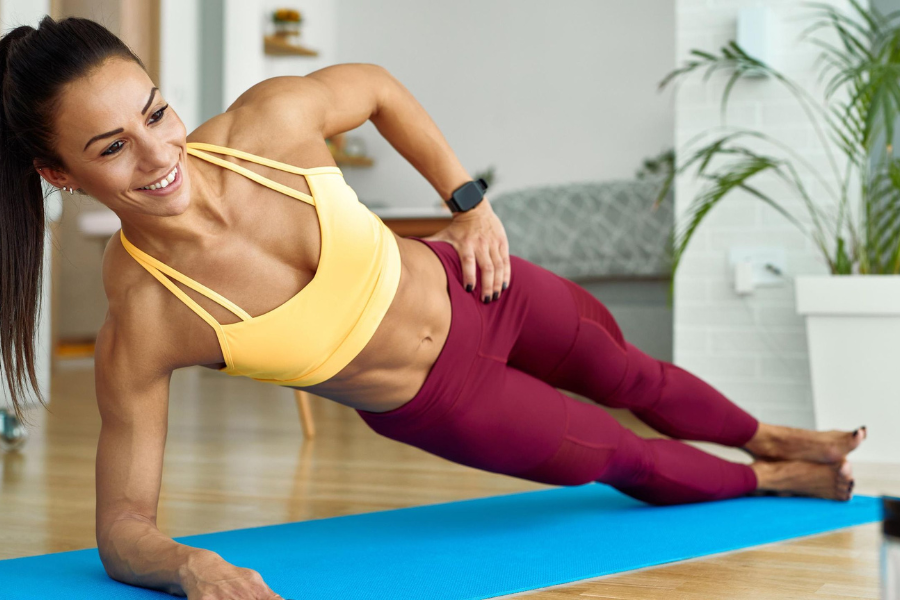
5. Modified side plank
Side planks are excellent for your obliques and deep core muscles. A modified version on your knees is beginner friendly and still very effective for posture and stability.
How to do it
- Lie on your side with your knees bent and stacked.
- Place your bottom forearm on the ground, elbow under your shoulder.
- Engage your core and lift your hips so your body forms a straight line from head to knee.
- Hold for 30 to 45 seconds, then switch sides.
Form tips
- Keep your elbow directly under your shoulder to protect the joint.
- Do not let your hips drift backward or forward.
- If you need less intensity, shorten the hold time.
Side planks are powerful anti lateral flexion moves that train your core to resist side bending, which can help with posture and injury prevention, as highlighted in Gymshark’s ab training guide updated in 2024.
6. Standard plank
Planks are a classic core exercise for a reason. They train bracing, which is your core’s main job in real life. You are teaching your muscles to hold your spine steady rather than repeatedly crunching it.
How to do it
- Start on your forearms and knees.
- Step your feet back so your body forms a straight line from head to heels.
- Press the floor away with your forearms and slightly round your upper back.
- Squeeze your glutes and brace your abs.
- Hold for 20 to 45 seconds.
Form tips
- Do not let your hips sag or hike up.
- Think “tight plank of wood” from head to toe.
- According to core training guidelines, 4 sets of 30 seconds to 1 minute is a solid goal once you are comfortable.
7. Bicycle crunch
If you want one move that hits a lot of your abdominal muscles at once, the bicycle crunch is hard to beat. The American Council on Exercise (ACE) ranked bicycle crunches as the top ab exercise for engaging your obliques and transverse abdominis in a 2019 analysis.
How to do it
- Lie on your back and place your hands lightly behind your head.
- Lift your legs and bend your knees to 90 degrees.
- Bring your right elbow toward your left knee while you extend your right leg out.
- Switch sides in a pedaling motion.
- Continue for 20 controlled reps or 30 to 45 seconds.
Form tips
- Move slowly and focus on rotation from your torso, not your neck.
- Keep your lower back gently pressed into the floor.
- Avoid pulling on your head with your hands.
8. Leg raise
Leg raises are a go to lower ab and hip flexor move that can boost overall core control. They also support performance in movements like squats, running, and jumping.
How to do it
- Lie on your back with your legs straight and arms by your sides.
- Press your lower back into the floor by tightening your abs.
- Keeping your legs straight or slightly bent, raise them toward the ceiling.
- Slowly lower your legs until you feel your low back start to lift, then stop.
- Raise them back up and repeat for 10 to 15 reps.
Form tips
- Quality matters more than how low you can go.
- If your back arches, reduce the range of motion or bend your knees more.
- Gymshark recommends a controlled tempo, such as 3 seconds down and 2 seconds up, to increase difficulty.
9. Hollow hold
The hollow hold is a basic gymnastics move that teaches full body tension. It is highly efficient for building deep core strength and improving posture.
How to do it
- Lie on your back with your arms overhead and legs straight.
- Brace your core and press your lower back into the floor.
- Lift your head, shoulders, arms, and legs a few inches off the ground.
- Your body should form a gentle “banana” shape.
- Hold for 20 to 40 seconds.
Form tips
- If this is too challenging, bend your knees or keep your arms by your sides.
- The key is keeping your lower back pressed into the floor the entire time.
- Many guides suggest 3 to 4 rounds of 45 seconds to 1 minute as a long term goal.
10. Russian twist
Russian twists add rotation to your ab routine and build oblique strength. They also translate well to sports and daily movements that involve twisting.
Weighted core exercises like Russian twists, cable woodchoppers, and cable crunches allow you to add resistance for progressive overload, which can drive muscle growth and strength, as noted in Gymshark’s comprehensive core exercise guide updated in 2024.
How to do it
- Sit on the floor with your knees bent and heels on the ground.
- Lean back slightly until you feel your core engage, keeping your back straight.
- Clasp your hands together in front of your chest.
- Rotate your torso to the right, then to the left, moving as one unit from ribs to hips.
- Continue alternating sides for 20 to 30 seconds or 12 to 20 reps per side.
Form tips
- Keep your chest open, do not round your shoulders.
- To make it harder, lift your feet off the floor or hold a light weight.
- Move your torso, not just your arms.
How to build an ab workout that works
You do not need a long, complicated routine. To build a strong, defined core, focus on variety and consistency.
Mix exercises for full core coverage
Your core training should target:
- Front of your abs, like dead bugs and leg raises
- Sides of your core, like side planks and Russian twists
- Deep stabilizers and back, like bird dogs and glute bridges
A simple structure that aligns with many expert recommendations looks like this:
- Choose 3 to 5 exercises
- Include a mix of flexion moves (crunch like), anti movement (planks, dead bug), and rotation (bicycle, twists)
- Aim for 10 to 15 reps or 30 to 45 seconds per move
- Do 2 to 4 sets total, 1 to 3 times per week
Gymshark suggests a routine of three ab exercises, combining flexion and rotational movements, for 10 to 15 reps over three sets, three times per week for effective strength and definition.
Respect rest and recovery
Your abs are muscles just like any other. They need time to recover and grow.
- Leave at least 24 hours between full ab workouts
- Use active recovery like gentle stretching or yoga to ease soreness
- Watch for signs of overtraining, such as constant fatigue or nagging pain
Overdoing core work can increase stress hormones like cortisol, which is linked with belly fat accumulation, so slow and steady really does win this race.
Abs, body fat, and what “visible” really means
Even the best ab exercises will not reveal a six pack if your abs are hidden under a layer of body fat. You cannot spot reduce fat from your stomach. Your body uses fat from all over for energy during exercise, as WebMD explains in its 2024 overview on belly fat and ab training.
Key points to keep in mind:
- Diet has a major impact on whether your abs show.
- Most people need to reduce overall body fat to see clear ab definition.
- Guides commonly note that visible abs are more likely around 6 to 13 percent body fat for men and 14 to 20 percent for women, combined with solid nutrition and consistent training.
Supporting habits that help reveal your abs include:
- Eating enough protein to support muscle
- Prioritizing whole, minimally processed foods
- Getting enough sleep
- Combining strength training, cardio, and ab work 1 to 3 times per week
High intensity interval training, or HIIT, can be an efficient way to help burn fat at various fitness levels, especially when paired with a routine you enjoy so you stick with it.
Putting it all together
If you want a simple place to start, try this beginner friendly circuit once or twice a week:
- Dead bug, 30 seconds
- Glute bridge, 12 to 15 reps
- Bird dog, 30 seconds
- Bear plank with knee taps, 30 seconds
- Modified side plank, 20 to 30 seconds per side
Rest 1 to 2 minutes, then repeat the circuit 1 or 2 more times if you feel good. As your core strength improves, start adding in planks, bicycle crunches, leg raises, hollow holds, and Russian twists.
Start with just one change today, maybe a single round of the circuit above. Pay attention to how your posture, balance, and everyday movements feel over the next few weeks. With consistent practice, these best ab exercises will help you build a stronger core that supports every workout, and every part of your day.
About the Author