A strong lower body starts from the ground up, and calf workouts for women are one of the simplest ways to build that foundation. Your calves do more than help you look toned in shorts. They stabilize your ankles, support your balance, and protect you from common lower leg injuries, as strength coach Michael Hamlin, CSCS, explains in a recent piece for Women’s Health.
Below, you will find simple and fun calf exercises you can try today, whether you have a full gym or just a sturdy chair at home. You will also learn how your calf muscles work, how often to train them, and how to stay safe as you build strength.
Understand your calf muscles
Before you start, it helps to know what you are actually training. Your calf is not just one big muscle. It is a small team that works together every time you walk, climb stairs, or push off for a sprint.
The main players are the gastrocnemius and the soleus. The gastrocnemius is the larger, more visible muscle that runs from behind your knee down toward your mid calf. It is especially active when your knee is straight, like when you stand on your tiptoes. The soleus sits underneath the gastrocnemius and runs from the back of your knee to your heel. It works hard when your knee is bent, such as when you walk uphill or climb stairs.
Together with a smaller helper muscle called the plantaris, these muscles are known as the triceps surae. They are essential for posture, movement, and balance in both women and men. When you focus your calf workouts for women on both the gastrocnemius and soleus, you get stronger, more stable ankles and a more powerful stride.
Why calf strength matters for women
Strong calves are about much more than appearance. They play a direct role in how confident and controlled you feel in motion.
Your calves help stabilize your ankle joint, which reduces the risk of ankle sprains and other lower leg injuries. This is especially important if you enjoy activities that involve quick changes of direction like tennis, soccer, or basketball, or if you simply want to take long walks without worrying about a misstep on uneven ground.
Calves also support your endurance. They help you push off the ground efficiently with every step. Over time, this reduces fatigue so you can walk, hike, or run longer with less discomfort. For many women, improving calf strength is the missing link that makes hill walking, stair climbing, and jogging feel smoother and more sustainable.
Finally, strong calves make everyday tasks easier. Carrying groceries up stairs, chasing kids at the park, or standing for long shifts all rely on your lower legs. A bit of focused training can turn these daily challenges into something you handle without a second thought.
How often to do calf workouts
You do not need long, complicated routines to see progress. Your calves respond well to consistent, short sessions.
Aim to train your calves two to three times per week. This gives your muscles enough stimulation to grow stronger while still allowing recovery days in between. If you are new to strength training, start with two sessions and see how your legs feel. Slight soreness is normal, but sharp or persistent pain is a signal to ease up and, if needed, talk with a health professional.
When you use weights, increase them slowly over time. A common guideline is to raise the load by about 10 to 15 percent every couple of weeks. This approach helps you keep getting stronger without overloading your joints or tendons too quickly.
Safety tips before you start
You will get more from these calf workouts for women if you approach them with good habits from the beginning. A few simple guidelines go a long way.
Move slowly through each repetition, especially on the way down. This gives your muscles time under tension, which supports strength and control. It also protects your joints because you are not bouncing or jerking.
Stay hydrated, particularly if you are pairing these exercises with cardio like walking or jogging. Water supports muscle function and reduces the risk of cramps. If you have a history of ankle, knee, or Achilles tendon injuries, consider checking in with a doctor or physical therapist before making big changes to your routine.
Most importantly, listen to your body. Fatigue and mild burning in the muscles are normal during a set. Sudden, sharp pain is not. When in doubt, shorten your range of motion, reduce the reps, or pause the exercise instead of pushing through discomfort.
Quick rule of thumb: if your form breaks down, your set is done. Quality reps beat high numbers every time.
Simple standing calf raises
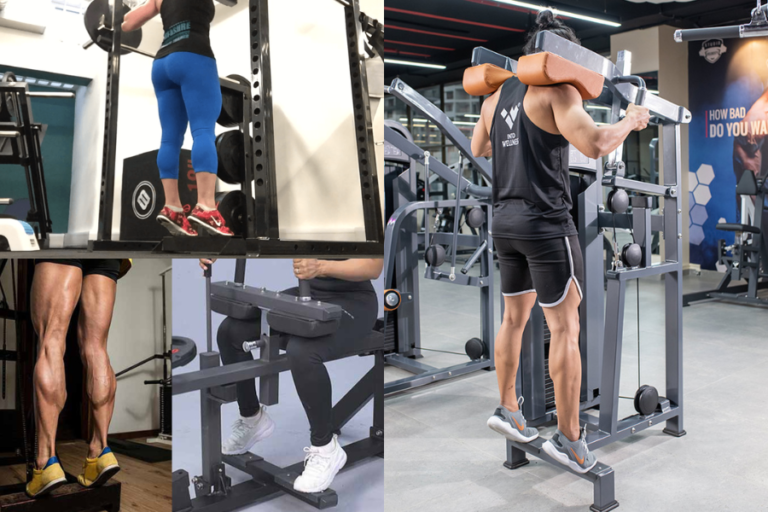
Standing calf raises are one of the simplest and most effective calf exercises. They primarily target the gastrocnemius and are a staple in most calf workouts for women.
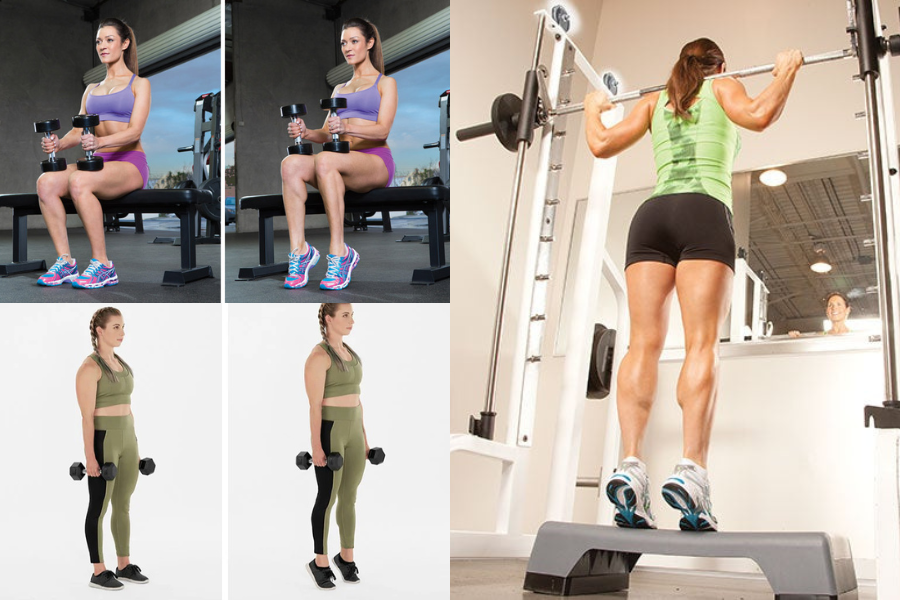
To do a basic standing calf raise, stand tall with your feet hip width apart. You can rest your fingertips lightly on a wall, countertop, or chair for balance. From here, press down through the balls of your feet and lift your heels as high as you comfortably can. Pause briefly at the top, then lower your heels slowly back to the floor.
Aim for 2 to 3 sets of 12 to 15 repetitions. Focus on keeping your knees straight but not locked, your core gently engaged, and your weight evenly distributed across both feet. Avoid rolling your ankles outward or inward as you rise.
If you want a slightly greater challenge without extra equipment, try doing your calf raises on the edge of a stair or a sturdy step. Place the balls of your feet on the step with your heels hanging off. Lift up high on your toes, pulse three small times at the top, then lower your heels so they dip just below the step. This variation tones your calves and stretches your Achilles tendon without adding strain to your back, feet, or tendons.
Single leg calf raises for balance
Once the basic version feels comfortable, single leg calf raises are a natural next step. Working one leg at a time builds unilateral strength, which helps correct side to side imbalances and improves stability in your ankles and feet.
Stand near a wall or chair for support. Shift your weight onto your right foot and lightly lift your left foot off the floor. Keeping your right knee straight but soft, press into the ball of your right foot and rise onto your toes. Pause for a second at the top, then lower your heel slowly. Complete all your reps on one side before switching to the other leg.
For a starter goal, try 2 sets of 8 to 10 reps per leg. Because you are balancing on one leg, you may notice your ankles wobbling at first. That is normal and part of the training effect. Over time, your muscles and nervous system learn to keep you more stable, which can translate to fewer rolled ankles and better performance in sports and daily life.
If you want to progress, hold a light dumbbell in the hand on the same side as the working leg. Keep your posture tall and avoid leaning your upper body forward as you rise and lower.
Seated calf raises to target the soleus
Seated calf raises shift more of the work to the soleus muscle, which lies underneath the gastrocnemius. This muscle is especially important for activities like walking upstairs and running uphill, so it deserves direct attention.
To perform a bodyweight seated calf raise at home, sit tall in a sturdy chair with your feet flat on the floor and your knees bent at about 90 degrees. Place your hands lightly on your thighs for support. From here, rise up onto the balls of your feet, lifting your heels as high as possible. Hold briefly, then lower your heels back down with control.
Start with 1 to 2 sets of 16 repetitions, three times per week. Some women notice improvements in calf strength and tone in about 8 weeks when they stay consistent.
If you have access to a gym, you can use a seated calf raise machine or place a barbell or weighted plate across your thighs. As always, increase weight gradually by about 10 to 15 percent every couple of weeks and stop if you feel discomfort in your knees or Achilles tendons.
Barre inspired elevé to relevé
If you enjoy graceful, dance like movements, the elevé to relevé sequence from barre training is a great addition to your calf workouts for women. It tones the entire calf area and also engages your glutes and core.
Stand with your feet parallel and hip width apart, or in a small turned out position if that feels natural, and lightly hold the back of a chair or countertop for balance. For the elevé, lift your heels as high as you comfortably can with your knees straight. Focus on feeling your weight over the center of the balls of your feet.
From there, move into relevé by gently dropping your tailbone under you while keeping your heels lifted. Your knees bend slightly and your torso stays upright. You will feel your calves, thighs, and glutes work together. Then straighten your knees back to the elevé position and finally lower your heels to finish with your feet flat.
Flow through this pattern for 10 to 12 repetitions. Move slowly and smoothly rather than bouncing. The controlled motion challenges your calves in different angles and makes the exercise feel more like a mini barre routine than a typical gym move.
Cardio moves that sculpt your calves
You do not have to rely only on strength exercises to work your calves. Many everyday activities and cardio options naturally engage your lower legs and help tone the muscles while also improving your conditioning.
Walking is a simple place to start. If you add hills, either outside or by setting your treadmill to an incline around 8.0, your calves will work much harder. A power walk at speeds of about 3.5 to 4.2 miles per hour or a gentle jog at 4.3 miles per hour or faster gives you a solid challenge. If you are already fit and injury free, you can increase intensity further by wearing a light weighted vest, for example 10 pounds, although this is optional and should be added with care.
Other activities that are great for calves include hiking, especially on uneven or uphill trails, soccer, basketball, tennis, step classes, and swimming. Each of these forces your calves to push off, stabilize, and react quickly to changes in direction or terrain, which builds strength and endurance in a dynamic way.
Jump rope is another powerful tool. It is essentially a series of small, repeated standing calf raises. When you jump rope, focus on turning the rope with your wrists rather than your shoulders and keep your jumps low, just high enough for the rope to pass under your feet. This keeps the impact manageable while still giving your calves a high quality workout.
Putting it all together: a sample routine
To make this easy to use, here is a straightforward calf workout you can start today. You can do it at the end of a walk, after a full body strength session, or as a short stand alone routine.
-
Standing calf raises
2 to 3 sets of 12 to 15 reps -
Single leg calf raises
2 sets of 8 to 10 reps per leg -
Seated calf raises
1 to 2 sets of 16 reps -
Barre style elevé to relevé
1 to 2 sets of 10 to 12 slow reps
Rest 30 to 45 seconds between sets if you need it. If you combine this with cardio, such as a 15 to 20 minute hill walk or 5 to 10 minutes of jump rope, you will challenge your calves from multiple angles without spending a lot of extra time.
As you get stronger, your options expand. You can add light weights, increase reps, or include more challenging variations, such as holding the top position for a longer pause or slowing down the lowering phase.
Calf training recap and next steps
Calf workouts for women do not need to be complicated to be effective. When you understand the basic calf muscles, train them two to three times a week, and blend simple strength moves with everyday cardio, you build a lower body that is strong, stable, and ready for whatever your day brings.
Start with just one exercise today, such as standing calf raises at your kitchen counter, and notice how your legs feel over the next few days. Small, consistent steps will add up to stronger calves, better balance, and more confidence in every stride.
About the Author