Why dumbbell bicep exercises at home work
If you want stronger, more defined arms without joining a gym, dumbbell bicep exercises at home are one of the most efficient ways to get there. With just a pair of dumbbells and a bit of space, you can target the biceps from multiple angles, build grip strength, and correct side‑to‑side imbalances.
Dumbbells are especially effective because they allow each arm to work independently. This unilateral training helps you fix strength differences and move through a more natural range of motion than a straight bar would. You also do not need much equipment or room, so you can be consistent, which is the real driver of progress.
In this guide, you will learn how to perform key bicep moves with proper form, how to choose the right weights, and how to put everything together into a simple home workout.
Get set up for home bicep training
A little planning makes your dumbbell bicep exercises at home feel smoother and safer.
Choose the right dumbbells
If possible, have at least two pairs on hand:
- One lighter pair for higher reps and new exercises
- One heavier pair for classic curls and strength work
Selecting an appropriate weight helps you match your current level and your muscle gain goals. You want a load that feels challenging by the last 2 or 3 reps, but still allows clean form.
If you only have one pair, you can still make progress by:
- Slowing down each rep
- Adding partials or isometric holds
- Doing more reps or extra sets
Pick a safe training space
You do not need a full home gym. You just need:
- Enough room to stand or sit without hitting furniture
- A stable surface like a chair or bench for seated or incline variations
- Clear floors so you can set dumbbells down safely
Good lighting and a mirror, if you have one, can help you monitor your form.
Master the basic biceps curl
The traditional dumbbell biceps curl is your foundation. According to Dr. Edward R. Laskowski from Mayo Clinic, this exercise directly targets the muscles in the front of your upper arm and is effective for building strength.
How to do a standing dumbbell curl
- Stand tall with a dumbbell in each hand, arms at your sides, palms facing forward.
- Brace your core and keep your chest up.
- Keep your elbows close to your body and fixed slightly in front of your hips.
- Curl the weights up by bending at the elbow. Focus on feeling the front of your upper arm working.
- Do not swing your arms or lean back. Keep your wrist straight and rigid.
- Squeeze your biceps at the top of the movement.
- Slowly lower the dumbbells back to the starting position in a controlled way.
You can also perform this sitting in a chair. The key is to move smoothly and avoid using momentum.
Form tips to protect your elbows
To get the most from this exercise and reduce the risk of strain:
- Keep your wrists straight, not bent back.
- Keep your elbow close to your side, rather than drifting forward and back.
- Avoid rocking your torso to lift heavier weight.
The Mayo Clinic recommends one set of 12 to 15 controlled repetitions as enough for most people to build upper arm strength, especially when you are getting started.
Build variety with key dumbbell bicep moves
Once you are comfortable with the standard curl, you can add other dumbbell bicep exercises at home to target different parts of the muscle and your forearms. Here are some of the most useful variations highlighted in the research.
Alternating biceps curl
Instead of curling both arms at once, you work one arm at a time.
- Start as you would for a standing curl.
- Curl one dumbbell up while the other arm stays extended.
- Lower it back down with control, then switch sides.
Alternating arms can help you focus on the mind‑muscle connection and engage your core for extra stability.
Hammer curl
Hammer curls change your grip and shift emphasis slightly to the brachialis and parts of the forearm while still working your biceps.
- Stand with dumbbells at your sides, palms facing your body.
- Keep that palm‑in position as you curl the weights up.
- Squeeze at the top, then lower slowly.
Research notes that hammer curls are effective for the forearms, brachialis, and outer head of the biceps brachii, and they can also support grip strength.
Reverse curl
Reverse curls flip your grip to target your biceps and forearms differently.
- Hold the dumbbells with your palms facing down toward the floor.
- Keep your elbows close to your sides.
- Curl the weights up without letting your wrists sag.
- Lower under control.
Beginners should start with lighter weights for this variation so you can focus on solid technique.
Incline and long‑head focused curls
To reach the long head of the biceps, which contributes to the peak, variations that stretch the muscle are useful.
Two options you can do at home if you have a reclining chair or bench:
- Incline dumbbell curl: Sit back on an incline with arms hanging down and palms forward, then curl.
- Drag curl: Stand with dumbbells at your sides, then as you curl, pull your elbows back and let the dumbbells “drag” along your body.
Incline and drag curls help stretch and activate the long head for more complete development.
Short‑head focused curls
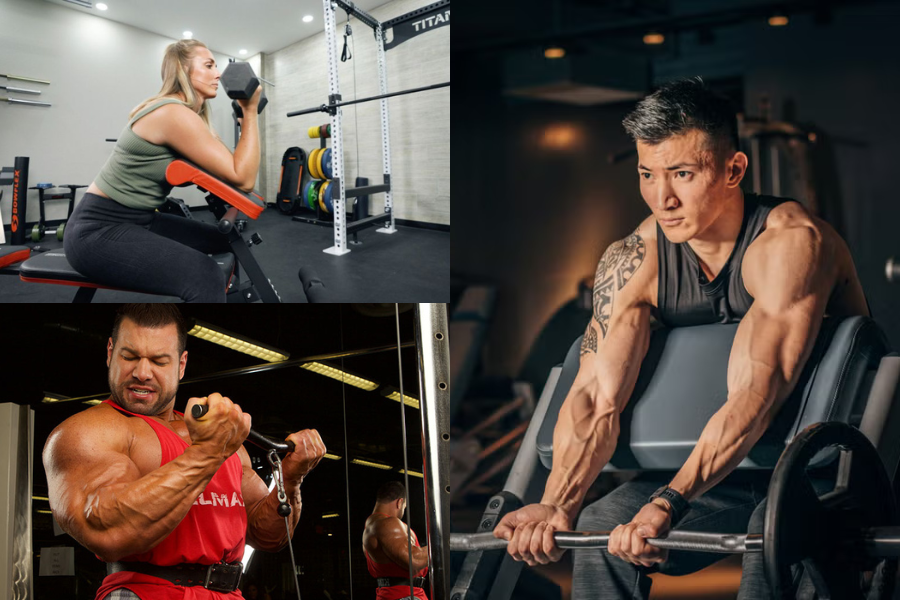
For the inner portion of your biceps, exercises that keep tension in front of your body can help, similar to preacher curls.
If you have a way to brace your upper arm against a surface, you can mimic this preacher‑style position and put more emphasis on the short head.
Strict wall curl
To isolate your biceps and reduce cheating:
- Stand with your back, shoulders, and the backs of your upper arms pressed against a wall.
- Hold the dumbbells at your sides with palms forward.
- Curl without letting your elbows leave the wall.
This variation increases full‑body tension and makes it harder to swing or lean, so your biceps do most of the work.
Use tempo and control to grow faster
How you perform each repetition matters as much as which exercise you choose. Slowing down your dumbbell bicep exercises at home increases time under tension, which is a key factor in muscle growth.
Slow concentric and eccentric phases
Jeff Cavaliere of Athlean‑X recommends using a tempo of about four seconds up and four seconds down for curls to maximize activation and limit help from your shoulders and forearms. Moving too fast turns the exercise into a momentum swing instead of a muscle builder.
Focus on:
- Lifting in a smooth, controlled path
- Pausing briefly to squeeze at the top
- Lowering slowly rather than dropping the weight
Supination for a stronger contraction
You can increase biceps involvement by emphasizing supination, which is the outward rotation of your forearm.
One method described by Cavaliere is to grip the dumbbell so your thumb and index finger press more into one end of the bell. This creates a slight seesaw effect and challenges your ability to rotate the forearm fully as you curl, which can deepen the contraction in the biceps.
Try advanced methods when you are ready
Once you are comfortable with the basics and your form is consistent, you can explore more advanced ways to make your dumbbell bicep exercises at home more challenging without needing much more weight.
Purgatory reps and sliced reps
Two progression techniques mentioned in the research are:
- Purgatory reps: You alternate curling one side while the other holds the dumbbell in a fixed position. This isometric hold keeps constant tension on the muscle and makes even light weights feel demanding.
- Sliced reps: You divide each repetition into smaller segments. For example, curl one third of the way up and back down, then two thirds, then a full rep. This keeps you working through sticking points and increases time under tension.
These strategies are useful if you have limited weight at home but still want a tough stimulus.
Mechanical drop sets
Mechanical drop sets involve changing the exercise angle or style mid‑set to keep going when you start to fatigue. For example, you might do:
- Strict standing curls until you are close to failure.
- Then switch to a slightly easier curl variation or allow a small amount of body English for extra reps.
Research supports that extending sets beyond your usual stopping point in this way can promote muscle hypertrophy and it is especially practical at home because you do not need additional equipment.
Put it together: a simple 30‑minute home bicep workout
Here is a sample routine that uses several of the dumbbell bicep exercises at home covered above. Adjust sets and reps based on your experience.
Beginner‑friendly routine
Start with 1 to 2 sets if you are new to strength training.
- Standing dumbbell curl
- 1 to 3 sets of 12 to 15 reps
- Focus on smooth, controlled movement.
- Alternating biceps curl
- 2 to 3 sets of 10 to 12 reps per arm
- Hammer curl
- 2 to 3 sets of 10 to 12 reps
- Reverse curl
- 1 to 2 sets of 12 to 15 reps with lighter weight
Rest 45 to 60 seconds between sets. Aim to feel challenged but not exhausted, especially when you are starting out.
Intermediate routine in about 30 minutes
A 30‑minute bicep workout can be very effective when you keep rest periods short and focus on quality.
Perform 3 to 4 sets of each exercise with minimal rest:
- Standing dumbbell curl
- Alternating biceps curl
- Hammer curl
- An incline or drag curl variation if you have a suitable setup
- Optional: a final set of strict wall curls for isolation
The research suggests that performing multiple sets of different biceps exercises with limited breaks is an efficient structure for building size and strength at home.
Train smart, recover well
Your muscles grow when you rest, not when you lift. A few simple guidelines will help you get more from your dumbbell bicep exercises at home.
Frequency and progression
- Train biceps no more than twice per week.
- Allow at least 48 hours between sessions for recovery.
- Apply progressive overload by gradually increasing weight by about 5 to 10 percent, or by adding reps and sets over time while keeping form strict.
Good form should always come before heavier loads. Using momentum or swinging your back may let you lift more, but it shifts work away from your biceps and raises your injury risk.
Support with nutrition
For your training to pay off, you also need:
- Enough protein to support muscle repair
- Carbohydrates to fuel your workouts
- Healthy fats for overall health and hormone balance
A balanced diet paired with consistent training and enough sleep will help your arms grow stronger over time.
Common mistakes to avoid
A few habits can quietly hold back your progress with dumbbell bicep exercises at home. Watch out for:
- Twisting the dumbbell halfway up and turning the curl into a mix of hammer and standard curl rather than committing to one variation.
- Letting your elbows drift too far back or forward instead of staying near your sides.
- Leaning back and losing core tightness to lift heavier weights.
- Dropping the weight quickly instead of controlling the lowering phase.
- Letting your wrists go limp instead of staying straight and engaged.
Focusing on clean, repeatable reps will build your strength and protect your joints.
Your next step
You do not need a complicated routine or a room full of machines to build impressive arms. With a pair of dumbbells, a small training space, and a few key dumbbell bicep exercises at home, you can steadily increase strength and definition.
Start by mastering the basic standing curl with strict form. Then add hammer curls, alternating curls, and one or two variations that challenge your biceps from different angles. Keep your movements controlled, train 1 or 2 times per week, and gradually increase the difficulty.
Choose one exercise from this guide to try in your very next workout, focus on form, and build from there.
About the Author