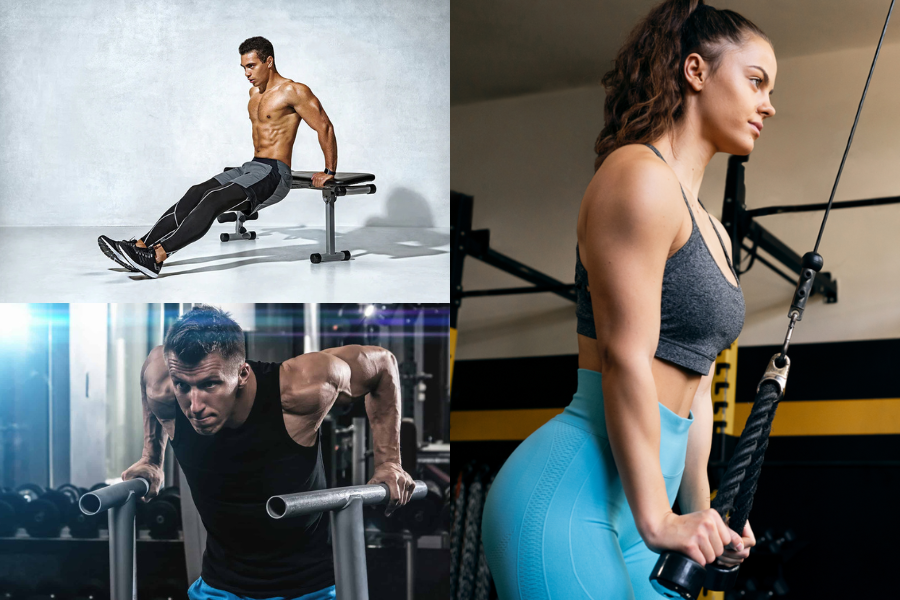
Understand your triceps and why they matter
If you want a stronger upper body and more defined arms, a focused dumbbell tricep workout is one of the most efficient ways to get there. Your triceps sit on the back of your upper arm and actually make up the majority of your arm size. Multiple sources note that the triceps account for around two thirds of total arm mass and play a major role in pressing movements like bench presses, push ups, and overhead lifts, as highlighted in a June 2024 feature by Men’s Health UK.
Your triceps have three heads:
- Long head
- Lateral head
- Medial head
Together, they:
- Straighten your elbow
- Help stabilize the shoulder, especially in overhead positions
- Act as the opposing muscle group to your biceps
Training them directly with dumbbells gives you:
- Better arm definition
- Stronger push movements in daily life and in the gym
- More balanced upper body strength
- Improved shoulder and elbow stability, which can reduce injury risk
Dumbbells are especially useful because, according to Men’s Health UK, they:
- Allow a wide range of motion in multiple planes
- Require stabilizer muscles to work harder
- Make it easy to train one arm at a time to correct imbalances
- Are portable and can be used at home or in the gym
Warm up before your tricep workout
Before you dive into your dumbbell tricep workout, spend 5 to 10 minutes getting your joints and muscles ready. This helps you move better and lowers the risk of strain.
Try:
- 2 to 3 minutes of light cardio like brisk walking, marching in place, or easy cycling
- Arm circles, forward and backward, 10 to 15 each way
- Shoulder rolls, 10 to 15 reps
- Gentle elbow bends and straightens, 10 to 15 reps
- A few easy wall push ups to wake up your pressing muscles
Once you feel warm and your shoulders move freely, you are ready to lift.
Key form tips for dumbbell tricep exercises
Good form matters more than heavy weight. You will feel your triceps work harder and protect your joints at the same time. Here are the basics you can use across most exercises:
- Keep your shoulders away from your ears
- Tuck your elbows in close to your sides when the exercise calls for it
- Move through a full but comfortable range of motion
- Control both the lifting and lowering phase
- Breathe out as you push or extend, breathe in as you return to the start
When your form starts to fall apart, that is your cue to rest or use lighter weights.
Core dumbbell tricep workout routine
This dumbbell tricep workout strings together some of the most effective exercises called out by Peloton coaches and Men’s Health UK features. You can perform it 2 to 3 times per week as part of your upper body or arm day.
Aim for:
- 3 sets of 8 to 12 reps for strength and muscle gain
- 60 to 90 seconds of rest between sets
Start with a light to moderate weight that lets you finish your reps with good control.
Close grip dumbbell bench or floor press
This move is a dumbbell alternative to the close grip bench press and places a big load on your triceps while being gentler on your shoulders, as noted by Men’s Health UK.
How to do it
- Lie on a bench or on the floor with a dumbbell in each hand.
- Hold the dumbbells over your chest with palms facing each other and weights close together.
- Keep your elbows tucked close to your sides, do not flare them out.
- Lower the dumbbells toward your chest in a controlled way.
- Press the weights back up until your arms are straight but not locked.
Form cues
- Think about pushing the weights up by driving through your triceps.
- Keep your wrists straight, not bent back.
Lying dumbbell triceps extension
This is a powerful hypertrophy move because it heavily stretches the long head of the triceps when your arms are positioned overhead, as explained in the Men’s Health UK dumbbell tricep guide.
How to do it
- Lie on a bench or the floor, holding one dumbbell in each hand.
- Extend your arms up so the weights are above your shoulders.
- Angle your arms slightly back toward your head rather than straight up. This keeps tension on the triceps.
- Keeping your upper arms still, bend at the elbows and lower the dumbbells toward the sides of your head.
- Stop when you feel a good stretch in the back of your arms, then extend your elbows to return to the start.
Form cues
- Keep your elbows pointing up, not drifting out wide.
- Move slowly, especially near the bottom of the range.
Dumbbell triceps kickback
The dumbbell triceps kickback is one of the best isolation moves for achieving a strong contraction in the muscle. By keeping your working arm behind your body and straightening the elbow, you get maximum shortening of the triceps fibers, but you will need lighter weights to keep good form as fatigue sets in, as noted in the June 2024 guide from Men’s Health UK.
How to do it
- Hold a dumbbell in one hand.
- Hinge forward at your hips, keeping your back flat and your chin tucked so your neck stays in line with your spine.
- Place your other hand on a bench or your thigh for support. This neutral spine position lowers your risk of injury.
- Start with your working arm bent at 90 degrees so your upper arm is aligned with your torso and your forearm points down.
- Keeping your elbow close to your body, extend your arm straight back until it is fully straight and slightly behind your body.
- Squeeze your triceps at the top, then slowly return to the starting 90 degree bend.
You can perform this move with both arms at the same time to save time, but working one side at a time often makes it easier to focus on form.
Form cues
- Do not swing the weight, let your elbow act as the hinge.
- Keep your shoulders square and avoid rotating your torso.
Overhead dumbbell triceps extension
This variation targets all three heads, with a strong emphasis on the long head when your arms are overhead, according to Men’s Health UK’s June 2024 dumbbell tricep workout guide.
You can perform it seated to help stabilize your torso.
How to do it
- Sit tall on a bench or chair, feet flat on the floor.
- Hold one dumbbell with both hands, palms around one end of the weight.
- Press the dumbbell overhead with straight arms.
- Keeping your upper arms still and close to your head, bend your elbows to lower the weight behind your head.
- Stop when you feel a comfortable stretch in your triceps.
- Straighten your elbows to bring the weight back overhead.
Form cues
- Keep your rib cage down to avoid arching your lower back.
- Move slowly and avoid letting the weight pull your arms too far back.
Close grip push up on a dumbbell
This bodyweight move, often paired with a dumbbell as a grip tool, is suggested in Men’s Health UK’s dumbbell tricep workout as a way to emphasize triceps activation by keeping the elbows tucked in.
How to do it
- Place one dumbbell on the floor and grip it with both hands so your palms face each other.
- Step your feet back into a high plank, body in a straight line from head to heels.
- Keep your elbows close to your sides.
- Lower your chest toward your hands.
- Push back up to the starting position.
Form cues
- If this is too intense, drop to your knees while keeping your body in a straight line from knees to shoulders.
- Focus on pushing the floor away using the back of your arms.
Optional progressions and variations
As you get stronger, you can progress your dumbbell tricep workout in a few simple ways, many of which are highlighted by Peloton instructors and strength coaches in the research.
Add single arm work
Unilateral tricep exercises help you correct strength imbalances and require more engagement from your core. You can:
- Do single arm overhead extensions
- Perform one arm kickbacks, focusing on stability and control
- Try alternate arm row into kickback combinations for a hybrid back and tricep move
Use incline or support to protect your back
If you notice your lower back working hard during bent over movements, you can:
- Lean on a bench during kickbacks so your spine stays neutral, which reduces injury risk
- Use an incline bench for lying extensions to change the angle and stress on your triceps while giving your back more support
Introduce resistance bands
If you have bands at home, pairing them with dumbbells keeps tension on your triceps throughout the entire range of motion. For example:
- Wrap a band under the bench and over your hands during pressing moves
- Anchor a band for tricep kickbacks to maintain steady resistance from start to finish
How often to train your triceps
Peloton experts recommend including tricep work in your routine 2 to 3 times per week. You will get more out of your dumbbell tricep workout when you:
- Place your tricep exercises after compound push moves like push ups or bench presses
- Pair tricep exercises with bicep moves in a superset for balanced arm training, such as tricep kickbacks followed by curls
- Allow at least one rest day between heavy tricep sessions so muscles can recover and grow
You can also use guided digital programs to stay consistent. The Start TODAY app, for example, offers on demand workouts and tricep routines led by certified personal trainer Stephanie Mansour, along with challenges and healthy meal ideas to support your training and overall wellness.
Combine training, recovery, and nutrition
To see visible changes from your dumbbell tricep workout, you need more than just one exercise repeated forever. The research makes it clear that:
- Relying on only one move like the dumbbell tricep kickback will limit your progress
- You will get better results from a mix of 5 to 7 different dumbbell tricep exercises, 10 to 12 reps each, performed consistently
- Proper form and gradual weight increases are essential for muscle gain
- A supportive diet that includes enough protein, fruits, vegetables, and dairy helps your body repair and build muscle
Give your triceps at least 24 to 48 hours of rest between hard workouts, get enough sleep, and pay attention to early signs of joint discomfort so you can adjust load and technique.
Sample beginner friendly tricep session
Here is a simple dumbbell tricep workout you can try as a starting point. Adjust weights so the last 2 reps of each set feel challenging, but still controlled.
- Close grip dumbbell floor or bench press
- 3 sets of 8 to 10 reps
- Lying dumbbell triceps extension
- 3 sets of 8 to 12 reps
- Dumbbell triceps kickback, single arm
- 3 sets of 10 to 12 reps per side
- Seated overhead dumbbell triceps extension
- 2 to 3 sets of 10 to 12 reps
- Close grip push up on a dumbbell
- 2 sets to near fatigue, stopping before form breaks
Start with this routine twice a week. As it begins to feel easier, you can increase the weight slightly, add a third training day, or plug in some of the advanced variations from earlier.
Key takeaways
- A focused dumbbell tricep workout builds arm size, strength, and joint stability.
- Dumbbells let you move through a wide, joint friendly range of motion and address imbalances one arm at a time, as highlighted by Men’s Health UK.
- Tricep kickbacks, close grip presses, lying extensions, overhead extensions, and close grip push ups all target the triceps in slightly different ways so you get more complete development.
- You will see the best results with consistent training 2 to 3 days per week, progressive overload, and solid nutrition and recovery habits.
Pick one or two of the exercises above to practice this week, focus on smooth, controlled reps, and build from there. With steady effort, you will feel your arms getting stronger every time you push, press, or lift.
About the Author