Understand tricep pushdown variations
If you want stronger, more defined arms, learning a few simple tricep pushdown variations is one of the easiest places to start. By changing your grip, attachment, and body position, you can shift emphasis between the tricep heads, reduce elbow and wrist strain, and keep your workouts from feeling repetitive.
You can do tricep pushdowns with different cable attachments like a rope, straight bar, V-bar, EZ bar, single handles, or even resistance bands. Each option slightly changes how your shoulders, elbows, and wrists line up, which affects how your triceps work.
Nail the basic tricep pushdown
Before you experiment with variations, make sure your foundation is solid. The basic movement pattern stays similar across most tricep pushdown variations.
Standard setup and form
- Stand facing the cable machine
- Attach a rope, straight bar, V-bar, or EZ bar to a high pulley.
- Take a small step back so the cable has tension at the top.
- Set your grip
- Overhand grip for bars, neutral grip for ropes.
- Hands just inside shoulder width for most people.
- Position your upper body
- Keep your chest tall and ribs stacked over your hips.
- Tuck your elbows close to your sides. They should stay in roughly the same spot throughout the set.
- Perform the pushdown
- Start with your elbows bent around 90 degrees.
- Push the attachment down by straightening your elbows, not by swinging your shoulders or leaning on the weight.
- Pause briefly at the bottom and squeeze your triceps.
- Return the attachment with control until your forearms are just above parallel to the floor.
Simple form check
Ask yourself during each set:
- Are your elbows pinned close to your body instead of flaring out?
- Are you using a weight you can control for the full range of motion?
- Do you feel the movement in the back of your arm more than in your shoulders or lower back?
If you can say yes to these, you are in a good place to start layering in tricep pushdown variations.
Use different attachments for better results
Changing the attachment is the easiest way to create new tricep pushdown variations without learning a totally new exercise. Each attachment has its own pros, cons, and feel.
Rope pushdowns
A rope attachment is one of the most popular choices for pushdowns. Many lifters like it because it lets your wrists move more naturally and can help you avoid elbow discomfort.
Why you might like rope pushdowns
- Neutral grip (palms facing each other) feels more natural for many wrists.
- You can pull the ends of the rope apart at the bottom, which increases range of motion.
- That extra motion may help you better target parts of the triceps as you push down and out.
People often report that rope pushdowns feel friendlier on the joints and allow a smooth, full extension. The ability to twist your hands and separate the rope at the bottom can also make it easier to really finish the movement.
Straight bar pushdowns
A straight bar offers a very direct, classic feel. It encourages a strong lockout and can be great for building pressing strength, but it can also bother your wrists if you push too heavy or use awkward angles.
Key details
- Overhand grip, palms facing down.
- Often used when you want to go heavier and really load the triceps.
- Some people feel more lateral head activation with a straight bar.
However, the fixed hand position can increase wrist strain and may contribute to issues like tennis elbow if your form breaks down or the load is too high.
EZ bar and V-bar pushdowns
If the straight bar feels harsh on your wrists, an EZ bar or V-bar can be a comfortable middle ground.
EZ bar pushdowns
- Angled grips allow your hands to sit in a more natural position.
- Can be used with an overhand grip to target the medial and long heads of the triceps.
- Often feels easier on the wrists compared to a straight bar.
V-bar pushdowns
- Compact, solid attachment with a neutral-ish grip.
- Comfortable for going heavy due to a secure hand position.
- Many lifters find the V-bar reduces wrist strain compared to a straight bar.
Both options are good if you want the solid feel of a bar but with less discomfort in your forearms and wrists.
Single-arm and handle variations
Using single handles instead of a fixed bar lets you train unilaterally, which is helpful if one arm is stronger or more coordinated than the other.
Benefits of single-arm pushdowns
- Great for isolating each arm and correcting imbalances.
- Easier to find a wrist angle that feels comfortable.
- Helps improve your mind muscle connection, since you can really focus on one arm at a time.
You can do these with a single D-handle, small strap, or even light resistance band at home.
Resistance band pushdowns
If you do not have access to a cable machine, resistance bands give you a simple way to mimic tricep pushdowns anywhere.
How to set them up
- Loop a band over a pull up bar, sturdy door anchor, or overhead beam.
- Grip the ends and perform the same motion as a cable pushdown.
Bands offer variable resistance that increases as you extend, which can feel very natural for your triceps. They are also useful if underhand cable pushdowns bother your wrists, since you can freely rotate your hands and find a comfortable angle.
Try underhand and reverse grip pushdowns
Grip changes are one of the most powerful tricep pushdown variations because they can shift which parts of the muscle group are doing the most work. The reverse grip tricep pushdown is a good example of this.
What is a reverse grip tricep pushdown?
The reverse grip pushdown looks similar to the standard version, but you use an underhand grip instead of overhand:
- Attach a straight bar or rope to the high pulley.
- Grip it with your palms facing up.
- Keep your elbows tucked close to your sides and push down by straightening your arms.
This variation primarily targets the medial head of the triceps brachii and is known for hitting that less visible but important inner part of your tricep. It also involves several stabilizing muscles like your lats, abs, obliques, pecs, and traps to keep your body steady.
Why reverse grip can build bigger triceps
Using an underhand grip changes how your shoulders and elbows align:
- Your elbows stay more tucked and adducted, closer to your torso.
- This positioning allows for greater shoulder extension and a larger range of motion at the triceps.
- The long head of the triceps can contract more fully as you extend your arm behind your body line.
Compared to many triceps moves that mainly hit three muscles, the reverse grip pushdown can engage more muscles in total, which can make it a more comprehensive upper arm exercise. It is often described as the second most compound triceps move after the close grip bench press, which also brings in more chest involvement.
Technique tips for reverse grip pushdowns
- Use a lighter weight than you would for standard overhand pushdowns. The grip makes the movement harder.
- Focus on control and avoid jerking the weight.
- Keep your wrists in line with your forearms instead of letting them bend back sharply.
- Think about keeping your elbows glued to your ribs to avoid flaring.
Performing this move as an isolation exercise can help correct imbalances, especially if one side of your triceps tends to take over in pressing exercises.
Sample set and rep scheme
For reverse grip pushdowns:
- Do 3 to 4 sets.
- Aim for 8 to 12 controlled reps per set.
- Rest 60 to 90 seconds between sets.
You can work these after your heavier compound lifts to focus on size, shape, and definition.
Use variations to target different tricep heads
Your triceps have three heads, and no single exercise perfectly isolates just one. However, small changes in grip, attachment, and shoulder position help you emphasize specific areas over time.
Lateral head focus
To bring out the outer sweep of your triceps, you can:
- Use an overhand grip with a straight bar or V-bar.
- Keep your elbows tight but allow a strong lockout at the bottom.
- Use moderate to heavy weight as long as your form stays clean.
Many lifters report that bar style attachments with an overhand grip feel like they hit the lateral head harder, especially when you push straight down and resist swinging or leaning.
Medial head focus
To emphasize the medial head:
- Use a neutral rope grip or an underhand grip on a bar or rope.
- Focus on full range of motion and a strong squeeze at the bottom.
- Try both standard underhand and reverse grip pushdowns to see which feels best.
Research and coaching reports suggest that an underhand grip specifically helps target the medial head, likely due to how it positions your elbow and shoulder.
Long head focus
The long head crosses both your shoulder and elbow, so shoulder position matters more than grip alone.
To challenge it:
- Keep your elbows slightly in front of your body or directly at your sides.
- Focus on shoulder extension by thinking about pushing your hands slightly behind your hips at the bottom.
- Include overhead tricep moves in your routine, such as cable overhead extensions, skull crushers, or dumbbell overhead extensions, to complement pushdowns.
Here, the way you set your shoulders and elbows is more important than whether you use a rope or bar.
Choose the best attachment for your joints
You might find that some attachments feel amazing for your triceps but rough on your wrists or elbows. It is worth experimenting until you find what suits your body.
When straight bars feel harsh
A straight bar can offer a strong contraction but may cause wrist strain or contribute to elbow issues if your grip or alignment is off.
If you notice discomfort:
- Try an EZ bar so your hands can sit at a more natural angle.
- Switch to a V-bar, which often feels more forgiving on the wrists.
- Use a rope, which allows free wrist rotation, so you are not locked into one position.
If underhand grip hurts your wrists
Underhand pushdowns and reverse grip variations are powerful for tricep growth, but not everyone’s wrists tolerate them.
If you feel pain or pinching:
- Use a rope instead of a straight bar so your hands can rotate more.
- Attach light resistance bands to a high anchor and use an underhand or neutral grip that feels natural.
- Cross handles on a dual pulley cable, which lets each hand move independently and reduces strain.
The key is to keep your elbows tucked and find a grip that lets you move through a full range of motion without joint pain.
Build a simple tricep pushdown workout
You do not need a complicated program to benefit from tricep pushdown variations. Here is a straightforward way to include them in your weekly training.
Pushdown focused day
Add this after your main pressing work like bench press or overhead press.
- Standard overhand pushdown
- Attachment: V-bar or straight bar
- Sets: 3
- Reps: 8 to 10
- Focus: Moderate weight, strong lockout, elbows pinned
- Rope pushdown with flare
- Attachment: Rope
- Sets: 3
- Reps: 10 to 12
- Focus: Separate the rope at the bottom, pause briefly, squeeze hard
- Reverse grip pushdown
- Attachment: Straight bar or rope with underhand grip
- Sets: 3
- Reps: 8 to 12
- Focus: Control, long range of motion, elbows tucked
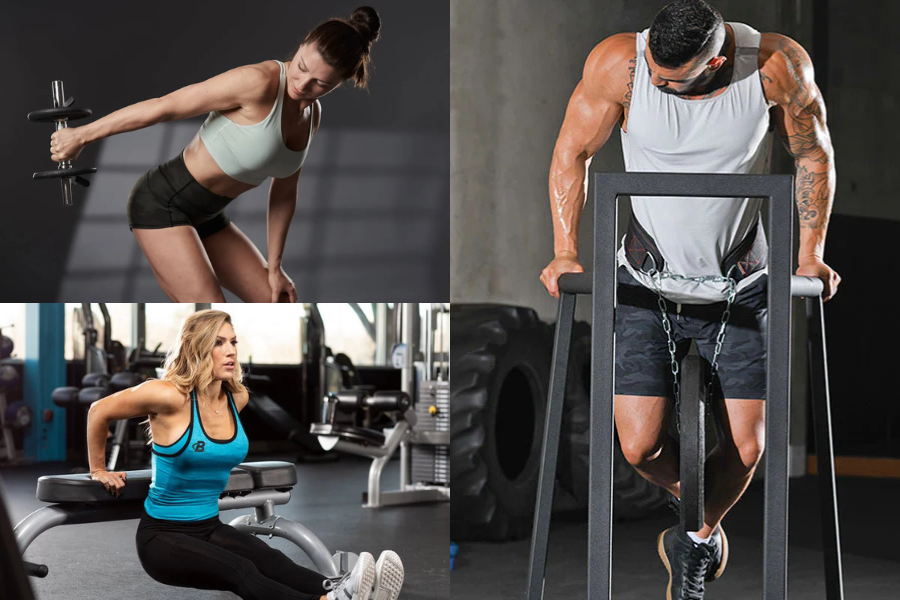
You can finish with a different tricep move such as dumbbell overhead extensions, skull crushers, or kickbacks to work the muscles from another angle.
At home version with bands
If you train at home:
- Band pushdowns, overhand grip
- Band pushdowns, neutral or underhand grip
- Overhead band tricep extensions
Use similar set and rep ranges, focusing on smooth control and full extension.
Common mistakes to avoid
Even the best tricep pushdown variations will not do much if your form drifts too far from the basics. Watch out for these habits:
-
Using too much weight
If you have to swing your torso, let your elbows drift far forward, or bounce at the bottom, the load is too high. Reduce the weight so your triceps, not momentum, do the work. -
Letting elbows flare out
Flaring reduces tricep isolation and increases shoulder involvement. Keep your upper arms close to your torso and move mainly at the elbow joint. -
Cutting the range of motion
Stopping halfway on the way down or up means you leave a lot of muscle activation on the table. Aim to fully straighten your arms at the bottom, then come up until your elbows are comfortably bent but not overly stretched. -
Rushing the negative
The lowering phase matters for growth. Take at least a second or two to return the weight instead of letting it snap up. -
Ignoring discomfort
Persistent wrist or elbow pain is a sign to change attachments, grip width, or load. You have plenty of options, so do not force a variation that does not suit your body.
Put it all together
Tricep pushdown variations give you a simple toolkit for building stronger, more defined arms without learning dozens of new exercises. By shifting between rope, bar, and band setups, experimenting with underhand and overhand grips, and paying attention to shoulder and elbow position, you can:
- Target different areas of your triceps
- Reduce joint strain
- Break through plateaus in your press strength
- Keep your workouts engaging instead of repetitive
Pick one or two new variations to try in your next session, pay close attention to how they feel, and gradually build a small rotation that suits your body and your goals. Over time, those small changes will add up to noticeably stronger arms.
About the Author