Understand why your triceps are not growing
If you are training hard but still seeing no results, you are probably making a few key tricep workout mistakes without realizing it. Triceps make up around 70% of your upper arm size, so when your tricep workouts are off, your overall arm growth and pressing strength stall, as highlighted by Gymshark’s 2024 training advice.
You are not dealing with “stubborn” muscles. As Jeff Cavaliere from ATHLEAN-X notes, triceps rarely resist growth when you train them correctly. In most cases, it is a mix of form issues, exercise choice, and recovery habits that holds you back.
Use the sections below to spot your own mistakes and swap them for smarter habits that protect your elbows and actually grow your triceps.
Mistake 1: Ignoring elbow pain and warning signs
Elbow discomfort is not a badge of honor. It is a sign that your current setup is not working for your joints.
One lifter developed persistent elbow tendonitis after rushing into heavy weighted pushups. Certain tricep exercises, especially those using a pronated grip and cable pushdowns, repeatedly aggravated the pain. That experience is common when you push too fast, too heavy, and ignore early warning signs.
How elbow pain creeps in
- You jump weight too quickly on pushups or skull crushers.
- Your grip position forces your wrists and elbows into awkward angles.
- You rely heavily on cable pushdowns that irritate the joint over time.
If you keep “working through it”, mild irritation can turn into chronic tendonitis that lingers for months.
What to change right now
- Scale back the load and volume for any exercise that hurts your elbow.
- Test neutral or slightly angled grips instead of strict pronated grips.
- Prioritize pain free compound moves like close grip bench press or dips, then add isolation work only if your elbows tolerate it.
Listening early saves you from long layoffs later.
Mistake 2: Letting biceps steal the spotlight
If your sessions are packed with curls and you “sprinkle in” a few tricep sets at the end, you are capping your own progress.
Gymshark’s 2024 guidance points out that triceps make up around 70% of total arm mass. Overemphasizing biceps while neglecting triceps not only limits arm size, it also affects your big lifts and shoulder stability because weak triceps reduce lockout strength on presses and pushups.
Signs you are overdoing biceps
- You can list five bicep exercises off the top of your head, but only one or two tricep moves.
- Triceps are always trained last, when you are already tired.
- Your elbows feel beat up from curls, but your triceps rarely feel fully worked.
A more balanced approach
- Pair biceps and triceps in the same session, alternating exercises.
- Give triceps at least as much total volume as biceps.
- Occasionally start an “arm day” with triceps first so they are not always the afterthought.
Balancing the two will help your arms look fuller and your compound lifts feel stronger.
Mistake 3: Using way too much weight
Trying to impress yourself or others by loading up isolation movements is one of the biggest tricep workout mistakes.
Gymshark’s 2024 article notes that using too much weight on tricep pushdowns leads to common form breakdowns:
- Your shoulders start moving instead of staying locked.
- Your torso swings to create momentum.
- You stop feeling the triceps and start “just moving the stack”.
The same thing happens on skull crushers and tricep pushups when the weight or difficulty jumps too fast.
How this kills your gains
When momentum and other muscles take over, tricep activation drops. You end up stressing your joints without giving your triceps the tension they need to grow.
How to fix it
- Choose a weight that lets you keep your elbows tucked and still.
- Keep reps controlled, especially the lowering phase.
- Only increase the load when you can hit every rep with clean, repeatable form.
Perfect technique with a moderate weight will beat sloppy heavy sets every time.
Mistake 4: Butchering pushdowns, skull crushers, and dips
Some of the best tricep exercises can become the worst if your technique slips.
Common pushdown errors
Gymshark’s 2024 training tips highlight frequent problems with cable pushdowns:
- Using your shoulders to drive the movement.
- Letting your elbows drift forward away from your sides.
- Swinging your body to move the weight.
These habits reduce tricep involvement and raise injury risk.
Better pushdown form
- Keep elbows pinned to your sides.
- Stand tall with a stable torso.
- Move only at the elbow, from roughly 90 degrees to full extension.
Skull crusher mistakes
Skull crushers are great for the long head of the triceps, but they are unforgiving when done poorly.
Common issues:
- Starting too heavy on a movement that brings the bar close to your face.
- Rushing reps instead of keeping the bar path controlled.
- Using a grip that strains your wrists and elbows, which Jeff Cavaliere has flagged as a frequent problem on ATHLEAN-X.
Safer guidelines
- Begin with a light weight and master control first.
- Lower the bar under control toward your forehead or slightly behind it.
- Stop the set as soon as you feel your elbows or wrists complaining.
Dip technique slip ups
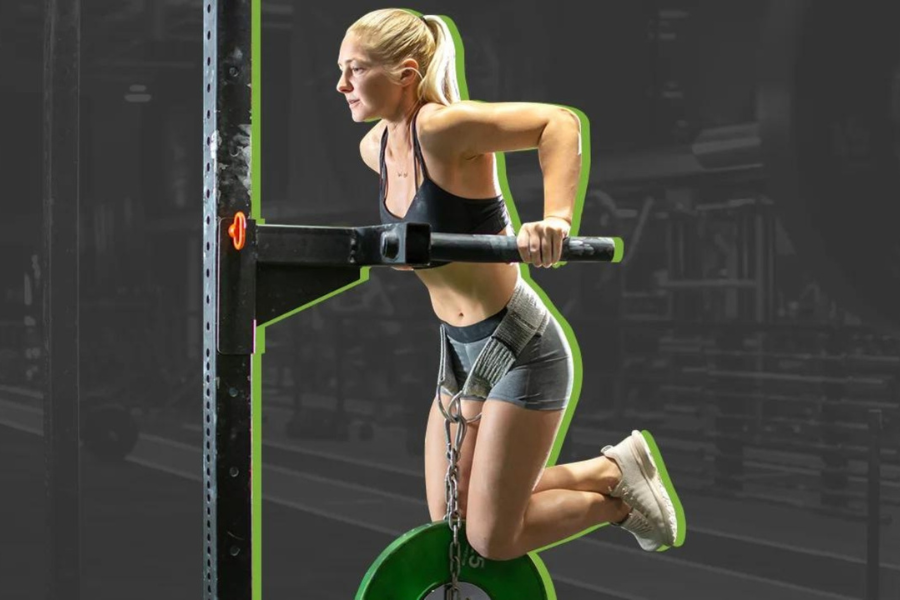
Tricep dips can be a mass builder or a shoulder wrecker, depending on your form.
Errors include:
- Flaring your elbows wide.
- Doing partial reps that never reach proper depth.
- Leaning too far forward, which shifts the work to your chest instead of your triceps, a mistake noted in recent training guidance.
Cleaner dip form
- Keep your torso relatively upright to bias the triceps.
- Tuck your elbows in close to your body.
- Lower until your upper arms are about parallel to the floor, then press back up.
Small adjustments go a long way toward better results and fewer aches.
Mistake 5: Ignoring all three tricep heads
Your triceps have three heads: long, lateral, and medial. No single exercise can fully isolate one head, so if you rely on just one or two movements, you leave growth on the table.
Gymshark’s 2024 recommendations and Squatwolf’s June 2025 guide both emphasize that you need variety in angle and elbow position to train the whole muscle.
What usually goes wrong
- You only do pushdowns and bench variations.
- You never include overhead tricep work, so the long head is undertrained.
- You skip lighter, higher rep sets that help target different fiber types.
How to cover all bases
Aim to include:
- A compound press that hits triceps heavily, like close grip bench or dips.
- A pushdown or extension with elbows at your sides for the lateral and medial heads.
- An overhead extension to challenge the long head, which requires shoulder flexion.
Mix low, moderate, and higher rep ranges so the triceps are challenged in different ways, as Gymshark suggests.
Mistake 6: Picking the wrong tools for the job
Not all setups are equal. Small equipment choices can limit your range of motion and how well you feel the muscle.
According to recent training insights, bar pushdowns can restrict your range because the bar collides with your legs before your arms reach full extension, especially when you try to extend the shoulder behind your torso. Cable pushdowns, on the other hand, allow greater freedom of movement and a more complete contraction.
Squatwolf’s 2025 article also warns that relying too heavily on machines and cables can limit stability and overall muscle engagement compared to free weights.
How to choose better options
- Prefer cable setups that let you fully straighten your arms and slightly extend at the shoulder without hitting your legs.
- Use free weights like dumbbells and barbells regularly to build stability and deeper activation.
- Treat machines as accessories, not the entire tricep plan.
The goal is not just to move resistance, but to move through a full, joint friendly range of motion.
Mistake 7: Going too narrow on close grip bench
Close grip bench press is a great tricep builder and often more joint friendly, especially if other tricep moves bother your elbows. In one lifter’s experience, it was the only tricep exercise that did not cause elbow pain.
However, tightening your grip too much is a common mistake.
Research notes that bringing your hands closer than shoulder width does not boost tricep activation further, but it does increase stress on your wrists. You may end up focusing so much on joint discomfort that you lose the tricep mind muscle connection.
A smarter close grip
- Place your hands roughly at shoulder width, not with your thumbs touching.
- Keep your elbows close to your body, but not jammed in painfully.
- Think about “pushing the bar away” using your triceps at lockout.
If you can bench this way without elbow pain but struggle to feel your triceps, slow down the lowering phase and pause briefly near the chest before pressing up.
Mistake 8: Training in only one rep range
Doing the same 8 to 10 reps on every tricep exercise is simple, but it is also limiting.
Gymshark’s 2024 advice highlights the value of using low, medium, and high reps for maximal tricep development, and Squatwolf notes that the different tricep heads have varied fiber types and functions.
Problems with a single rep range
- Your body adapts and progress stalls.
- You never build top end strength or deep endurance.
- Certain fibers are under stimulated, which can blunt growth.
How to mix it up
Across a week or even within one workout, you might use:
- Heavy compound tricep work in the 4 to 6 or 6 to 8 rep range.
- Moderate isolation work in the 8 to 12 range.
- Lighter, pump focused sets in the 12 to 20 range.
This variety keeps your triceps challenged and progressing instead of stuck at the same level.
Mistake 9: Treating isolation moves like max lifts
Some isolation exercises are simply not built for heavy loading, especially if you care about your elbow health.
The research notes that heavy skull crushers in particular can be very tough on your elbows. Because the movement places a lot of direct stress across the joint, ramping up the weight aggressively can aggravate or even trigger tendon issues.
Better loading strategies
- Use compound presses like close grip bench or weighted dips for your heaviest tricep work.
- Treat skull crushers, overhead extensions, and similar moves as moderate load, higher control exercises.
- Focus on tension and smooth motion rather than chasing personal records on every tricep isolation movement.
Think of isolation work as sculpting and refining, not your primary strength test.
Mistake 10: Starting with the wrong exercise order
If you begin your workout with small isolation movements, you may be tiring out your triceps before they can shine on the big lifts.
Squatwolf’s June 2025 guide points out that doing lighter isolation exercises first can cause early muscle exhaustion and contribute to triceps pain after training.
Why order matters
- Pre fatiguing the triceps makes heavy presses feel unstable and uncomfortable.
- You are forced to reduce the weight or cut sets on your main compound lifts.
- Your elbows may feel overworked from lots of small, high tension moves before any big patterns are trained.
A more joint friendly order
Most of the time, structure your tricep work like this:
- Start with a compound press that heavily involves triceps, such as close grip bench or dips.
- Move to a mid range accessory like pushdowns or lying extensions.
- Finish with lighter, higher rep isolation for a pump and extra volume.
You can still use “pre fatigue” techniques occasionally, but they should not be your default.
Mistake 11: Copying tricep workouts but skipping recovery
Even a perfectly designed routine will fail if you do not let your triceps recover.
According to Squatwolf’s 2025 article, overtraining the triceps, especially when you train them immediately after chest or shoulder days, can lead to:
- Muscle fatigue and lingering soreness.
- Elbow and tricep pain that sticks around between sessions.
- Stalled muscle growth due to poor recovery.
Typical overtraining patterns
- Heavy benching one day, then lots of dips and pushdowns the next.
- Hitting some form of pressing almost every day of the week.
- Never planning deloads or easier weeks.
How to recover better
- Allow at least 24 to 48 hours between heavy tricep intense sessions, as Squatwolf recommends.
- Count all pressing work, not just “direct tricep” exercises, when you plan your week.
- Rotate heavier weeks with slightly lighter weeks in terms of load or volume.
Your triceps grow when you rest, not while you rush from one hard session to the next.
Mistake 12: Forgetting the mind–muscle connection
You might be technically “doing” tricep exercises, but barely using your triceps.
Gymshark’s 2024 guidance emphasizes that failing to focus on the mind muscle connection, especially when you chase heavy weights, leads to poor technique and flat results.
Jeff Cavaliere has also highlighted that stacking multiple small training mistakes, including lack of focused contraction, with nutrition and recovery errors slows muscle building as a whole.
How to reconnect with your triceps
- Start some sets with a short pause at peak contraction, really squeezing your triceps.
- Use lighter loads for a few weeks and focus on feeling the muscle through the entire range.
- Visualize your triceps driving the movement, especially during lockout on presses.
When you can consistently feel your triceps working, every rep becomes more productive.
Putting it all together for better results
If your tricep progress has stalled, you are not stuck. You are probably just one or two adjustments away from better growth and healthier elbows.
To recap the biggest tricep workout mistakes to avoid:
- Ignoring elbow pain instead of adjusting load, grip, or exercise choice.
- Training biceps far more than triceps, even though triceps dominate arm size.
- Using too much weight and letting form fall apart on pushdowns, skull crushers, and tricep pushups.
- Skipping overhead and varied angle work, which leaves some tricep heads undertrained.
- Overloading isolation moves instead of focusing heavy work on compound presses.
- Piling sessions too close together so your triceps never fully recover.
Pick one or two changes from this list and apply them in your very next workout. For example, you could:
- Swap bar pushdowns for a cable setup that lets you fully extend.
- Start with close grip bench, then move to lighter extensions.
- Take a genuine rest day between heavy pressing sessions.
With cleaner form, smarter exercise choices, and better recovery, you will stop spinning your wheels and finally see the tricep results you have been working for.
About the Author