Understand your upper chest
If you want a fuller, more balanced chest, an upper chest workout belongs in your routine. The upper chest, or clavicular head of the pectoralis major, runs from your collarbone down toward your upper arm. Because these fibers angle upward, they respond best when you move your arms up and in on a slight diagonal rather than straight out in front of you.
That is why exercises like incline presses and low to high cable flyes feel different from a flat bench press. They line up more closely with the direction of the muscle fibers and encourage your upper pecs to work harder with each rep.
Set realistic training expectations
Before you jump into new exercises, it helps to know how much upper chest work you actually need.
Weekly volume guidelines
For most people, upper chest growth fits into a broader chest plan, not a separate, extreme specialization.
-
Beginners
-
1 chest exercise per training day in a full body routine
-
Focus on learning form and using a variety of rep ranges
-
Avoid fixating on upper chest only, so you build strength and coordination safely
-
Intermediate lifters
-
Around 4 to 6 total chest exercises per week
-
Include 1 to 2 upper chest exercises in each chest session
-
Frequency
-
Train chest 1 to 2 times per week
-
Give yourself 24 to 48 hours of rest between chest sessions so muscle can recover and grow
For hypertrophy, you usually want to work close to, but not at, failure. Most of your upper chest sets should leave you about 2 to 3 reps short of your absolute limit. Many strength coaches describe this as an RPE (Rate of Perceived Exertion) of 7 to 8.
Learn the key training principles
The exact exercises you choose matter less than how you perform them. A smart upper chest workout follows a few key ideas.
Use progressive loading
Your muscles grow when they face more challenge over time. Progressive loading simply means you gradually increase:
- Weight
- Reps
- Sets
- Time under tension (slower reps, pauses)
As your incline press or cable fly becomes easier, increase the weight slightly or add a rep or two. Small, steady jumps are safer and more effective than big, ego driven increases.
Stay close to failure, not past it
For muscle growth, chest exercises usually work best when you stop a set with 2 to 3 reps left in the tank. Training this way:
- Keeps tension on the upper chest
- Reduces injury risk compared with grinding to absolute failure
- Let you maintain good form across your whole workout
You can occasionally push a set closer to failure, but make that the exception, not your baseline.
Prioritize good form
Form matters for two reasons: it keeps you safe and it directs work into the muscle you are actually trying to train.
Two common mistakes with chest pressing:
- Flaring elbows out to 90 degrees, which loads your shoulders instead of your chest and often feels uncomfortable or painful
- Pressing with your arms almost vertical to your torso in steep incline positions, which again shifts stress into the shoulder joint instead of your upper pecs
Better alternatives:
- Keep your upper arms at about a 45 degree angle to your torso during presses
- Keep your forearms as close to perpendicular to the floor as you can, regardless of bench angle
Retract your shoulder blades against the bench, think about lightly tucking them into your back pockets. This helps you feel your chest, including the upper portion, instead of your shoulders.
Include stability and balance work
Free weight chest exercises, like dumbbell pressing, help you develop stabilizing muscles and learn what a good chest contraction feels like. When you combine them with back exercises like rows, you also keep your shoulders healthy and your posture more upright, which makes upper chest development more visible.
Choose the best upper chest exercises
You have plenty of options for an effective upper chest workout. You do not need to do all of them at once. Instead, pick a few and rotate occasionally.
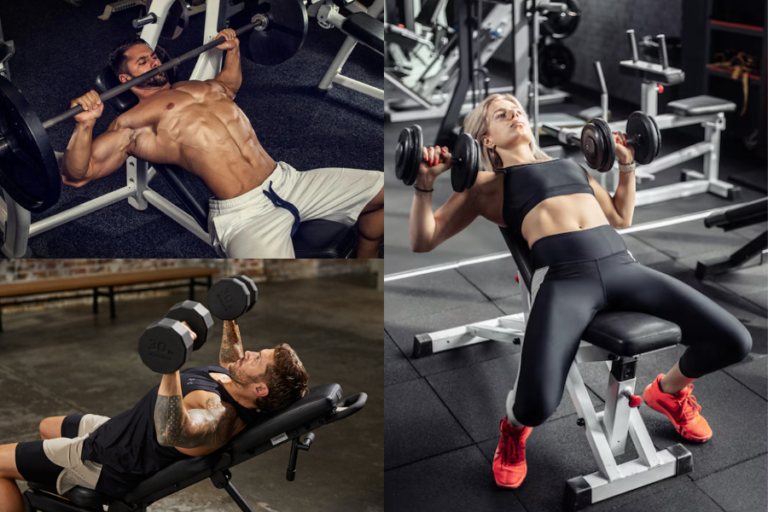
1. Incline bench press (barbell or dumbbell)
The incline bench press is a classic upper chest exercise. Most lifters use a 30 to 45 degree bench angle to target the clavicular fibers of the pecs.
Research based programming often recommends 4 sets of 6 reps at an intensity that leaves you 2 to 3 reps short of failure for hypertrophy focused training, as highlighted by Barbell Medicine in 2024.
Key points:
- Set the bench between 30 and 45 degrees
- Plant your feet firmly on the ground
- Retract your shoulder blades so your upper back feels stable
- Keep your elbows at about 45 degrees from your torso, not straight out to the sides
- Lower the bar or dumbbells under control to chest level, then press back up
Although it is widely used to target the upper chest, current scientific evidence does not strongly prove that incline presses isolate the upper portion more than flat presses. It is still an excellent choice for building overall chest mass and strength while emphasizing the upper area through angle and mind muscle focus.
2. Incline dumbbell bench press
A dumbbell incline press at 30 to 45 degrees often provides a better stretch and range of motion than a barbell. Dumbbells also make it easier to find a wrist and elbow path that feels natural.
A 2010 study reported that activation of the clavicular head of the pecs peaks at incline angles around 44 to 56 degrees, which supports using a moderate incline for upper chest work.
Technique tips:
- Start with the dumbbells directly over your shoulders at arm’s length
- Lower them in a slight arc toward the outer upper chest
- Keep your forearms vertical at the bottom of the rep
- Press up while thinking about bringing your biceps toward each other rather than locking out your elbows aggressively
If you are a beginner, keep the weight light enough to maintain a 45 degree arm angle instead of flaring out. This protects your shoulders and helps your chest do more of the work.
3. Reverse grip bench press
The reverse grip bench press uses an underhand grip. This variation increases activity in the upper pecs and in the biceps brachii. A study in the Journal of Strength & Conditioning Research found that this grip can shift emphasis toward the clavicular portion and may feel more comfortable for your shoulders because your elbows naturally tuck closer to your torso.
How to set up:
- Use a flat bench with safety pins or a competent spotter
- Take an underhand grip slightly wider than shoulder width
- Keep your wrists straight and your forearms vertical at the bottom
- Lower the bar toward your lower chest or upper stomach with elbows tucked
- Press up by driving the bar back toward the rack
Start conservatively with weight, since the grip can feel unfamiliar at first. Many lifters find this an effective alternative or supplement to incline pressing.
4. Low to high cable flyes
Low to high cable flyes are a strong choice for direct upper chest isolation. Because the cables provide constant tension and allow you to move your arms diagonally up and in, they fit the natural direction of the upper chest fibers.
A 2022 study by Schütz et al. reported that cable pulley exercises can produce larger shoulder joint moments compared with some bench press movements, which often means more mechanical tension in the chest across the range of motion.
Form cues:
- Set the pulleys at about hip level
- Step forward into a staggered stance and lean slightly forward
- Start with your arms slightly behind your body, palms facing up or in
- Sweep your hands up and together so they meet around upper chest or nose level
- Squeeze your chest briefly at the top, then return slowly to the start
You can use this move with moderate weights in the 10 to 15 rep range to keep your shoulders comfortable and emphasize muscle squeeze.
5. Decline push ups
Decline push ups elevate your feet and shift more load toward your upper chest and front shoulders. They are a simple bodyweight option that mimics the pressing path of an incline bench press.
Set up:
- Place your feet on a bench, box, or step
- Keep your hands under or slightly wider than shoulder width
- Maintain a straight line from head to heels, no sagging or piking hips
- Lower your chest toward the floor with elbows at about 45 degrees
- Press back up while keeping your core tight
To adjust difficulty:
- Lower the height of the platform to make the move easier
- Raise the platform or add a weight vest or backpack to make it harder
Decline push ups work well in higher rep ranges, such as 8 to 20 reps, especially at the end of your upper chest workout.
6. Fiber following cable and band moves
Some exercises are designed specifically to follow the exact line of upper chest fibers. Examples include:
- Dual cable UCV raise
- Upper chest dips
- Pushaway pushups
- Sunrise or sunset band moves
- Upper chest uppercut
- Lean back cable presses
- Jammer press
- Landmine rainbows
These share a similar theme. Your arm travels up and in, often from low and wide to high and close, which aligns closely with the upper chest’s diagonal fibers. You can plug one or two of these into your routine if you have access to cables, bands, or a landmine station.
Build a simple upper chest workout
You do not need a complicated plan to grow your upper chest. Start with a basic structure and adjust based on how you feel and progress.
Sample beginner friendly upper chest focus day
Use this if you have some lifting experience but are still early in your journey.
- Incline dumbbell bench press
- 3 sets of 8 to 10 reps
- Stop each set with 2 to 3 reps left in reserve
- Low to high cable flyes
- 3 sets of 10 to 15 reps
- Focus on slow, controlled movement and strong chest squeeze
- Decline push ups
- 2 to 3 sets close to technical failure, while keeping form neat
- Row variation (for balance and posture), for example a barbell or cable row
- 3 sets of 8 to 12 reps
Rest 60 to 90 seconds between sets of flyes and push ups, and 2 minutes between heavier incline press sets.
Sample upper chest emphasis within a full chest week
If you train chest twice per week, you can sprinkle in upper chest work without taking over the whole session.
-
Day 1 chest
-
Flat barbell or dumbbell press
-
Incline dumbbell press
-
Seated cable row or similar back exercise
-
Day 2 chest
-
Reverse grip bench press
-
Low to high cable flyes
-
Decline push ups or standard push ups
Across the week, you get both overall chest development and specific upper chest focus, plus pulling work to keep your shoulders balanced.
Avoid common upper chest training mistakes
A few habits can slow your progress or invite injury. Watching for these will keep your upper chest workouts productive.
Ego lifting
If the weight forces you to bounce reps, flare your elbows, or lift your hips off the bench, it is too heavy. Using loads that you can control lets your upper chest, not your joints or momentum, do the work.
Focus on:
- Controlled lowering
- Stable body position
- Consistent bar paths or dumbbell arcs
Poor arm path and elbow position
As noted in 2024 guidance from Men’s Health fitness director Ebenezer Samuel, flaring your elbows to 90 degrees during presses tends to stress your shoulders instead of your chest and can feel painful. Keeping your arms closer to a 45 degree angle improves chest activation and comfort.
Similarly, overly steep incline angles or pressing with your arms nearly straight out in front of you overload the shoulders. You want the bench angle and arm path that let your chest feel like the main driver of each rep.
Neglecting recovery
Muscle grows during rest, not during the workout itself. Give your chest 24 to 48 hours to recover before hitting it hard again.
Recovery basics:
- Aim for at least 7 hours of sleep each night to support muscle repair and hormone balance
- Eat enough protein throughout the day to rebuild muscle tissue
- Keep overall training stress in check so joints and tendons can adapt
Support your upper chest with lifestyle habits
Your upper chest workout is only part of the picture. Small daily choices can speed or slow your progress.
Nutrition for muscle repair
To build a fuller chest, you need enough energy and protein.
- Include a good protein source at each meal, such as poultry, fish, lean meats, eggs, dairy, beans, or tofu
- Time does not have to be perfect, but getting protein within a few hours after training helps support recovery
- Stay hydrated so your joints and muscles function well during heavy pressing
Sleep and stress management
Sleep is a free performance booster. At least 7 hours per night is a realistic target for most adults. Quality sleep:
- Improves workout performance and mental focus
- Supports muscle growth and repair
- Reduces your risk of overuse injuries
Managing stress, whether through light walking, stretching, time outdoors, or other calming activities, also helps your body adapt to training instead of constantly playing catch up.
Put it all together
A well designed upper chest workout does not have to be complex. You will make steady progress if you:
- Include 1 to 2 upper chest exercises in your weekly chest plan
- Work with good form and keep your elbows at a shoulder friendly 45 degree angle
- Train near, but not past, failure with an RPE of about 7 to 8
- Progress your loads gradually over time
- Balance pressing with pulling and give yourself 24 to 48 hours between chest sessions
- Support your training with enough protein, calories, and sleep
Start by adding one upper chest move, such as the incline dumbbell press or low to high cable flyes, to your next workout. Pay attention to where you feel the exercise, adjust your form until you feel your upper pecs kicking in, and build from there. Over the next few months, those small, consistent changes will add up to a fuller, stronger chest.
About the Author