Why men should focus on hamstrings
If you want strong, athletic legs, you cannot rely on squats and leg presses alone. A well designed hamstring workout for men helps you build power for sprinting and jumping, protects your knees, and supports your lower back in everyday life.
Your hamstrings are a group of three muscles that run along the back of each thigh. Together, the biceps femoris, semitendinosus, and semimembranosus flex your knee and extend your hip. That means they help you walk, run, sit, stand, and stabilize your knees and hips during movement, as explained by Banner Health in 2024. When these muscles are weak or constantly tight, you are more likely to deal with strains, joint injuries, poor posture, and lower back pain.
Many men have strong quadriceps and underdeveloped hamstrings because typical leg days are packed with squats, leg presses, and lunges, which lean heavily on the front of your thighs. Over time, that imbalance can limit your performance in cutting, jumping, and landing and can increase your risk of injury. Targeted hamstring training closes that gap, improves knee stability, and rounds out your leg development.
Understand how your hamstrings work
Knowing what your hamstrings do makes it easier to train them effectively. Each of the three muscles on the back of your thigh has slightly different attachments and functions, so you want movements that cover all of them.
Collectively, the hamstrings:
- Extend your hips, which happens when you drive out of the bottom of a deadlift or push off during a sprint
- Flex your knees, which you feel in leg curls and when you pull your heel toward your glutes
- Help stabilize the knee and hip joints whenever you run, change direction, or land from a jump
In everyday life, you engage your hamstrings when you walk, climb stairs, bend down to pick something up, or lean over the sink to wash dishes. Strong hamstrings support your back during those forward bends, so your spine does not have to handle all the stress on its own.
Key benefits of a hamstring workout for men
A dedicated hamstring workout for men offers more than just bigger legs. It supports almost everything you do in and out of the gym.
You can expect benefits like:
- Better athletic performance in running, jumping, and cutting
- Improved knee stability, which helps protect ligaments when you change direction
- Reduced risk of hamstring strains and pulls, especially if you also work on flexibility
- Stronger, more balanced hips that take pressure off your lower back
- More balanced leg aesthetics, so your quads do not overpower your rear thigh
Athletes across many sports, and even recreational lifters, often have below average hamstring development, which is linked to more frequent injuries from imbalanced strength. Treating hamstrings as a priority on leg day, instead of an afterthought, is one of the simplest ways to protect yourself long term.
Essential hamstring exercises for men
To build strong, resilient hamstrings, you need a mix of heavy compound lifts and focused isolation work. The exercises below combine both approaches so you hit all portions of the muscle group.
Barbell deadlift
Barbell deadlifts are a cornerstone of any hamstring workout for men. They train your entire posterior chain, including hamstrings, glutes, lower back, and core. Because you can handle heavy weight, they are excellent for building overall strength and muscle.
Men’s Health highlights deadlifts as one of the best hamstring builders, recommending 3 sets of 6 to 8 reps for strength and size.
Quick form cues:
- Stand with your midfoot under the bar, feet about hip width apart
- Grip the bar just outside your legs, brace your core, and flatten your back
- Push the floor away, driving through your heels and keeping the bar close to your body
- Lock out by fully extending your hips, then control the bar back down
Romanian deadlift (RDL)
The Romanian deadlift is a hip hinge with only a slight bend in your knees. That limited knee flexion shifts more of the work into your hamstrings and glutes. You will feel a deep stretch on the back of your legs as you lower the bar.
Men’s Health recommends 3 sets of 6 to 8 reps, focusing on controlled movement and a strong hip hinge.
To perform RDLs:
- Stand tall holding a barbell or dumbbells in front of your thighs
- Keep a soft bend in your knees, then push your hips back as if closing a door with your glutes
- Lower the weight along your legs until you feel a stretch in your hamstrings, while your back stays flat
- Drive your hips forward to return to standing and squeeze your glutes at the top
Single leg RDLs can be added later to improve balance and unilateral strength.
Kettlebell swing
The kettlebell swing is a powerful hinge that trains your hamstrings explosively. It also challenges your core, upper and mid back, and raises your heart rate.
Kettlebell swings are recommended as a ballistic hamstring move, often performed for 3 sets of 12 to 15 reps.
Key tips:
- Hinge at the hips, do not squat the weight
- Snap your hips forward to swing the kettlebell to chest height
- Let the bell fall naturally, then guide it back between your legs while maintaining a flat back
Leg curls
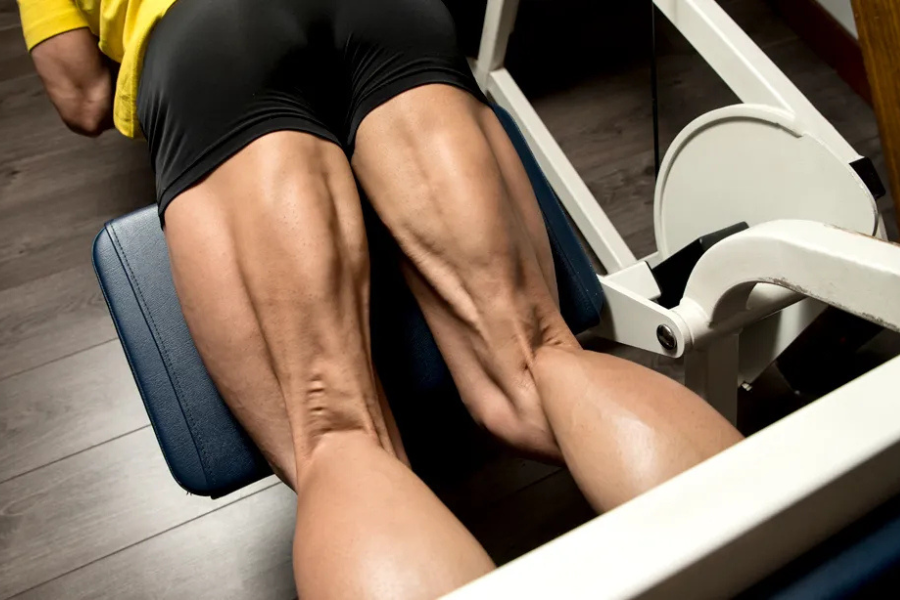
Leg curls directly target hamstring knee flexion, which balances all the hip hinge work from deadlifts and RDLs. You can use lying, seated, or kneeling versions to hit slightly different areas of the muscle group.
A common mistake is treating leg curls as an afterthought with light weight and fast reps. Slowing down, pausing at the top, and using a full range of motion makes them far more effective. You can also perform curls one leg at a time to correct imbalances.
Glute ham bridge with curl
A bridge with a hamstring curl on an exercise ball challenges both hip extension and knee flexion in a single move. This is a good option if you do not have access to machines.
To do it:
- Lie on your back with your heels on top of a stability ball
- Lift your hips into a bridge position, forming a straight line from shoulders to knees
- Bend your knees and pull the ball toward your glutes while keeping hips high
- Slowly extend your legs back out, maintaining control
Bridges and curls like this help you learn how to engage your hamstrings and glutes together, which carries over into heavier lifts.
A complete hamstring workout for men
You can integrate hamstring work into a full leg day, or give hamstrings their own emphasis session. Many men respond well to around 12 total sets for hamstrings, spread across different angles and functions.
Here is a sample hamstring focused routine you can follow once per week:
- Barbell deadlift
- 3 sets of 6 to 8 reps
- Rest 2 to 3 minutes between sets
- Romanian deadlift
- 3 sets of 6 to 8 reps
- Rest 2 minutes between sets
- Seated or lying leg curl
- 3 sets of 10 to 12 reps
- Rest 60 to 90 seconds between sets
- Kettlebell swing
- 3 sets of 12 to 15 reps
- Rest 60 to 90 seconds between sets
If you prefer shorter sessions, you can split this routine in half. For example, perform deadlifts and leg curls on one leg day, then RDLs and swings on another.
Sample progression plan
To keep gaining strength and muscle, focus on progressive overload in your hamstring movements. Many men track every increase in weight on squats, then stay stuck with the same load on RDLs and curls for months.
You can progress by:
- Adding 5 to 10 pounds to your deadlifts and RDLs when you hit the top end of the rep range
- Extending sets of curls by 1 or 2 reps while keeping form clean
- Slowing down the eccentric (lowering) portion to increase time under tension
High intensity techniques like drop sets, forced reps, or rest pause can be used on isolation exercises once you are confident in your form, to push past plateaus without adding too much joint stress.
Form tips to maximize results
Good technique is essential if you want your hamstrings, not your lower back, to do most of the work. It is better to move lighter weights well than to rush through heavy sets with poor control.
Keep these cues in mind:
- Engage your core and glutes before every set to stabilize your spine
- Think about pushing your hips back on hinges instead of bending at the waist
- Move through the largest pain free range of motion you can control
- Pause briefly at the bottom of RDLs and at the top of leg curls to feel your hamstrings working
- Perform reps with steady tempo rather than bouncing or jerking the weight
If you cannot maintain a flat back during deadlifts or RDLs, shorten the range of motion until your hamstrings and mobility improve.
Do not skip hamstring flexibility
Strength without flexibility often leads to tight, cranky hamstrings. That combination limits your range of motion in exercises and increases your risk of strain.
Physical therapist Sam Becourtney, PT, DPT, C.S.C.S., recommends stretches such as the hamstring scoop, hamstring flossing, and a lying hamstring stretch using a towel to combat tightness. Simple standing and seated forward bends also work well, as long as you move into them gently and avoid pain.
Aim to stretch your hamstrings two to three times per week:
- Hold each stretch for 15 to 30 seconds
- Breathe slowly, and avoid bouncing
- Stop before you feel sharp or pinching pain
You can add light stretching after your workout, or on off days as part of a short mobility routine.
Strong, flexible hamstrings are one of the best protections you can give your knees and lower back, both in the gym and in everyday life.
Putting it all together
A focused hamstring workout for men does not have to be complicated. Your main goal is to balance hip hinges like deadlifts and RDLs with direct knee flexion work such as leg curls, then back that up with simple flexibility drills.
Start with weights that let you control every rep, pay attention to how your hamstrings feel during each exercise, and increase intensity gradually. Over the coming weeks, you will notice stronger lifts, better athletic performance, and legs that look just as powerful from the back as they do from the front.
About the Author