Calf workouts for ankle strength are a simple way to protect your joints, move with more confidence, and stay active longer. Your calves do much more than point your toes. They help you balance, absorb impact, and keep your ankles steady every time you walk, run, or jump.
In this guide, you will learn how your calf muscles support ankle strength, and you will get a practical routine of calf workouts for ankle strength that you can start today, even at home with no equipment.
Why your calves matter for ankle strength
Your calf is made up of two main muscles, the gastrocnemius and the soleus. Together, they attach to your heel through the Achilles tendon and control plantar flexion, which is the motion of pointing your toes down.
When these muscles are strong and flexible, they help your ankle:
- Handle higher loads during running and jumping
- Stay stable on uneven ground
- Recover better after everyday twists or stumbles
According to physical therapists at Hinge Health, calf raises are one of the most effective ways to strengthen the muscles above your ankle and improve overall lower body stability and mobility. Strong calves also support the ankle joint when it carries several times your body weight during sports that involve quick changes of direction, which helps reduce the risk of ankle sprains.
Warm up and prepare your calves
Before you jump into calf workouts for ankle strength, give your muscles and joints a few minutes to wake up. This improves mobility and can lower your injury risk.
Light cardio to get blood flowing
Spend 5 to 10 minutes on gentle, low impact movement such as:
- Walking around your home or outside
- Easy cycling on a stationary bike
- Marching in place
This type of warm up prepares your calves and ankles for more focused strengthening and stretching.
Self-myofascial release with a foam roller
If you have a foam roller or a firm ball, use it on your calves before your workout. Gently roll from your ankle to the back of your knee, pausing on tight spots for 20 to 30 seconds.
Starting calf workouts with self-myofascial release can increase mobility, improve how your muscles respond to exercise, and may help reduce the chance of future calf and ankle injuries, as suggested by Meredith Cale in a 2019 article on calf health.
Foundational calf raises for ankle strength
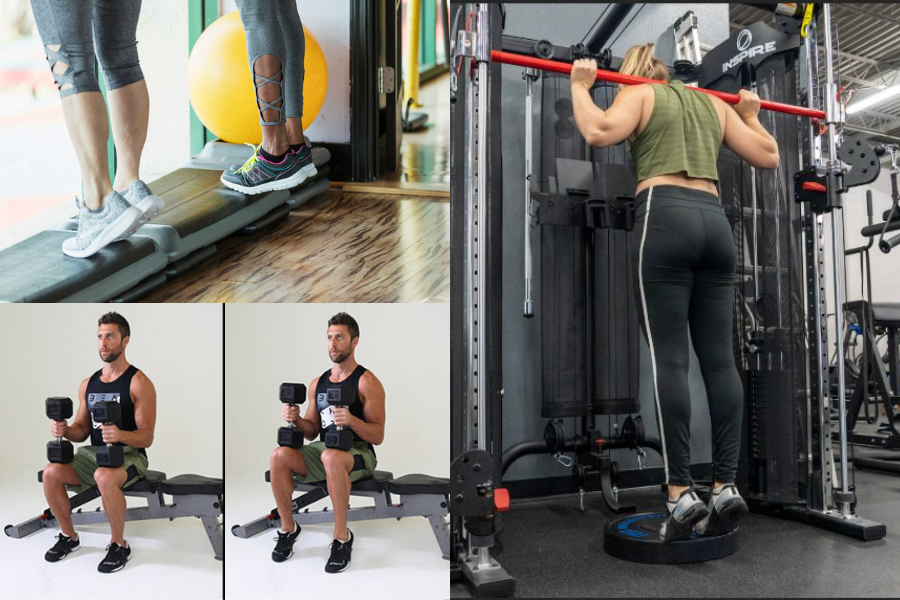
Calf raises are the core of most calf workouts for ankle strength. You can do them on flat ground or on the edge of a step to increase the range of motion.
According to physical therapist Julianne Payton, standing calf raises strengthen the calf muscles above the ankle, which in turn support your ankles and improve lower body strength and mobility. The Cleveland Clinic also recommends standing calf raises on a step as a key exercise to build ankle strength and stability.
Standing double leg calf raise
This is your starting point. It builds basic strength and helps you learn good control.
- Stand with your feet hip width apart, close to a stable support like a wall, banister, or the back of a chair.
- Slowly lift your heels as high as you can so you are on the balls of your feet.
- Pause for 1 to 2 seconds at the top.
- Lower your heels slowly back down to the floor.
Aim for 2 to 3 sets of 10 to 15 repetitions. Focus on moving in a straight line and avoiding wobbling at your ankles.
The Cleveland Clinic suggests lifting as high as possible on your toes and lowering slowly, repeating 10 times once a day, as a safe starting target for ankle strengthening through calf raises.
Progression: Step calf raise
Once double leg raises on flat ground feel easy, move to a small step to increase the stretch and strength challenge.
- Stand on the edge of a step with the balls of your feet on the step and your heels hanging off.
- Hold a railing or wall for support.
- Slowly raise your heels as high as you can.
- Lower your heels below the step level so you feel a gentle stretch in your calves.
This greater range of motion helps strengthen your calves and improve ankle mobility. Perform 2 to 3 sets of 10 to 15 reps with control.
Single leg work to train stability
When you are comfortable with double leg raises, single leg variations take your calf workouts for ankle strength to the next level.
Single leg calf raises train your ankle to stay stable when all your weight is on one leg, which is exactly what happens during walking, running, and many sports. Hinge Health physical therapist Julianne Payton notes that this kind of exercise is especially useful for improving balance and ankle stability.
Single leg calf raise
- Stand on one leg near a wall or chair for balance.
- Keep your knee straight and your weight centered over your toes.
- Lift your heel slowly until you are on the ball of your foot.
- Pause briefly, then lower your heel in a slow, controlled way.
Start with 2 to 3 sets of 8 to 12 repetitions per leg. If needed, begin by lightly touching a support and reduce support over time as your balance improves.
Single leg step calf raise
For an extra challenge, move to a step:
- Stand on one leg on the edge of a step, holding a railing or wall.
- Raise your heel as high as possible.
- Slowly lower your heel below the step for a stretch.
Limit the range at first if you have a history of Achilles or ankle issues. Over time, this variation can help strengthen your Achilles tendon and increase its ability to handle load, which is important for sprinting, jumping, and other high impact activities.
Targeting the soleus for deep ankle support
The soleus is the deeper calf muscle that plays a big role in ankle stability, particularly when your knee is bent. Soleus focused work is often missed, but it can make a noticeable difference in how strong and steady your ankles feel.
Hinge Health physical therapists recommend the soleus raise, a calf raise with bent knees, as a way to better target this muscle and improve ankle strength.
Bent knee soleus raises
You can do these seated or standing.
Seated heel raise
- Sit on a chair with your feet flat on the floor and knees at about 90 degrees.
- Keeping your toes on the ground, lift your heels as high as you can.
- Hold briefly at the top, then lower slowly.
Standing bent knee calf raise
- Stand with your feet hip width apart, holding a support.
- Bend your knees slightly, like a small squat.
- From this position, lift your heels up while keeping your knees bent.
- Lower your heels back down in a slow, controlled movement.
In both versions, aim for 2 sets of 10 to 15 reps. These exercises focus on the soleus and can improve ankle strength and support when your knee is bent, which is common in walking, climbing stairs, and many sports.
Simple ankle focused strength moves
Along with calf raises, smaller ankle specific movements can round out your calf workouts for ankle strength. The goal is slow, controlled motion that strengthens the muscles and tendons around the ankle.
NHS Inform suggests beginning with just 2 to 3 repetitions of new exercises throughout the day and gradually increasing volume every few days until you reach around 2 sets of 15 repetitions.
You can include:
- Seated heel raises with both legs
- Standing double heel raises with support
- Ankle bends, flexing your foot up and down slowly
- Ankle tilts, gently rolling your ankle in and out
These are particularly useful if you are coming back from an injury or surgery and need a gradual introduction to movement and loading. Gradual strengthening supports tissue healing and helps you regain mobility after calf or ankle problems.
Stretching to support mobility and strength
Strong muscles that are also flexible give your ankles the best support. Regular stretching after your calf workouts for ankle strength helps maintain range of motion and may reduce stiffness.
Standing calf stretch for the gastrocnemius
This stretch targets the larger, more visible calf muscle.
- Stand facing a wall with your hands on the wall at about chest height.
- Step one leg back, keeping the back knee straight and the heel on the floor.
- Lean your body forward until you feel a stretch in the back calf.
- Hold for 20 to 30 seconds, then switch legs.
Repeat 2 to 3 times per leg, 2 to 3 times per day, especially after workouts. This type of stretch helps improve ankle flexibility over time.
Standing soleus stretch
To reach the deeper soleus muscle, you need to bend the back knee.
- Start in the same wall position as the calf stretch.
- Step one leg back, but this time bend the back knee while keeping the heel down.
- Sit your weight slightly down and back until you feel a stretch lower in the calf, closer to the Achilles.
- Hold for 30 seconds, then switch legs.
Repeat 3 times per side. This is a useful way to relieve tightness and improve ankle mobility that relies on the soleus muscle.
Towel or band stretch
If you prefer stretching on the floor:
- Sit with your leg stretched out in front of you.
- Loop a towel or resistance band around the ball of your foot.
- Gently pull the towel or band toward you until you feel a stretch in your calf and Achilles tendon.
- Hold for 20 to 30 seconds and repeat 2 to 3 times.
Using props like towels or bands can create a deeper stretch and help improve both ankle strength and flexibility over time.
How often to train and how hard to push
Consistency matters more than intensity for ankle and calf strength. Here is how you can approach your routine in a safe and realistic way.
Frequency and progression
- Aim to work on calf strength 3 to 5 days per week.
- Start with low volume, 2 to 3 repetitions of new exercises, done several times a day.
- Every few days, add a few more reps until you reach about 2 sets of 15 repetitions per exercise.
- As you get stronger, you can increase difficulty by adding single leg variations or holding light weights.
Gradual loading gives your muscles, tendons, and joints time to adapt without becoming overwhelmed.
Pain and safety guidelines
Some mild discomfort is common when you start new exercises, especially if you have not trained your calves before. You can use a simple 0 to 5 pain scale where 0 is no pain and 5 is strong but manageable pain.
NHS Inform suggests that it is acceptable to feel some mild discomfort while you exercise, as long as it does not get worse during the workout and does not feel significantly worse the next day. If your pain spikes above 5 out of 10 or lingers and increases after exercise, reduce the intensity or volume and, if needed, speak with a healthcare professional.
What stronger calves can do for you
When you stick with calf workouts for ankle strength, you are doing more than building visible muscle. You are:
- Reducing your risk of ankle sprains and related injuries, especially in activities that involve quick twisting or cutting movements
- Supporting your Achilles tendon so it can handle higher loads during running and jumping
- Improving your balance and lowering your risk of falls
- Boosting your running and sprinting performance by improving your push off power and endurance
- Helping prevent lower leg issues such as shin splints by stabilizing nearby muscles and tendons
On the other hand, neglecting calf strength can limit your balance, make daily tasks feel harder, and raise your risk of ankle and lower leg injuries.
Start with one or two of the exercises in this guide today, such as standing double leg calf raises and a simple standing calf stretch. As they become easier, build up to the full routine. With steady practice, you will feel more stable on your feet and more confident in every step.
About the Author