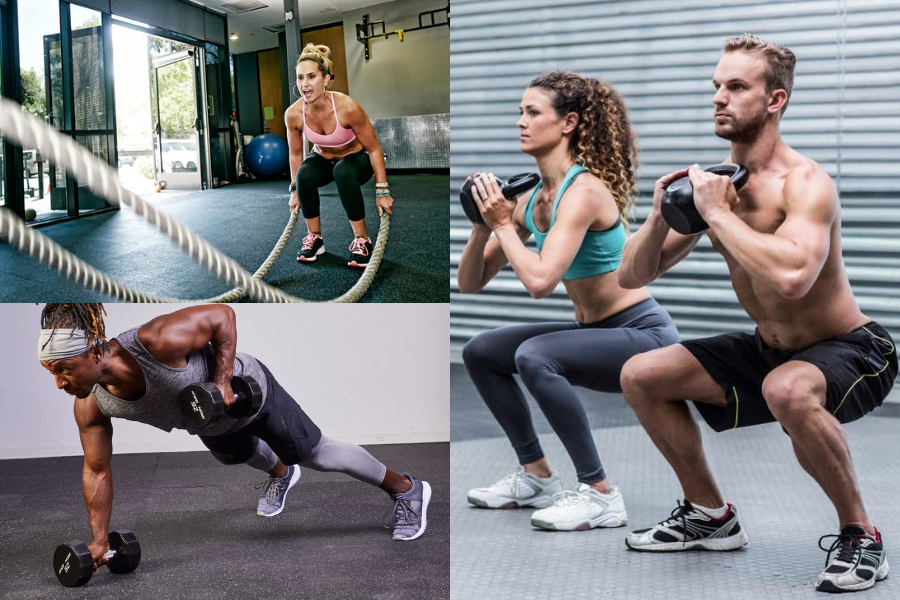
Understand what a HIIT workout with dumbbells is
A HIIT workout with dumbbells combines short bursts of intense effort with brief rest periods, while you use dumbbells for resistance. You alternate between working hard and recovering, which keeps your heart rate high and challenges your muscles at the same time.
This style of training is popular because it:
- Fits into 20 to 30 minutes
- Builds strength and endurance together
- Boosts fat burning through the “afterburn” or Excess Post-Exercise Oxygen Consumption (EPOC) effect, where you keep burning calories at an elevated rate for hours after you finish
Dumbbell HIIT can be adapted to almost any fitness level. You adjust:
- The weight of your dumbbells
- The duration of your work and rest intervals
- The difficulty of the exercises
You can also do a hiit workout with dumbbells almost anywhere, whether you are at home, in the gym, or traveling.
Benefits of dumbbell HIIT
Combine strength and cardio in one
Traditional strength training and cardio are often separate sessions. With dumbbell HIIT, you blend them into one efficient workout. You use moves like:
- Squats and lunges
- Shoulder or chest presses
- Rows and swings
- Burpees or thrusters
Because you are using resistance and moving quickly, you build muscle strength and cardiovascular endurance together. This is especially useful if you have limited time.
Burn more calories in less time
Dumbbell HIIT workouts are time efficient. A 20 to 30 minute session can burn as many calories as a longer, moderate intensity workout because:
- You are working at a higher intensity
- Multiple large muscle groups are involved
- The EPOC effect keeps your metabolism elevated after you finish
Research on HIIT supports the idea that shorter, intense sessions can be as effective, or sometimes more effective, than longer, steady state cardio for fat loss, especially when resistance is included to build lean muscle.
Build strength, power, and lean muscle
Adding dumbbells to HIIT increases the challenge for your muscles. This is important for:
- Building and maintaining muscle mass
- Increasing strength and power
- Avoiding fitness plateaus
Exercises like dumbbell squats, rows, presses, swings, and goblet squats help you work your legs, core, back, chest, and shoulders in a single workout. Some movements, like the dumbbell goblet squat, can boost muscle building hormones naturally by letting you squat deeper and recruit more muscle fibers in one powerful move.
Improve balance, coordination, and joint stability
Many dumbbell HIIT moves require you to control weight while your body is in motion. This can:
- Engage stabilizing muscles around your joints
- Improve your balance and coordination
- Strengthen your core
Exercises such as single arm rows, one arm swings, and renegade rows ask your body to resist rotation and wobble. Over time, this can make everyday movements feel more controlled and athletic.
Support mental health and motivation
High intensity workouts can also benefit your mind. According to fitness professionals, dumbbell HIIT can:
- Improve mood
- Reduce anxiety
- Increase your motivation to stay active
The short, focused nature of HIIT often feels more engaging than long, slow workouts. You always know there is a break coming, which can help you push harder during each work interval.
Stay safe during hiit workout with dumbbells
Because HIIT is intense, safety is important. A few smart habits help you get the benefits without unnecessary risk.
Warm up before you start
A proper warm up prepares your body by:
- Raising your body temperature
- Lubricating your joints
- Activating key muscle groups
Spend 5 to 10 minutes on:
- Light cardio, such as brisk walking, marching in place, or easy cycling
- Dynamic moves, such as leg swings, arm circles, bodyweight squats, or hip circles
Avoid going from sitting straight into max effort intervals. Your body needs time to ramp up.
Choose the right dumbbell weight
For HIIT, the right weight is one you can move with good form at a quick but controlled pace. As a rule of thumb, your weight should:
- Feel manageable at the start of the interval
- Feel challenging by the last few seconds
- Allow you to keep technique solid without swinging or twisting
If your form falls apart or you move too slowly to keep the interval structure, lower the weight. It is better to use slightly lighter dumbbells with great form than heavier weights that strain your joints.
If you do not own dumbbells, you can use substitutes like:
- Large water bottles
- Heavy books
- Canned goods
- A filled backpack or paint tin
These can still give you a solid dumbbell style HIIT workout, especially at home.
Focus on form first, speed second
Proper technique makes your workout more effective and safer. Before adding speed or heavier weights:
- Learn the basic pattern of each move
- Practice the exercise slowly
- Use a mirror or record yourself to check alignment
For example:
- In squats, keep your knees tracking over your toes and your chest lifted
- In rows, keep your back flat rather than rounding
- In swings, power the movement with your hips, not your lower back
Once you can perform 8 to 10 solid reps with control, you can start to increase your pace for intervals.
Hydrate and cool down
Dehydration can lead to fatigue, dizziness, and poor coordination, which raises your injury risk. To stay safe:
- Drink water before your workout
- Sip during rest periods if needed
- Rehydrate afterward
A cool down is just as important as the warm up. Spend 3 to 5 minutes on:
- Gentle walking or marching in place
- Easy stretching for the muscles you used the most, such as quads, hamstrings, glutes, chest, and shoulders
Cooling down helps lower your heart rate gradually and supports recovery.
Respect recovery and rest days
HIIT is demanding. To avoid overuse injuries and excessive stress hormone levels, it is recommended that you:
- Limit dumbbell HIIT to 2 or 3 sessions per week
- Leave at least 48 hours of rest between full intensity sessions
On days between HIIT workouts, you can:
- Go for a brisk walk
- Do light cycling
- Try mobility or gentle stretching
If you feel unusual pain, dizziness, or extreme fatigue, stop your session and rest. Listening to your body is part of training smart.
How often to do dumbbell HIIT
Your ideal schedule depends on your fitness level and goals.
- If you are a beginner, aim for 1 or 2 dumbbell HIIT sessions per week. Keep the workouts shorter and focus on technique and recovery.
- If you are intermediate or advanced, you can progress to 2 or 3 sessions per week. Make sure you still allow recovery time between sessions.
You can combine dumbbell HIIT with lower intensity activities like:
- Walking
- Steady cycling
- Gentle jogging
This mix gives you both high intensity cardio and enough easy movement for overall cardiovascular health.
Sample full body dumbbell HIIT workout
Below is a simple structure you can follow at home or in the gym. Adjust weights, intervals, and rounds to match your level.
Step 1: Warm up (5 to 10 minutes)
- 2 minutes of brisk walking or marching in place
- 10 bodyweight squats
- 10 alternating reverse lunges
- 10 arm circles forward and backward
- 10 hip circles each direction
Repeat once if you still feel cold or stiff.
Step 2: Choose your interval format
You have two common options mentioned by trainers:
- 40 seconds work, 20 seconds rest
- Perform each exercise for 40 seconds
- Rest for 20 seconds
- Move to the next exercise
- Tabata style 20/10 protocol
- 20 seconds work, 10 seconds rest
- 8 rounds of the same exercise
- 4 minutes total per movement
If you are new to HIIT, the 40/20 format often feels more approachable because you move through a circuit instead of repeating one move for 4 minutes.
Step 3: Full body dumbbell HIIT circuit
Perform each exercise for 40 seconds followed by 20 seconds of rest, then go directly to the next move. After all exercises are done, rest 1 to 2 minutes and repeat the circuit 2 or 3 times.
- Dumbbell squat to press (thruster)
- Targets legs, glutes, shoulders, and core
- Hold dumbbells at shoulder level
- Squat down, then stand up and press the dumbbells overhead in one smooth motion
- Single arm dumbbell row
- Targets upper back, biceps, and shoulders
- Place one hand and knee on a bench or sturdy surface
- Row the dumbbell toward your hip, then lower slowly to keep muscles under tension
- Switch arms halfway through the interval or on the next round
- Dumbbell goblet squat
- Great for legs, glutes, and core, and helps you squat deeper with control
- Hold one dumbbell close to your chest
- Keep your chest up and push your hips back as you lower into the squat
- One arm dumbbell swing
- Targets hamstrings, glutes, lower back, quads, and shoulders
- Start with the dumbbell between your legs
- Hinge at the hips, then drive your hips forward to swing the weight to chest height
- Focus on hip power rather than lifting with your arms
- Switch arms each round or halfway through the set
- Renegade row
- Works back, shoulders, triceps, biceps, and especially your core
- Start in a plank position with a dumbbell in each hand
- Row one dumbbell toward your rib cage while keeping your hips as steady as possible
- Alternate sides
- Burpee with or without dumbbells
- Full body conditioning and cardio
- From standing, place your hands on the floor, jump or step your feet back into a plank, then return to standing and add a small jump
- If you add dumbbells, keep them light and focus on safe hand placement
If you want a shorter workout, you can cut the circuit to 4 exercises and complete 3 to 4 rounds. If you are more advanced, you can keep all 6 and aim for 3 or 4 rounds, as long as your form remains solid.
Step 4: Cool down (3 to 5 minutes)
Finish with:
- 2 minutes of slow walking or marching
- Light stretching for:
- Quads and hamstrings
- Glutes
- Chest and shoulders
- Back
Hold each stretch for about 15 to 30 seconds, breathing steadily.
Adapting the workout to your level
You can make a hiit workout with dumbbells easier or harder with small adjustments.
To make it easier
- Use lighter weights or no weights at first
- Shorten your work intervals, for example 20 seconds work, 40 seconds rest
- Reduce the total number of rounds
- Swap high impact moves like burpees for low impact options like step back planks or bodyweight squats
To make it harder
- Increase dumbbell weight slightly while keeping good form
- Add another round of the circuit
- Shorten rest periods
- Use more challenging variations, such as jump squats or push ups with rows
Always increase difficulty gradually. The goal is steady progress, not pushing so hard that you cannot recover.
Key takeaways
- A hiit workout with dumbbells combines high intensity intervals with resistance training so you build strength and cardiovascular fitness at the same time.
- Dumbbell HIIT is time efficient, versatile, and can support fat loss, muscle gain, endurance, and mental health.
- Warm up, choose appropriate weights, focus on form, stay hydrated, and cool down to reduce injury risk.
- Most people do best with 2 or 3 dumbbell HIIT sessions per week with at least 48 hours of rest between them.
- You can tailor intervals, exercises, and weights to match your current level and your goals.
If you are curious, start with one short circuit this week using lighter weights and longer rests. Pay attention to how your body feels during and after. From there, you can gradually build toward a routine that fits comfortably into your schedule and supports your strength and conditioning goals.
About the Author