Understand what a beginner tricep workout is
A beginner tricep workout is a simple, focused routine that helps you build arm strength and confidence without overwhelming you. Your triceps make up about two thirds of your upper arm size, according to Men’s Health UK in 2025, so training them is one of the quickest ways to see visible arm changes.
As a beginner, your goal is not to crush your arms with endless sets. Instead, you want steady progress, good form, and enough recovery so your muscles can actually grow.
A few key guidelines from recent tricep training resources:
- Aim for about 6 to 9 total sets of triceps per week to start, which is enough to build strength without overloading your joints.
- Begin at the lower end of the volume range, then gradually add more sets as you feel stronger.
- Allow at least 48 hours of rest between tricep workouts so your muscles can repair and adapt.
You can do your beginner tricep workout at home with dumbbells, at the gym with machines and cables, or a mix of both. The best option is the one you can stick with consistently.
Set smart expectations for your progress
Starting a tricep routine is as much about building confidence as it is about building muscle. You will move faster and feel better if you keep your expectations realistic and your structure simple.
How often you should train triceps
For most beginners, 1 or 2 focused tricep sessions per week is plenty:
-
Option 1: Once per week
Do a short, focused tricep workout as its own session or after another upper body day. -
Option 2: Twice per week
Add 2 to 3 tricep sets at the end of your pushing or upper body workouts. Since many chest and shoulder exercises already hit your triceps, this extra volume is enough for growth.
Whatever schedule you pick, keep at least 48 hours between tricep sessions.
How many sets and reps to start with
A simple place to begin:
- Sets per workout: 3 to 6 total tricep sets
- Reps per set: 8 to 12 controlled reps
- Effort level: You should feel challenged near the end of the set, but still able to maintain good form.
This aligns with the guidance that beginners do about 3 to 5 sets of triceps per workout, starting on the lower side while you learn technique.
Warm up safely before you lift
Warming up helps your joints feel smoother and reduces injury risk. You do not need a long routine, just a few minutes of movement before your beginner tricep workout.
Quick warm up sequence
Spend 3 to 5 minutes on the following:
- General warm up
- March in place, perform gentle jumping jacks, or walk up and down a hallway.
- Aim to feel slightly warm and alert, not exhausted.
- Arm circles and shoulder rolls
- 10 circles forward and 10 backward on each arm.
- 10 slow shoulder rolls up, back, and down.
- Light tricep activation
- 1 easy set of wall pushups or counter pushups, 10 to 12 reps.
- Move slowly and focus on straightening your elbows with control.
If you plan to do a close grip bench press, perform two lighter warm up sets before your working sets as recommended in beginner routines. This prepares your muscles and helps protect your shoulders and elbows.
Learn essential tricep training tips
Before you pick up a weight, a few principles will help you get more from every rep.
Focus on form, not ego
When you are new to triceps training, technique is more important than the number on the dumbbells:
- Keep your elbows stable when you can, so the triceps do most of the work.
- Avoid locking out hard at the top of movements to reduce joint stress.
- Lower the weight slowly, then push or extend with control.
Planet Fitness emphasizes that proper form and gradual increases in intensity are key for safe and effective tricep strength gains. That applies whether you use machines, cables, or free weights.
Progress slowly and listen to your joints
You want your muscles to feel tired, not your joints:
- Increase weight only when you can complete all your sets with solid form.
- If your elbows or shoulders hurt sharply, stop that exercise and switch to a pain free alternative.
- Remember that dips and skullcrushers can be tough on sensitive shoulders and elbows. Limit your range of motion at first.
Do not skip stretching and recovery
Stretching your triceps before and after workouts can improve flexibility and reduce tension, as highlighted in Planet Fitness beginner guidance.
After training, try:
- Gently pulling one arm overhead and bending at the elbow, then pressing lightly on the forearm for a triceps stretch, 15 to 30 seconds each side.
- Shoulder and chest stretches to open the upper body.
Pair that with rest days, hydration, and enough sleep so your muscles can recover and grow.
Try this simple beginner tricep workout
Below is a beginner tricep workout you can do once per week on its own or after a chest or shoulder session. It uses dumbbells because they are accessible and beginner friendly. Men’s Health UK notes that dumbbell tricep exercises are especially useful for arm mass and can be done at home or in the gym.
Dumbbells also allow unilateral training, which means each arm works independently. This helps fix small left and right strength differences as you learn.
Workout overview
- Exercises: 3
- Total sets: 6
- Frequency: 1 time per week to start
- Equipment: 1 or 2 dumbbells, plus a bench or sturdy surface if available
Exercise 1: Close grip dumbbell bench press
This beginner friendly move targets your triceps while also engaging your chest. It mimics a close grip barbell press but with dumbbells, which often feels more comfortable on your shoulders and wrists.
How to do it
- Lie on a flat bench with a dumbbell in each hand, resting them on your chest.
- Press the dumbbells up so they are above your chest and close together, palms facing each other.
- Keeping your elbows close to your sides, slowly lower the dumbbells toward your chest.
- Push the dumbbells back up while squeezing your triceps at the top.
- Do not slam your elbows into lockout. Stop just short and repeat.
Sets and reps
- 2 warm up sets with very light weight, 10 to 12 reps.
- 2 working sets, 8 to 10 reps.
Rest 60 to 90 seconds between working sets.
Exercise 2: Overhead single arm dumbbell tricep extension
This exercise hits the long head of your triceps and builds stability in each arm on its own.
How to do it
- Sit tall on a bench or stand with your feet hip width apart.
- Hold one dumbbell in your right hand and press it overhead so your arm is straight.
- Keep your elbow pointing up and close to your head.
- Slowly bend your elbow, lowering the dumbbell behind your head.
- Pause briefly when you feel a stretch in your triceps.
- Extend your arm back up, focusing on your triceps doing the work, not your shoulder.
Switch sides after each set.
Sets and reps
- 2 sets per arm, 10 to 12 reps.
If you feel any shoulder discomfort, shorten your range of motion and use a lighter weight.
Exercise 3: Dumbbell tricep kickbacks
Tricep kickbacks are a classic beginner friendly move. They are highlighted in both Men’s Health UK and Planet Fitness guides because they are simple, low equipment, and effective.
How to do it
You can do this with or without a bench.
- Place your left knee and left hand on a bench, or hinge at the hips and place one hand on a sturdy surface.
- Hold a dumbbell in your right hand, arm bent at about 90 degrees so your elbow is by your side.
- Keep your upper arm still and your back flat.
- Straighten your arm by pushing the dumbbell backward until your arm is almost fully extended.
- Squeeze your triceps at the top, then slowly return to the starting position.
Repeat on the other arm.
Sets and reps
- 2 sets per arm, 10 to 12 reps.
If you do not have a bench, simply hinge at the hips with a slight bend in your knees and support yourself with your free hand on your thigh.
Use bodyweight options when you have no equipment
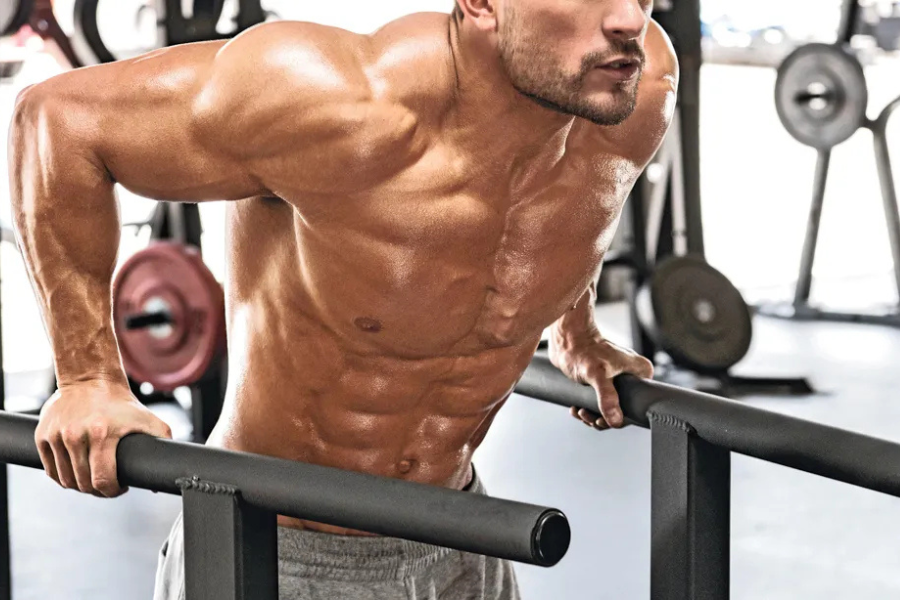
If you do not have dumbbells, you can still follow a beginner tricep workout using bodyweight moves like dips and pushups. Planet Fitness suggests pairing dips with pushdowns and extensions at the gym, but at home you can keep it simpler.
Tricep dips on a chair or bench
For many beginners, chair or bench dips are a good starting point to build arm and shoulder strength.
How to do it
- Sit on a stable chair or bench, hands gripping the edge beside your hips.
- Walk your feet forward and slide your hips off the front of the chair.
- Bend your elbows to lower your body, keeping your shoulders down and close to your ears.
- Push back up until your elbows are almost straight, but do not lock them out at the top.
Beginner friendly modifications
- Bend your knees instead of keeping your legs straight. This reduces stress on your shoulders and makes the move more manageable.
- Limit the range of motion at first. Lower only part of the way down and increase depth as your strength improves.
A safe beginner target is 3 sets of 10 reps, adding more reps or sets over time as you get stronger. If you feel shoulder or elbow pain, stop and consider swapping dips for close grip pushups or dumbbell kickbacks.
Close grip pushups or incline pushups
Close grip pushups target your triceps more than standard pushups.
If full floor pushups are too difficult, you can:
- Place your hands on a counter or sturdy table for an incline version.
- Bring your hands closer together under your chest to increase tricep engagement.
If bodyweight is still too challenging, a common suggestion is to substitute close grip pushups with seated bent over dumbbell kickbacks, which you already saw in the dumbbell section.
Aim for 2 to 3 sets of 8 to 12 reps, resting as needed.
Fit tricep training into your weekly routine
Your beginner tricep workout does not need to be complicated or long to be effective. What matters most is consistency and smart planning.
Here are two sample ways to fit triceps into your week.
Sample plan A: Dumbbell focused
-
Day 1: Upper body workout
-
Chest and shoulders first.
-
Finish with 2 sets of dumbbell tricep kickbacks.
-
Day 3 or 4: Tricep focus day
-
Close grip dumbbell bench press, 2 working sets.
-
Overhead single arm dumbbell extensions, 2 sets per arm.
-
Optional: 1 easy set of bodyweight dips if your joints feel good.
Sample plan B: Bodyweight and gym combo
If you have a gym membership, Planet Fitness suggests a simple beginner routine that is easy to slide into a half hour visit:
- 3 sets of 10 tricep dips
- 3 sets of 12 tricep pushdowns
- 3 sets of 10 dumbbell tricep extensions
You can do dips or pushups at home, then use cables and machines at the gym for extra variety and support.
Spot and fix common beginner mistakes
You will progress faster if you know what to avoid. As you work through your beginner tricep workout, pay attention to these common pitfalls.
Letting other muscles take over
If your chest and shoulders dominate every movement, your triceps will not get the full benefit.
Try to:
- Keep your elbows tucked closer to your sides on presses.
- Avoid leaning far forward in dips, which turns them into more of a chest exercise.
- Choose weights light enough that you do not have to swing or heave them.
Ignoring pain signals
Mild muscle burn is normal. Sharp or sudden joint pain is not.
If you experience:
- Pinching in your shoulders during overhead extensions or dips.
- Sharp elbow pain during skullcrushers or pushdowns.
Back off that move, try a lighter weight, or switch to a more joint friendly exercise like kickbacks or close grip pushups. Building confidence includes learning what your body can handle right now.
Pushing too hard too soon
More sets are not always better, especially early on. Since guides for beginners recommend around 6 to 9 sets of triceps per week, stay near that range at first.
Only add volume when:
- Your soreness is mild and short lived.
- Your form stays solid through all sets.
- You feel energized during workouts, not drained.
Keep your confidence growing
Your first goal with any beginner tricep workout is consistency. Every time you show up, use good form, and respect your recovery, you are building both strength and confidence.
To keep yourself on track:
- Pick 2 or 3 exercises you enjoy and stick with them for a few weeks.
- Note your weights and reps so you can see your progress on paper.
- Add a small challenge each week. That might be one extra rep per set or a slightly heavier dumbbell.
With a simple plan, realistic expectations, and steady effort, your triceps will get stronger and your arms will start to look noticeably more defined. More importantly, you will feel more confident every time you pick up a weight.
About the Author