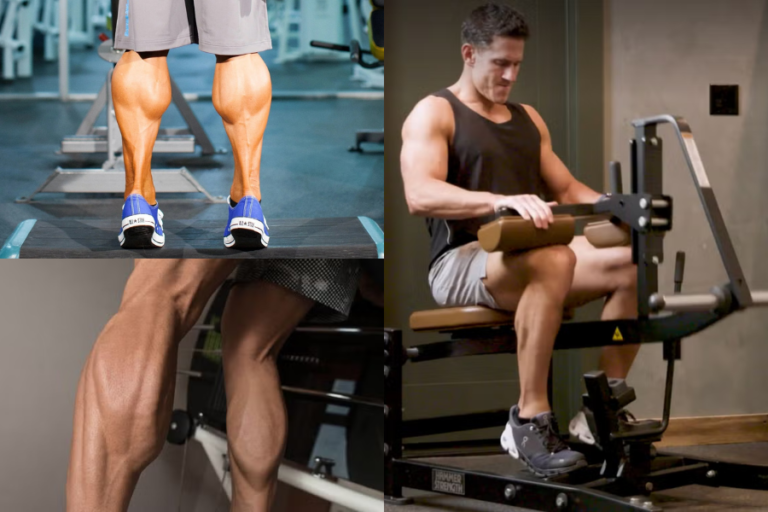
A strong hamstring hypertrophy workout does more than add size to the back of your legs. It supports heavier squats and deadlifts, protects your knees, and improves sprint speed and jumping power. If your leg days are mostly squats and leg presses, your hamstrings are probably lagging behind your quads.
Below, you will learn exactly how to train your hamstrings for fast, noticeable muscle growth using science-backed exercises, smart volume, and practical programming.
Understand how your hamstrings grow
Your hamstrings are not just one muscle. They are a group that includes the biceps femoris (long and short head), semitendinosus, and semimembranosus. Together they flex your knee and extend your hip, helping balance the work your quadriceps do and stabilizing your knees during running, jumping, and cutting movements.
Because they cross both the hip and knee joints, you need two main movement patterns in your hamstring hypertrophy workout:
- Hip hinge movements like Romanian deadlifts and good mornings
- Knee flexion movements like seated or lying leg curls and Nordic curls
Research-backed guides on hamstring training highlight that training both patterns is essential if you want complete development, not just a pump in one area of the muscle group.
Pick the best hamstring hypertrophy exercises
You do not need a long exercise list. You need the right ones, done well, and done consistently.
Hip hinge staples for size and strength
Hip hinge exercises train the hamstrings in a lengthened position, which is especially powerful for hypertrophy.
-
Conventional deadlifts
Conventional deadlifts heavily load your hamstrings through hip extension while also challenging your core, hips, and back. A 2024 guide on hamstring exercises notes that these are one of the most effective ways to build both strength and size in the posterior chain. -
Romanian deadlifts (RDLs)
Romanian deadlifts keep a soft bend in your knees and focus on pushing your hips back. This gives you a deep stretch and strong contraction in the hamstrings and targets the posterior chain more than conventional deadlifts. Many coaches consider RDLs a top-tier hamstring hypertrophy movement. -
Stiff-legged deadlifts and good mornings
These are variations of the hip hinge pattern that load the hamstrings in a long range of motion. The RP Strength hamstring guide classifies these as key tools for complete hamstring development because they train the hip extension function of the muscles.
Knee flexion moves you should not skip
If you only hinge and never curl, you miss one of the main jobs of the hamstrings: bending the knee.
-
Leg curls (seated and lying)
Leg curls are strongly recommended for hamstring hypertrophy and overall posterior chain strength. A 12 week study with 20 adults found that seated leg curls produced greater overall hamstring muscle growth than prone leg curls. Whole hamstring volume increased by about 14.1 percent with seated curls compared to 9.3 percent with prone curls, when both were done for 5 sets of 10 reps at 70 percent of 1RM twice per week.The same study showed that the commonly injured biceps femoris long head grew about 2.2 times more with seated curls than with prone curls, making seated curls especially valuable if you care about both size and injury prevention.
-
Nordic hamstring curls
Nordic curls isolate knee flexion and hit your hamstrings hard in the eccentric, or lowering phase. A 2024 article on hamstring training notes that Nordics can significantly increase muscle hypertrophy and can be done using a partner or equipment to anchor your feet. -
Glute ham raises and GHD extensions
When you use a Glute Ham Developer (GHD), you can train both hip extension and knee flexion in a single movement. Guides on advanced hamstring training highlight glute ham raises and hip extensions on a GHD as powerful options to maximize muscle engagement and growth when you focus on squeezing your hamstrings and glutes through the full motion.
If your hamstring routine has only one curl variation and lots of squats, you are undertraining a major muscle group that supports your entire lower body.
Use proven training volume and rep ranges
You do not have to guess how much work your hamstrings need. The RP Strength hamstring guide lays out useful volume landmarks for hypertrophy:
- Minimum Effective Volume (MEV), the smallest amount of work that starts growth
- Maximum Adaptive Volume (MAV), the sweet spot where most growth happens
- Maximum Recoverable Volume (MRV), the upper limit you can recover from
Typical hamstring programs start at MEV and gradually progress volume across a mesocycle of up to 12 weeks to keep growth coming without burning you out.
A simple weekly approach that fits most lifters:
- Train hamstrings 2 times per week, sometimes 3 if recovery allows
- Use 2 to 3 different exercises across the week
- Perform only one hamstring exercise per session so you can push it hard without wrecking your lower back or nervous system
- Change variations rarely, so you can progress weight and reps over time rather than constantly adjusting to new movements
For rep ranges:
- Hip hinge lifts like RDLs and conventional deadlifts work best in heavy sets of 5 to 10 reps. This range gives a strong growth stimulus while limiting spinal erector fatigue.
- Leg curls and isolation movements respond well to moderate to light ranges of 10 to 30 reps. This lets you push close to failure without your posture breaking down.
Focus on technique and range of motion
Good form is not just about safety. It also determines how much growth you get from each set.
For hip hinge exercises:
- Break at the hips, not the lower back. Think of pushing your hips back while keeping a soft knee bend.
- Lower the weight until you feel a deep stretch in your hamstrings, but stop before you lose spinal alignment.
- Keep the bar close to your body to reduce stress on your lower back.
For leg curls:
- Start from full knee extension so your hamstrings are long at the bottom of each rep.
- Bring the pad all the way toward your butt to finish in a strong contraction.
- Avoid fast, bouncing reps. Slower, controlled curls with full stretches and contractions are far more effective for hypertrophy.
Coaches also note that doing leg curls too quickly and with too short a range of motion is a common mistake that limits growth. Unilateral standing or kneeling leg curls are useful if you want to ensure a full range of motion and balanced strength between legs.
Build a sample hamstring hypertrophy workout
Here is a structured session you can plug into your week. Aim to run it for at least 8 to 12 weeks before changing key movements so you can actually progress.
Option 1: RDL plus leg curls
Day 1 (heavier focus):
- Romanian deadlift
- 3 to 4 sets of 6 to 8 reps
- Rest 2 to 3 minutes between sets
- Seated leg curl
- 3 to 4 sets of 10 to 15 reps
- Rest 90 seconds between sets
Day 2 (higher rep focus):
- Conventional deadlift or stiff-legged deadlift
- 3 sets of 5 to 6 reps at a challenging weight
- Leg curl variation (lying, standing, or single leg)
- 3 sets of 15 to 20 reps, close to failure
A common recommendation is around 12 total hard sets per week for many lifters, for example 4 sets each of Romanian deadlifts, lying leg curls, and seated leg curls. This is often enough to drive growth without pushing you past your recovery capacity.
Option 2: Eccentric focused hamstring plan
Eccentric training, where you control slow lowering against resistance, is especially powerful for building both strength and size.
- A 6 week study in 2024 combined Nordic hamstring exercises with single leg deadlifts and found significant increases in both concentric and eccentric hamstring strength in young female dance students compared with traditional stretching or no training.
- The same study showed greater improvements in hamstring flexibility in the eccentric training group, highlighting that you can gain both range of motion and strength at the same time.
You can apply this in your program like this:
Day 1:
- Single leg Romanian deadlift
- 3 sets of 8 to 10 reps per leg
- Lower for 3 to 4 seconds each rep
- Seated leg curl
- 3 sets of 12 to 15 reps
- Use a 3 second lowering phase
Day 2:
- Nordic hamstring curls
- 3 sets of as many controlled reps as you can
- Focus on resisting the descent as far as possible, then lightly push off the floor to return
- Glute ham raises or GHD hip extensions
- 3 sets of 8 to 12 reps
- Squeeze your hamstrings and glutes at the top each time
Eccentric focused training stimulates longitudinal muscle fiber growth and drives strong gains in strength and flexibility, making it a smart choice if your hamstrings feel both tight and weak.
Dial in intensity, progression, and recovery
Volume alone is not enough. Your hamstring hypertrophy workout needs intensity and progression.
-
Train close to failure
Your hard working sets should finish within one to two reps of failure most of the time. If you rack the weight and feel like you could have done five more reps, the set was too easy. -
Progress week to week
Add a small amount of weight, a rep or two, or an extra hard set across the weeks. One of the big mistakes in hamstring training is treating movements like RDLs as a stretch rather than a strength lift. You want to push for progressive strength increases over time so you do not plateau. -
Use advanced techniques sparingly
If you are more experienced, you can occasionally use forced reps, drop sets, or rest pause sets on curls to get past plateaus and increase intensity. Just keep these in check so your joints and connective tissues have time to recover. -
Respect recovery
Your hamstrings work during many other movements such as squats, lunges, and hip thrusts. Plan at least 48 hours between hard hamstring sessions and adjust volume if you notice persistent soreness or performance drop-offs.
Personalize your hamstring training
Recent research shows that not all parts of the hamstring muscle group grow the same way in everyone. A 2024 study on hypertrophy distribution found big differences in how individual hamstring heads responded to the same training, which means a generic plan can leave you with imbalances or less than optimal results.
Practical ways to personalize your hamstring hypertrophy workout:
- If the upper back of your thigh near the glutes is underdeveloped, prioritize hip hinges like RDLs and GHD hip extensions that train the hip extension function at long muscle lengths.
- If the area closer to the knee is lagging, include more seated leg curls and Nordic curls, which emphasize knee flexion and long muscle positions.
- Check your progress every 6 to 8 weeks and adjust exercise selection or volume toward the areas that are still behind.
Personal trainers are encouraged to reassess and adapt hamstring workouts over time because targeted growth is complex and highly individual.
Putting it all together
A power packed hamstring hypertrophy workout does not need to be complicated. Start by combining one big hip hinge and one curl movement, train them hard 2 times per week, and progress your loads and reps over a solid 8 to 12 week block.
You will not just see more muscle on the back of your legs. You will also feel stronger in your big lifts, more stable in your knees, and more confident in any sport or activity that demands power from your lower body.
About the Author