Why a strong back matters for women
A consistent back workout for women does more than shape your upper body. Strong back muscles support your spine, improve posture, and help you lift, carry, and move with less strain.
Experts note that strengthening the lats and traps helps you handle heavy loads, maintain better posture, and build muscular endurance, which is especially important if you sit a lot during the day, as Colleen Conlon, CPT, shared with Women’s Health in 2026. Targeting spine supporting muscles can also reduce pain linked to large breasts, repetitive lifting, prolonged sitting, or even protective hairstyles like braids, according to athletic trainer Vanessa Abrams in the same article.
You might notice that your back tires faster than other muscle groups. That is normal. Back muscles tend to fatigue more quickly, so a combination of higher repetitions, multiple sets, and smart exercise selection works especially well for women.
Understand your back muscles
Before you start a new back workout, it helps to know what you are actually training. Your back is a complex network, not a single muscle.
Key muscles you will train
-
Latissimus dorsi (lats)
The large muscles that sweep down the sides of your back. Strong lats help with pulling motions like rows and pull ups, and they give your back that tapered look. -
Trapezius (traps)
Runs from your neck across your shoulders and down the middle of your back. Traps support posture and help stabilize your shoulder blades when you lift or carry things. -
Rhomboids and rear delts
Smaller muscles between and behind your shoulder blades. These are key for keeping your shoulders from rounding forward. -
Erector spinae
Long muscles that line your spine. They help maintain a neutral position in your back during everyday movements and reduce strain on your lower back.
When you design a back workout for women, you want to hit all of these areas instead of only focusing on one “problem spot.” This balanced approach helps with strength, symmetry, and overall shape.
Benefits of a back workout for women
A strong, well trained back supports more than your workouts. It affects how you feel day to day.
Improve posture and reduce pain
If you sit for long hours at a desk, drive often, or tend to hunch over your phone, your upper back muscles can weaken and your chest can tighten. That combination leads to rounded shoulders and neck or upper back discomfort.
Regular back exercises help you:
- Pull your shoulders back into better alignment
- Support your head and neck so they are not doing all the work
- Reduce strain from large breasts or repeated lifting tasks
Research also links sedentary work with more frequent back pain. One 2019 study of call center employees found that most workers who sat for long periods reported chronic or acute back pain. Strength training gives key muscles the endurance to handle this kind of daily stress more comfortably.
Support your spine as you age
Women are more prone to back and spine related issues such as lower back pain and spinal osteoarthritis, especially after menopause. Strengthening the muscles around your spine helps:
- Stabilize each segment of the spine
- Improve spinal alignment and balance
- Lower the risk of injury from everyday tasks like bending, carrying groceries, or lifting children
A strong back is part of a strong core, along with your abs and glutes. This core unit helps keep your spine steady, supports better balance, and can reduce your risk of falls as you get older.
Boost your breathing and energy
Back exercises do more than shape muscles. When you build the muscles that support your rib cage, you also support better breathing mechanics. Proper breathing can help:
- Reduce day to day stress
- Improve your ability to focus
- Support emotional regulation
Better breathing and posture together can help you feel more energetic and grounded.
How to structure an effective back workout
You do not need fancy equipment or long sessions to see progress. A focused back workout for women can be as short as 15 minutes if you choose your exercises well.
General training guidelines
Keep these simple principles in mind:
-
Start with multi joint moves
Begin your workout with bigger exercises like deadlifts or bent over rows. These target large back muscles before your smaller arm muscles get tired. -
Use enough weight to feel challenged
Aim to reach muscular fatigue within 8 to 12 repetitions per set. If you can easily keep going past 12 reps, your weight is probably too light. -
Do multiple sets
For most exercises, 2 to 3 sets of 8 to 12 repetitions works well to build strength and tone. -
Progress gradually
Practice progressive overload by slowly increasing weight, reps, or sets over time instead of jumping straight to very heavy loads. -
Prioritize form over ego
Avoid lifting weights that feel so heavy that you lose control or feel pain. You want a neutral, straight back on every rep to protect your spine.
Warm up and cool down
Before you start pulling and rowing, give your body time to prepare.
Warm up ideas
Spend 5 to 10 minutes on:
- Light cardio, such as walking or cycling
- Dynamic moves like arm circles and shoulder rolls
- Simple mobility work like cat cow stretches or gentle thoracic rotations
Dynamic band pull aparts are also a helpful warm up for your upper back.
After your workout
Finish with:
- Light walking to gradually lower your heart rate
- Full body stretching, with extra focus on hips and hamstrings
Avoid long static stretches at the very beginning of your workout. Instead, save them for the end when your muscles are warm.
Beginner friendly back workout for women
If you are new to strength training, start with a simple routine that teaches you key movements and builds a solid base.
You can aim to do this routine 2 to 3 times per week, with at least one rest day in between sessions.
Sample beginner routine (gym based)
Perform 2 sets of 8 to 10 repetitions for each exercise. Rest 60 to 90 seconds between sets.
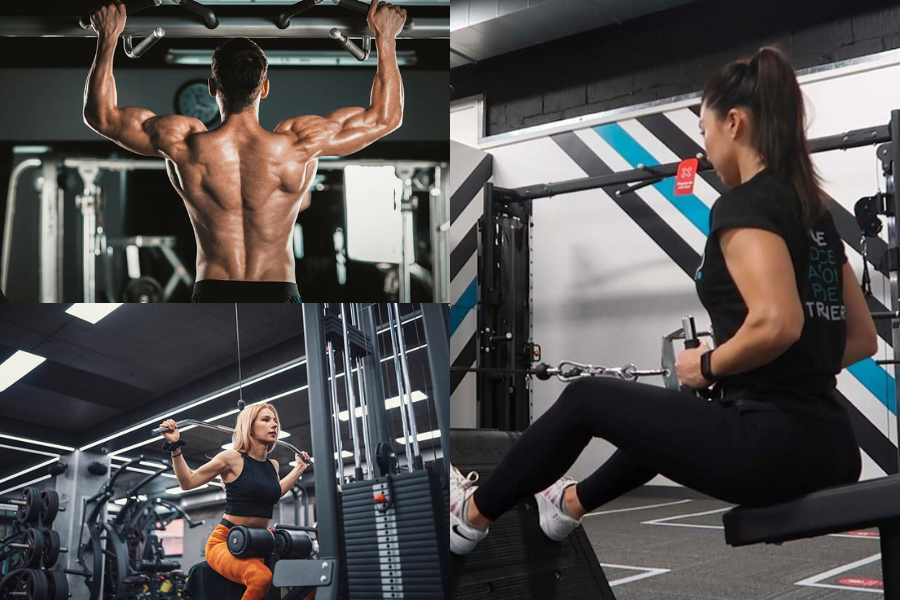
- Lat pulldown
- Sit tall and pull the bar down to your upper chest.
- Focus on driving your elbows down and in toward your ribs.
- Think of bringing your shoulder blades down and back instead of shrugging.
- One arm dumbbell row
- Support one hand and knee on a bench.
- Hold a dumbbell in your free hand, arm straight, palm toward your body.
- Pull the weight toward your hip, keeping your back flat and core engaged.
- Lower with control and repeat.
- Seated cable row
- Sit with a slight bend in your knees and hold the cable handle with both hands.
- Keeping your torso still, pull the handle toward your rib cage.
- Squeeze your shoulder blades together at the end of the movement.
- Plank
- Support your body on your forearms and toes.
- Keep your body in a straight line from head to heels.
- Hold for 20 to 30 seconds. Repeat 2 times.
This routine focuses on learning proper pulling mechanics and engaging your core, both of which set you up for more advanced exercises later.
Intermediate back workout for women
Once you feel comfortable with basic movements and can maintain form with slightly heavier weights, you can progress to a more challenging plan.
Aim for 2 to 3 sessions per week. Perform 3 sets of 10 to 12 repetitions for each exercise, resting 45 to 60 seconds between sets.
Sample intermediate routine
- Cable pullover
- Stand facing away from a high cable attachment with a straight or rope handle.
- With straight but not locked arms, pull the handle down and toward your thighs.
- Focus on using your lats, not your arms, to move the weight.
- High row machine
- Sit with your chest supported or upright, depending on the machine design.
- Pull the handles toward your upper chest or rib cage.
- Keep your shoulders relaxed and your neck neutral.
- Bent over row
- Stand with feet hip width apart, holding a barbell or dumbbells.
- Hinge at your hips until your torso is about 45 degrees forward, keeping your back straight.
- Pull the weight toward your lower ribs or upper waist.
- Lower the weight with control and repeat.
- Assisted pull ups
- Use an assisted pull up machine or a resistance band hung from the bar.
- Start with an overhand grip slightly wider than shoulder width.
- Pull your chest toward the bar, then lower slowly.
- Reverse fly
- Sit or stand, hinging at your hips with a flat back.
- Hold light dumbbells with your arms hanging down.
- Raise your arms out to the sides until they are in line with your shoulders.
- Focus on squeezing your shoulder blades together at the top.
- Landmine or dumbbell row variation
- For a landmine row, stand over one end of a barbell anchored in a landmine attachment.
- Hold the bar with both hands and pull it toward your chest or upper abdomen.
- For a dumbbell variation, you can perform single or double arm rows.
- Plank (longer holds)
- Hold for 30 to 45 seconds, keeping your spine neutral.
- Repeat 2 to 3 times.
This progression combines machine and free weight moves to challenge your back from multiple angles and build both strength and shape.
Quick 15 minute back workout for busy days
If you are short on time, you can still complete an effective back workout for women in about 15 minutes.
A routine highlighted by Women’s Health in 2026 suggests:
- Pick five exercises from a curated list
- Perform 8 to 10 repetitions of each
- Use free weights of 10 pounds or less if you are newer to lifting
- Move from one exercise to the next with minimal rest
- Repeat the full circuit as many times as you can in 15 minutes
Example 15 minute circuit
Choose five of the moves below and perform them in a circuit:
- Bent over rows
- Single arm bent over rows
- Reverse flies
- Superman holds
- Renegade rows
Try this structure:
- Exercise 1: 8 to 10 reps
- Exercise 2: 8 to 10 reps
- Exercise 3: 8 to 10 reps
- Exercise 4: 8 to 10 reps
- Exercise 5: 8 to 10 reps
Rest 30 to 60 seconds, then repeat.
This style of workout keeps your heart rate up, challenges your back muscles, and fits into a busy schedule.
Back workout for women at home
You can build a strong back without a gym membership. Dumbbells, kettlebells, or resistance bands are helpful, but you can also start with just your body weight.
Bodyweight only back exercises
These moves are especially useful if you are working out in a small space:
-
Superman hold
-
Lie face down on the floor with arms extended overhead.
-
Lift your arms, chest, and legs a few inches off the ground.
-
Hold for 3 to 5 seconds, then lower. Repeat for 8 to 12 reps.
-
Reverse snow angel
-
Lie face down with your arms at your sides, palms facing the floor.
-
Lift your chest slightly and sweep your arms out and up toward your head, as if making a snow angel.
-
Return your arms to your sides with control.
-
Plank
-
Support your body on your forearms and toes or elevate your hands on a sturdy surface for a modification.
-
Maintain a straight line from head to heels.
-
Band pull apart (if you have a band)
-
Hold a resistance band at shoulder height with both hands.
-
Keeping your arms straight, pull the band apart until your arms are in line with your shoulders.
-
Control the return and repeat.
Simple home routine with minimal equipment
If you have a pair of dumbbells or a kettlebell, try:
- Gorilla rows with kettlebell or dumbbells
- Renegade rows
- Dumbbell shrugs
- Superman holds
- Plank
Perform 2 to 3 sets of 10 to 12 repetitions for each exercise, resting briefly between sets.
Form tips to protect your back
Proper technique is key for a safe and effective back workout for women. Good form helps you get more from each rep and lowers your risk of injury.
Keep a neutral spine
Whether you are deadlifting, rowing, or planking, aim for a neutral, straight back:
- Avoid rounding your lower back or excessively arching it
- Brace your core gently, as if you are preparing for a light tap to the stomach
- Keep your chin slightly tucked so your neck follows the line of your spine
This alignment keeps pressure off the discs in your spine and lets your muscles do the work.
Choose the right weight
Going too heavy too soon can lead to:
- Compensating with your arms or shoulders rather than your back
- Jerky, uncontrolled movements
- Pain or strain in your lower back or neck
Instead, pick a weight that lets you:
- Maintain control through the entire range of motion
- Reach your last couple of reps with effort, but without losing good form
If an exercise causes sharp pain, especially in your spine, stop and check your setup. Consider lighter weights or an easier variation.
Stretch smart to prevent back pain
Overdoing certain core moves can backfire. Excessive crunches, for example, can tighten your hip flexors, which may pull your lumbar spine forward and increase lower back stress. The Spine and Wellness Centers of America noted this potential issue in 2026.
You can support a healthy back by:
- Including full body stretching, especially for your hips and hamstrings, after your workouts
- Foam rolling tight areas such as your upper back
- Using simple tools like a tennis ball to gently release tension around your traps or shoulder blades
If you have a history of back issues, consulting a professional like a chiropractor or physical therapist before starting a new program can help you choose the safest exercises for your situation.
Common challenges and realistic expectations
You may be doing everything right and still feel like your upper back is not changing as quickly as you hoped. There are a few reasons for that.
Fat storage patterns
Many women naturally store more body fat around the upper back and bra line area. Physical therapist and strength coach Josh Kernen has noted that this can make that area slower to visually change, even when you are training consistently and building muscle underneath.
You cannot “spot reduce” fat in one area, but you can:
- Increase your overall activity level
- Combine your back workouts with full body strength training
- Pair your training with consistent, balanced nutrition
Over time, this combination helps your muscles show through more clearly.
Muscle fatigue and pacing
Because back muscles fatigue quickly, you might feel like you burn out early compared to leg or glute workouts. That does not mean you are weak. It simply means you should:
- Use higher repetitions and multiple sets for some exercises
- Rotate between different movements so one area can rest while another works
- Take structured rest days to give your muscles time to recover and grow
Allowing for this pattern will help you progress without feeling constantly worn out.
Putting it all together
A thoughtful back workout for women supports strength, shape, and long term function. When you:
- Train all major back muscles, not just one spot
- Start with bigger multi joint moves, then add more focused exercises
- Use enough weight to reach fatigue in 8 to 12 reps
- Protect your spine with neutral alignment and smart weight choices
- Combine your back training with stretching and overall movement
you build a back that not only looks strong but also helps you move through daily life with more ease and less discomfort.
You can start simple. Choose two or three exercises from the beginner section and add them to your weekly routine. As you feel more confident, expand to the intermediate and quick circuit options. Over time, your posture, strength, and comfort are likely to improve, rep by rep.
About the Author