Understand what bodyweight back exercises are
Bodyweight back exercises use your own weight as resistance to strengthen your upper, middle, and lower back without heavy machines or a full gym setup. You move your body against gravity, which helps you build strength, improve posture, and support a healthier spine, according to NASM certified trainers Danny Saltos and Vanessa Liu as of June 22, 2022.
These exercises target:
- Large extrinsic muscles like your lats and traps
- Intrinsic stabilizers like the erector spinae along your spine
- Supporting muscles such as your core, glutes, and shoulders
Because you only need a bit of space and maybe a bar or band, you can do a complete back workout at home, in a hotel room, or at the park.
Why training your back matters
You often hear about pushups, bench presses, and shoulder presses. Without pulling work to balance those pushing exercises, your posture can suffer and your shoulders may round forward. Bodyweight back exercises help you:
- Balance out push-heavy routines
- Reduce low back pain by strengthening your spinal stabilizers
- Improve performance in sports and daily activities that involve lifting, twisting, or carrying
- Support a wider, stronger, and more defined upper body
When you keep your back strong with consistent training, you lay a foundation for almost every other movement you do.
Avoid common back training mistakes
Before you jump into specific exercises, it helps to know what to avoid. A few tweaks to your habits can dramatically improve your results and lower your risk of injury.
Skipping your warmup
Going straight into pullups or rows with cold muscles makes strains more likely and can limit your range of motion. Research recommends warming up for at least 5 minutes with light cardio and dynamic movement to prepare your joints and back muscles.
Try this quick warmup before bodyweight back exercises:
- 1 to 2 minutes of light jogging in place or marching
- 10 arm circles forward and backward
- 10 torso rotations per side
- 10 bodyweight good mornings (small hip hinge with a flat back)
You should feel warm and loose, not exhausted.
Ignoring your lower back
If you only train what you see in the mirror, your lower back gets left behind. Neglecting it can lead to:
- Muscular imbalances between your upper and lower back
- Higher risk of lower back strains or minor dislocations
- Weaker posture and limited strength in lifting movements
Include lower back focused moves like the Superman and bird dog so your entire back chain gets attention, not just your lats.
Overusing the same muscles
Doing the same pullup or row variation every session can create overuse issues. Repetitive stress without variety can lead to:
- Localized muscle strain
- Nagging aches around your shoulders or mid back
- Plateaus in strength and muscle growth
You do not need a completely new workout every day, but you should rotate exercises that hit your upper, mid, and lower back from slightly different angles.
Ego lifting and poor form
Ego lifting is not only about heavy barbells. With bodyweight back exercises it can show up as:
- Trying advanced variations before you are ready
- Rushing reps and using momentum
- Cutting the range of motion short
This reduces muscle activation and raises injury risk. Start with versions you can control and build up gradually. If you feel pain, stop the movement and reassess your form or regress the exercise.
Forgetting about a neutral spine
For most bodyweight back exercises you want to keep a neutral spine. That means:
- Your head is in line with your torso
- Your ribs are stacked over your hips
- You avoid excessive rounding or arching
Maintaining a neutral spine helps you avoid back muscle strain and protects your spine during pullups, rows, hip hinges, and floor based movements.
Warm up properly before you train
A simple warmup can make your bodyweight back workout feel smoother and safer. Aim for at least 5 minutes before you start harder sets.
Step 1: Raise your body temperature
Pick any light movement that gets your heart rate up:
- March or jog in place
- Do jumping jacks at an easy pace
- Walk briskly around your space
Go for 2 to 3 minutes until you feel lightly warm.
Step 2: Mobilize your shoulders and spine
Then move through these dynamic drills:
- 10 arm swings across your chest and overhead
- 10 cat cow movements on all fours
- 10 gentle torso rotations side to side
- 10 shoulder rolls forward and backward
This combination helps your joints glide more easily through pull and row patterns.
Step 3: Activate your core and glutes
Light activation makes it easier to brace during the workout:
- 10 glute bridges
- 20 seconds of a basic plank
- 10 bodyweight hip hinges
Now your body is better prepared for back focused training.
Target your upper back and lats
Your upper back and lats give you that wide, V shaped look and help you pull yourself toward objects, or pull objects toward you. These bodyweight back exercises focus on that area with minimal gear.
Pullups and wide grip pullups
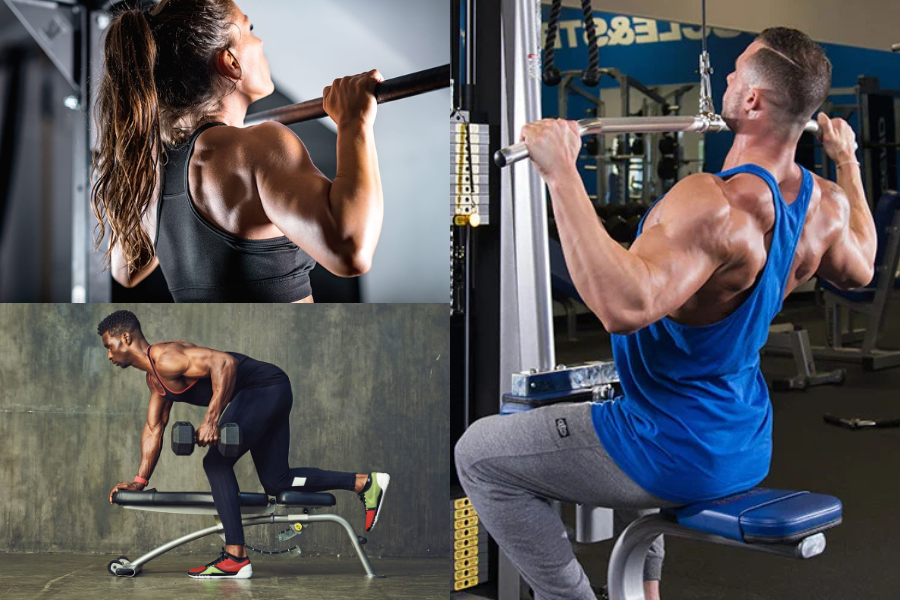
Pullups are a classic bodyweight back exercise for building a stronger, wider back. They primarily target your lats, lower trapezius, and core.
How to do a standard pullup:
- Grab a bar with your hands slightly wider than shoulder width, palms facing away.
- Start from a dead hang with your arms straight and your core tight.
- Pull your chest toward the bar by driving your elbows down and back.
- Pause briefly at the top, then lower yourself with control to a full hang.
Recommended sets and reps:
- 3 to 4 sets of 6 to 10 reps, according to recent guidance.
If you are not there yet, you can use a resistance band for assistance or perform inverted rows instead.
Wide grip variation:
- Take a slightly wider grip than a standard pullup.
- Keep your elbows pointing out to the sides as you pull.
A wider grip emphasizes the outer portion of your lats, which can contribute to a broader back, according to a 2020 HouseFit guide.
Inverted rows
Inverted rows are an excellent alternative if pullups are too challenging right now or if you want additional volume without overtaxing your joints.
How to do them:
- Set a sturdy bar at about waist height.
- Lie underneath and grab the bar with an overhand grip, hands slightly wider than shoulders.
- Keep your body in a straight line from head to heels with your heels on the floor.
- Pull your chest toward the bar, squeezing your shoulder blades together.
- Lower yourself slowly back to the starting position.
Suggested prescription:
- 3 sets of 8 to 10 reps.
To make it easier, bend your knees and plant your feet closer to your body. To make it harder, elevate your feet on a bench or chair.
TRX or suspension trainer rows
If you have suspension straps, you can use them to build your back with controlled pulling movements that limit momentum.
How to do a TRX row:
- Hold the handles with a neutral grip so your palms face each other.
- Walk your feet forward so your body leans back and forms a straight line.
- Brace your core and keep your hips in line with your shoulders.
- Pull your chest toward the handles, squeezing between your shoulder blades.
- Lower back with control without letting your shoulders roll forward.
Typical recommendation:
- 3 sets of 8 to 10 reps focused on slow, deliberate pulls.
Adjust the difficulty by changing your angle. The more horizontal your body, the harder each rep becomes.
Strengthen your mid back and postural muscles
Your mid back helps keep your shoulders down and back, supports your neck, and maintains upright posture. The following bodyweight back exercises focus on the muscles between your shoulder blades and along your spine.
Superman and Superman variations
The Superman exercise and its variations are simple yet powerful for training your mid and lower back with no equipment, as highlighted by HouseFit in 2020.
Basic Superman:
- Lie face down on the floor with your arms extended in front of you and legs straight.
- Engage your core and glutes gently.
- Lift your arms, chest, and legs off the floor a few inches while keeping your neck in line with your spine.
- Hold for 1 to 2 seconds, then lower back down with control.
Recommended volume:
- 3 sets of 12 to 15 reps.
Variations that change your arm position include:
- Y Superman, arms overhead in a Y shape to engage your upper lats and lower traps.
- T Superman, arms out to the side to focus more on the mid traps and rear delts.
- W Superman, elbows bent near your sides to emphasize scapular retraction.
- Pullup Superman, starting with arms overhead and then pulling your elbows down as if doing a pullup.
Rotating these versions lets you target different parts of your upper and mid back without any gear.
Reverse snow angels
Reverse snow angels teach you to move your shoulder blades smoothly while keeping your core stable.
How to do them:
- Lie face down with your arms at your sides, palms facing down.
- Gently lift your chest and arms a few inches off the floor.
- Slowly sweep your arms out to the sides and overhead, like making a snow angel in reverse.
- Keep your thumbs pointing up and your shoulders away from your ears.
- Reverse the motion to return to the starting position.
Aim for:
- 2 to 3 sets of 8 to 12 slow, controlled reps.
Keep the focus on smooth movement rather than height.
Plank rows
Plank rows combine core stability with mid back work. They are listed in the 2020 HouseFit guide as a useful bodyweight back exercise.
How to do them:
- Start in a high plank position with your hands under your shoulders and feet hip width apart.
- Brace your core and keep your hips level.
- Shift your weight slightly to one side and lift the opposite hand off the floor.
- Bend your elbow and pull your hand up toward your ribcage, as if rowing.
- Lower your hand back to the floor and repeat on the other side.
Work toward:
- 2 to 3 sets of 8 to 10 reps per side.
If your hips are rocking, widen your stance or drop to your knees to keep your spine stable.
Build a stronger lower back and core
A strong lower back supports everyday activities like lifting groceries, picking things up from the floor, and standing for long periods. It also helps you maintain safe positions when you do heavier strength work.
Superman for lower back focus
The Superman exercise is considered one of the easiest and most effective bodyweight movements for strengthening the lower back, according to HouseFit (2020).
To emphasize your lower back and glutes:
- Focus on squeezing your glutes as you lift your legs.
- Keep the lift small and controlled.
- Avoid yanking your chest high off the floor.
Stick with the standard prescription of:
- 3 sets of 12 to 15 reps.
Stop if you feel sharp pain and check your form. You should feel a gentle, controlled effort, not a pinch.
Bird dog
The bird dog is a staple for safe, functional lower back strengthening and is featured in the 2020 HouseFit list.
How to do it:
- Start on all fours with your hands under your shoulders and knees under your hips.
- Brace your core as if preparing for a gentle punch to the stomach.
- Extend your right arm forward and your left leg back until they are parallel to the floor.
- Keep your hips level and your lower back neutral.
- Hold for 1 to 2 seconds, then return to the start and switch sides.
Try:
- 2 to 3 sets of 8 to 12 reps per side.
If you struggle with balance, start by extending just your leg or just your arm and build up.
Hip hinge patterns
Even without weights, practicing a hip hinge teaches you to move from your hips instead of your lower back.
Hip hinge drill:
- Stand with your feet about hip width apart.
- Place your hands on your hips or across your chest.
- Soften your knees slightly.
- Push your hips back while you keep your spine neutral and your chest gently lifted.
- Stop when you feel a stretch in your hamstrings, then drive your hips forward to stand.
You can do 2 to 3 sets of 10 to 15 reps as part of your warmup or as a technique drill during your workout.
Add full body back moves
Some bodyweight back exercises recruit multiple muscle groups at once. These help you build coordination, athleticism, and strength that carries over into daily life.
Bear crawl
The bear crawl strengthens your upper and lower trapezius, lower back extensors, and core. It also challenges your shoulders and hips.
How to do it:
- Start on all fours, then lift your knees an inch or two off the ground.
- Keep your back flat and your hips low.
- Move your opposite hand and foot forward together.
- Take small, controlled steps, maintaining a tight core.
Guideline from recent recommendations:
- 3 sets of about 10 controlled steps per side.
You can crawl forward, backward, or sideways to vary the challenge.
Body drag
The body drag mimics a lat pulldown using only your bodyweight, as described in HouseFit’s 2020 workout suggestions.
How to do it:
- Find a smooth surface like a hardwood floor or use a towel under your feet.
- Start in a pushup position with your body straight.
- Keep your hands planted and slowly drag your body forward by pulling with your arms and back.
- Use your core to prevent your hips from sagging.
Aim for:
- 2 to 3 sets of 6 to 8 slow pulls.
Move slowly to keep tension on your lats and mid back rather than relying on momentum.
Suspension trainer row (pullup’s cousin)
The suspension trainer row, sometimes called the pullup’s cousin, works the lats, rhomboids, traps, biceps, core, shoulders, and mid back through a coordinated pulling movement.
Key technique points:
- Use a neutral grip with palms facing each other.
- Maintain a strong plank position throughout.
- Focus on pulling your chest toward your hands rather than curling your wrists.
A common prescription is:
- 3 sets of 12 reps with a controlled tempo.
Adjust your foot position to change the intensity, similar to the TRX row.
Use a simple bodyweight back workout template
You can turn these exercises into a short, effective routine that fits into a busy day. Here is a sample structure you can do two or three times per week.
Beginner friendly routine
If you are newer to strength training, start with easier variations and focus on clean movement.
- Warmup
- 5 minutes of light cardio plus dynamic mobility.
- Main exercises
- Inverted rows, 3 sets of 8 reps
- Bird dogs, 2 sets of 8 reps per side
- Superman, 2 sets of 10 reps
- Bear crawl, 2 sets of 6 steps per side
- Cooldown
- Gentle chest stretch, 20 to 30 seconds
- Child’s pose, 20 to 30 seconds
- Light neck and upper back stretches
Rest about 60 to 90 seconds between sets. As the movements feel easier, add 1 or 2 reps per set or one extra set.
Intermediate routine
If you already have a base of strength, you can build on the basics.
- Warmup
- 5 to 7 minutes, including hip hinges and light planks.
- Main exercises
- Pullups or band assisted pullups, 3 to 4 sets of 6 to 8 reps
- TRX or suspension trainer rows, 3 sets of 8 to 10 reps
- Superman variations (rotate between Y, T, W), 3 sets of 12 to 15 reps
- Plank rows, 3 sets of 8 to 10 reps per side
- Cooldown
- Thoracic spine rotations on all fours
- Doorway chest stretch
- Gentle seated forward fold for the lower back and hamstrings
Adjust rest to 60 seconds for a conditioning focus, or up to 90 seconds if you want to prioritize strength.
Train safely and progress over time
Getting stronger with bodyweight back exercises is about consistency and smart progression, not doing the hardest variation on day one.
Safety guidelines to follow
Keep these points in mind each session:
- Warm up for at least 5 minutes before training.
- Maintain a neutral spine during rows, hinges, and floor exercises.
- Stop any exercise that causes sharp or unusual pain.
- If you are unsure about your form, consider consulting a physical therapist or certified trainer before you progress your routine.
If something feels off, reduce the range of motion, slow your tempo, or move to an easier variation.
How to make steady progress
To keep improving:
- Increase reps gradually, for example by 1 or 2 per week for each exercise.
- Add another set once you hit the top end of your target rep range comfortably.
- Move to a slightly harder variation, such as elevating your feet for inverted rows or narrowing your base for plank rows.
Note that overtraining the same upper back muscles without variation can increase your risk of overuse injuries and stall your progress. Rotating between pullups, rows, floor based moves, and lower back exercises helps you build a more balanced and resilient back.
Key takeaways
- Bodyweight back exercises let you train your entire back anywhere, often with little or no equipment.
- A balanced routine should include upper, mid, and lower back moves plus core work.
- Neglecting your lower back or repeating the same pulling exercise without variation can create imbalances and raise injury risk.
- Safe form, a proper warmup, and controlled progression are more important than chasing the hardest variation.
You can start with just two or three of these exercises today. Pick one pulling move, one mid back exercise, and one lower back movement, and build from there as your strength and confidence grow.
About the Author