Why cable bicep exercises work so well
If you want arms that really pop, cable bicep exercises are one of the most efficient ways to get there. Cables keep constant tension on your biceps through the entire range of motion, which is a key driver of muscle growth and definition.
Unlike dumbbells, where the bottom of the curl can feel almost weightless, cable curls load your biceps at their most lengthened position. Fitness director Ebenezer Samuel, C.S.C.S., explains that this continuous tension fills in a critical gap left by traditional free weight curls, especially at the bottom of the movement where your biceps are usually least challenged.
A 2014 study by the American Council on Exercise also ranked the cable curl as one of the top exercises for activating the biceps brachii, tying with chin ups and coming in just behind the concentration curl for muscle activation. In other words, you are getting a lot of results for the time you put in.
Muscles you are actually training
Most cable bicep exercises work more than just your mirror muscles. The main muscles involved include:
- Biceps brachii, the main bicep muscle that gives your arm its peak
- Brachialis, a deeper elbow flexor that adds thickness to your upper arm
- Brachioradialis, a forearm muscle that helps your arms look fuller when relaxed
- Stabilizers in your shoulders, upper back, and core that keep you steady on the machine
This combination is why cable work can build both size and control, not just a pump.
How to use cable bicep exercises in your routine
Before you dive into specific moves, it helps to know how cable curls fit into a smart training plan.
Choose reps and sets for your goal
Research in Sports (Basel) suggests tailoring your reps, sets, and load to what you want most, whether that is strength, size, or endurance:
| Goal | Reps per set | Weight | Sets per exercise |
|---|---|---|---|
| Strength | 1 to 5 | Heavy | 3 to 5 |
| Hypertrophy | 8 to 12 | Moderate | 3 to 5 |
| Endurance | 15+ | Light | 2 to 4 |
For most people who want bigger, more defined arms, 3 to 4 sets of 8 to 12 reps works very well.
Several coaches also recommend placing cable bicep exercises toward the end of your workout, using slightly lighter weights and higher reps, to “finish” your biceps once your main compound and free weight lifts are done.
Technique rules that protect your joints
To get the most from every cable curl, focus on these fundamentals:
- Keep elbows pinned close to your sides or fixed on a pad
- Move only at the elbow, not at the shoulder
- Do not let your shoulders shrug up or roll forward
- Control both the lifting (up) and lowering (down) phases
- Stop each set when your form starts to break down
Keeping your form clean is more important than adding plates. Several sources point out that you should never sacrifice technique just to move heavier weight, especially on isolation moves like curls.
Best cable bicep exercises for size and definition
Below you will find a mix of beginner friendly and more advanced cable bicep exercises. Start with one or two, then add variations once you are comfortable with the basics.
Basic cable biceps curl
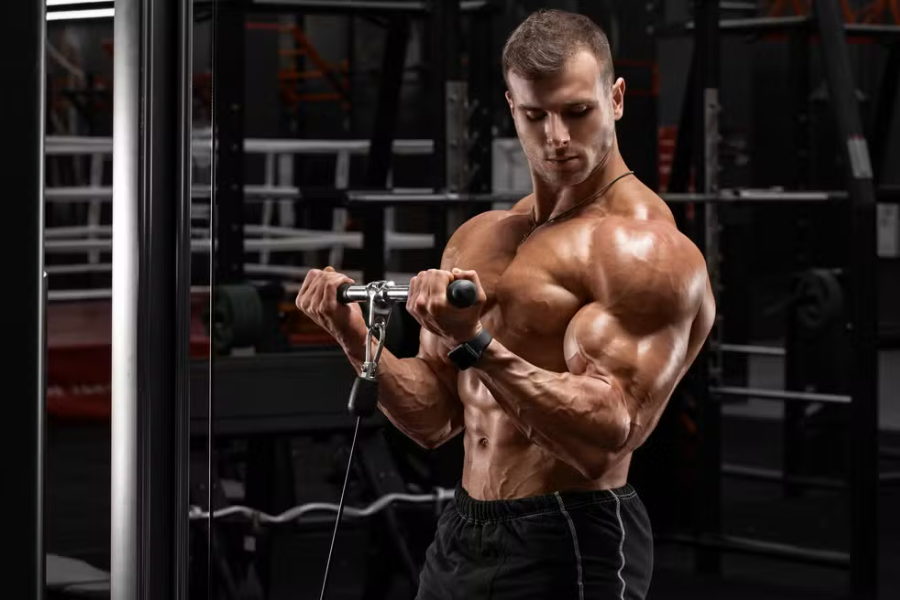
If you only pick one cable move, this is the one. The standard cable biceps curl gives your biceps constant tension through both the lifting and lowering phases and is one of the most effective isolation exercises for arm growth.
How to do it
- Set the pulley at the lowest position and attach a straight bar or EZ style bar.
- Stand facing the machine with feet about hip width apart.
- Grab the bar with an underhand grip, palms facing up, arms almost straight.
- Brace your core and keep your chest tall.
- Curl the bar toward your shoulders by bending at the elbows only.
- Squeeze your biceps hard at the top, without letting your shoulders roll forward.
- Slowly lower the bar until your arms are nearly straight again, keeping tension on the muscle.
Why it works
- Keeps your biceps under continuous stress which supports hypertrophy
- Requires less stabilization than dumbbells so you can focus on feeling the muscle work
- Easy to adjust load in small increments, perfect for beginners
Single arm cable bicep curl
Training one arm at a time can fix strength imbalances and sharpen your mind muscle connection. The standing single arm variation also challenges your core to keep you from rotating.
How to do it
- Set the pulley at the lowest position and attach a single D handle.
- Stand facing the stack with the handle in one hand, palm facing up.
- Step back slightly so there is tension on the cable with your arm almost straight.
- Keep your elbow close to your side and your torso still.
- Curl the handle toward your shoulder, squeezing your biceps at the top.
- Lower under control until your arm is nearly straight.
- Complete all reps, then switch arms.
Why it works
- Trains each arm independently to correct imbalances
- Engages your core to stop your torso from twisting
- Lets you focus on one side at a time for better control and technique
Cable rope hammer curl
If you want thicker arms and stronger forearms, rope hammer curls belong in your plan. The neutral grip, palms facing each other, hits both your biceps and brachioradialis.
How to do it
- Attach a rope handle to the low pulley.
- Stand facing the machine, holding the rope with a neutral grip so your palms face each other.
- Start with your arms almost straight and your elbows close to your sides.
- Curl the rope up, keeping palms facing inward the whole time.
- At the top, pull the ends of the rope slightly apart to intensify the squeeze.
- Lower slowly, keeping tension on your biceps and forearms.
Why it works
- Trains your biceps and forearms together, building overall arm size and grip strength
- Neutral grip is often more comfortable for wrists than straight bar curls
- Adds variety so your arms are challenged from a different angle
Cable preacher curl
The cable preacher curl combines the stability of a preacher bench with the constant tension of cables. By bracing your upper arms against the pad, you remove momentum and force your biceps to do all the work.
How to do it
- Position a preacher curl bench in front of a low pulley and attach a straight bar or EZ style bar.
- Sit on the bench and place the backs of your upper arms firmly against the pad.
- Grab the bar with an underhand grip, arms extended but not locked.
- Curl the bar toward your shoulders, keeping your upper arms glued to the pad.
- Pause briefly at the top to feel the squeeze in your biceps.
- Lower slowly until your arms are almost straight, keeping tension at the bottom.
Why it works
- Stabilizes your arms, which is helpful if you are a beginner
- Provides continuous cable tension even in the stretched position
- Great for focusing on strict, controlled reps instead of swinging the weight
High cable bicep curl (overhead curl)
High cable bicep curls, sometimes called overhead or crucifix curls, train your biceps in a fully shortened position. Many lifters feel an intense peak contraction and pump from this variation.
How to do it
- Set two pulleys at about head height and attach D handles to each.
- Stand in the middle, grab a handle in each hand with palms facing up or slightly forward.
- Step out so your arms are out to your sides in a “T” shape with your elbows slightly bent.
- Curl the handles toward the sides of your head by bending your elbows.
- Squeeze your biceps hard at the peak of the movement.
- Slowly extend your arms back out to the starting position without letting the weights slam.
Why it works
- Trains the biceps in a fully shortened posture, which can enhance peak development
- Targets the inner head of the biceps brachii along with the brachialis and brachioradialis
- Creates a strong pump and is excellent as a finishing move in your arm workout
Reverse grip cable curl
Reverse grip curls shift more work onto the brachioradialis and the upper forearm, which helps your arms look thicker from every angle.
How to do it
- Attach a straight bar to the low pulley.
- Stand facing the machine and grab the bar with an overhand grip, palms facing down.
- Keep your elbows close to your sides and your wrists in a neutral position.
- Curl the bar up toward your shoulders by bending at the elbows.
- Pause briefly at the top, then lower under control.
Why it works
- Emphasizes brachioradialis, an often neglected muscle in standard curls
- Adds thickness to your forearms and upper arms when your arms are relaxed by your sides
- Balances your arm development so you are not only training the front of your biceps
Sample cable bicep workout you can follow
You can plug cable bicep exercises into many different programs, but here is a simple example focused on size and definition that you can run 1 to 2 times per week:
Cable focused arm finisher
Perform after your main compound lifts like rows, pullups, and presses.
- Cable biceps curl
- 3 sets of 8 to 12 reps
- Cable rope hammer curl
- 3 sets of 10 to 12 reps
- High cable bicep curl
- 2 to 3 sets of 12 to 15 reps
Rest 60 to 90 seconds between sets. Choose a weight that makes the last 2 reps challenging while still allowing perfect form. Once you can do the top of the rep range with clean technique, increase the weight slightly.
If you want more unilateral work, you can swap one exercise for single arm cable curls.
Form, comfort, and staying injury free
Cable bicep exercises should feel challenging, not painful. Some people notice that certain variations, like standing cable curls, feel awkward or even uncomfortable in their joints, while other cable moves such as seated rows feel completely fine. That is a clue to adjust your grip, load, or exercise selection.
Here are practical ways to keep things safe and productive:
- Start lighter than you think, especially if you are new to cables
- Prioritize clean reps over heavy stacks
- Keep your wrists neutral and avoid sudden jerking
- Use a grip or attachment that feels natural for your elbows and shoulders
- Stop if you feel sharp pain and try a different angle or variation
If a specific curl consistently feels wrong despite good form and reasonable weight, you can replace it with another cable bicep exercise that works the same muscles from a slightly different position.
Combining cables with free weights
Cable bicep exercises do not have to replace your dumbbell or barbell curls. In fact, the combination is often ideal.
- Cable curls give you continuous tension, especially at the bottom of the movement
- Free weight curls often load the middle and top of the range more heavily
- Together, they allow you to challenge your biceps through their full range of motion
One effective approach is:
- Start your workout with heavier free weight curls, such as barbell or dumbbell curls
- Finish with lighter, higher rep cable curls for a focused pump and extra volume
This mix helps you build strength, size, and control, rather than only chasing one piece of the puzzle.
Putting it all together
If your goal is to make your arms pop, cable bicep exercises deserve a permanent spot in your routine. Cables provide:
- Constant tension for better hypertrophy
- Adjustable angles to hit your biceps from multiple positions
- Beginner friendly control and stability
Choose two or three of the exercises above, stick to solid technique, and progress your weights gradually. With consistent work and smart programming, you will feel your biceps working harder and see more shape and definition every time you flex.
About the Author