Why cable tricep exercises belong in your routine
If you want stronger, more defined arms, cable tricep exercises deserve a permanent spot in your workouts. Cables keep constant tension on your triceps, let you adjust the line of resistance easily, and make it simple to train all three heads of the triceps without needing a pile of different weights.
According to guides from Verywell Fit, cable tricep pushdowns and extensions are among the most effective moves for building tricep strength and size because they can target the long, lateral, and medial heads in a controlled way. Research summarized by Barbell Medicine also highlights cable isolation work as a smart choice since cables allow a long range of motion and precise loading that can rival or beat many free‑weight options for isolation work.
Below, you will learn the best cable tricep exercises, how to do them correctly, and how to put them together into an effective tricep workout.
Understand your triceps and cables
Before you start pulling on any handles, it helps to know what you are trying to train and why cables are so useful.
The three heads of the triceps
Your triceps brachii has three parts:
- Long head: Runs along the back of your upper arm and crosses the shoulder. It adds fullness and helps with shoulder stability.
- Lateral head: The outer part that gives your arm that “horseshoe” look when flexed.
- Medial head: Sits deeper and supports strength through the whole range of motion.
Different movements emphasize different heads:
- Pushdowns mainly target the lateral and medial heads, helping build shape and definition along the outer arm.
- Overhead and lying extensions hit the long head more, which adds thickness and overall size.
A complete cable tricep routine touches all three.
Why cable tricep exercises work so well
Cables offer a few advantages over dumbbells and barbells for triceps:
- Constant tension: The weight pulls on the cable through the entire range of motion, so your triceps work at the bottom, middle, and top of each rep.
- Flexible line of force: You can change pulley height and body position to hit the muscle from angles that free weights cannot, since free weights only load vertically. Barbell Medicine notes that cables let you adjust resistance in almost any direction, which helps you load the triceps effectively through ranges that are not possible with gravity-based resistance alone.
- Less momentum: Pulley friction reduces swinging and makes it harder to “cheat” with body English. You can move quickly but still keep tension on the muscle.
- Easy bilateral or unilateral work: You can train both arms together or one at a time without awkward setups, which can help correct imbalances and match the exercise to your body structure.
Verywell Fit also points out that stronger triceps can help prevent overuse injuries in activities like throwing and swimming by better supporting your elbows and shoulders.
Master the staple: cable tricep pushdown
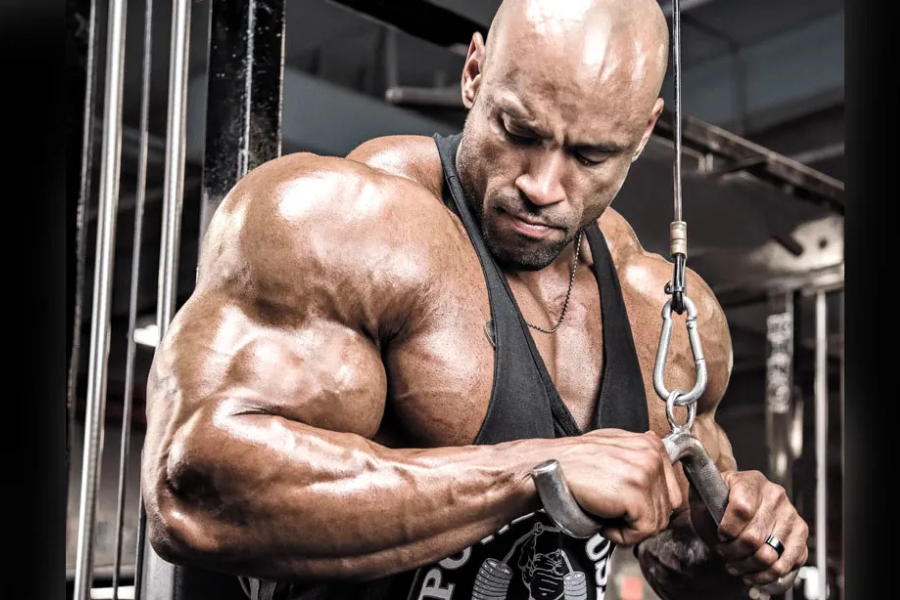
If you only did one cable move, the tricep pushdown would be a strong candidate. It is simple to learn and excellent for building mass in the lateral and medial heads.
How to set up and perform a cable pushdown
- Set the pulley
- Attach a straight bar, V‑bar, or rope to a high pulley.
- Choose a light to moderate weight so you can control every rep.
- Find your stance
- Stand facing the machine.
- Take a small step back, feet about hip width apart.
- Soften your knees and hinge forward slightly at the hips.
- Lock in your upper body
- Grip the attachment shoulder width.
- Pull your elbows down so they are beside your torso, just in front of your ribs.
- Keep your chest up and your shoulders relaxed.
- Perform the pushdown
- Start with your elbows bent around 90 degrees.
- Push the bar or rope down by straightening your elbows, not by swinging your shoulders.
- At the bottom, fully extend your elbows and squeeze your triceps.
- Slowly let the attachment rise until your elbows are bent again, but do not let your upper arms drift forward.
- Breathe
- Exhale as you push down.
- Inhale as you control the weight back up.
Attachment choices and what they change
Verywell Fit notes that no handle type is clearly superior for muscle activation, so your choice mostly comes down to comfort and loading preferences.
-
Rope attachment
-
Allows a greater range of motion.
-
Lets each arm work independently to help correct imbalances.
-
Good if you want a strong contraction at the bottom, since you can separate the ends slightly.
-
V‑bar attachment
-
Keeps your hands in a neutral grip and close together.
-
Often lets you press more weight compared with a rope because your hands are fixed and you can push straight down.
-
Solid choice if you want to overload the movement while keeping good form.
-
Straight bar attachment
-
Simple and familiar to most lifters.
-
Can feel better on the wrists for some people, or worse for others.
-
You can occasionally flip to an underhand grip just to change the feel, not because it targets a different tricep head.
One common myth is that you must twist your wrists out at the bottom of a rope pushdown to get more tricep activation. Research summarized in the training literature indicates that what really matters is full elbow extension. The twist mainly helps some people achieve that extension if their wrists or elbows are tight.
Common mistakes and how to fix them
Verywell Fit highlights a few frequent errors during pushdowns, along with ways to correct them:
-
Flaring your elbows out
-
Problem: Shifts work to your shoulders and chest and can stress your joints.
-
Fix: Keep elbows close to your sides. Imagine they are lightly pinned to your ribs.
-
Swinging your body or using momentum
-
Problem: Reduces tricep involvement and increases injury risk.
-
Fix: Lower the weight. Maintain a small forward lean and stable torso. Move only your forearms.
-
Uneven pushing between arms
-
Problem: One arm does more work, which can build imbalances.
-
Fix: Focus on pressing both sides evenly. Rope pushdowns help here since each hand has to contribute.
-
Shortening the range of motion
-
Problem: Stopping early at the top or bottom limits muscle stimulus.
-
Fix: Let your elbows bend enough at the top to feel a light stretch, then fully straighten them at the bottom without locking harshly.
Target the long head: overhead cable tricep extensions
Overhead cable tricep extensions are one of the best cable tricep exercises for training the long head at longer muscle lengths. Barbell Medicine notes that working muscles in these stretched positions can be particularly effective for hypertrophy.
How to do an overhead cable extension (two arms)
- Set the pulley and attachment
- Use a low pulley on a cable machine.
- Attach a rope.
- Get into position
- Stand facing away from the machine.
- Grab the rope and step forward so there is tension on the cable.
- Bring the rope overhead so your elbows are close to your ears, arms bent.
- Perform the extension
- Keep your upper arms mostly fixed and slightly angled forward.
- Straighten your elbows to drive the rope up and forward.
- Pause briefly when your arms are fully extended and your triceps are tight.
- Control the rope back down until you feel a stretch in the back of your upper arms.
- Form cues
- Keep your ribs down and core engaged so you do not overarch your lower back.
- Avoid letting your elbows flare too wide.
One‑arm overhead cable extension
Training one arm at a time lets you focus on each side and can improve shoulder stability.
- Set up with a single D‑handle on a low pulley.
- Step forward and raise your working arm overhead, elbow bent.
- Extend your elbow while keeping your upper arm relatively still.
- Switch sides after you finish your set.
Add variety: lying cable tricep extensions
Lying cable tricep extensions combine shoulder and elbow movement, which increases the stretch on the long head. They are effective after heavier compound pushing like bench press and dips, as highlighted in practical training guides.
How to do lying cable extensions
- Set up the cable
- Position a bench in front of a low pulley.
- Attach an E‑Z bar or straight bar.
- Lie on the bench with your head toward the machine and the cable running above you.
- Start position
- Grab the bar with a shoulder‑width grip.
- Press it up above your shoulders with arms straight.
- Lower with control
- Bend at the elbows and allow a small movement at the shoulders to bring the bar toward your forehead or slightly behind your head.
- Keep your upper arms angled slightly back so you feel a stretch in your triceps.
- Extend and squeeze
- Straighten your elbows to return the bar to the starting position.
- Do not let your elbows flare excessively.
Because the cable pulls along a slightly different path than gravity alone, this move can feel smoother than classic skull crushers with free weights.
Include one‑arm cable pressdowns and kickbacks
One‑arm cable work helps you address side‑to‑side differences and can make it easier to match each exercise to your joint comfort.
One‑arm cable pressdown
- Attach a single D‑handle to a high pulley.
- Stand sideways or facing the machine, depending on comfort.
- Tuck your working elbow to your side.
- Press the handle down by straightening your elbow.
- Control the handle back up with your elbow fixed in place.
Focus on the same rules as the two‑arm pushdown: no swinging, full extension, and elbows close.
One‑arm cable kickback
Cables can improve on classic dumbbell kickbacks, which often load the shoulder more than the elbow because of the vertical pull of gravity. With a cable, you can line up the resistance better with elbow extension.
- Set a low pulley with a D‑handle.
- Stand facing the machine with a slight hip hinge.
- Hold the handle and bring your elbow up beside your torso.
- Keeping your upper arm still, extend your elbow to “kick” the handle back.
- Slowly return to the start.
Because you can adjust how far you stand from the machine, you can fine‑tune where in the range the movement feels hardest.
Choose the right weight, sets, and reps
Your setup matters almost as much as your exercise selection. Verywell Fit and Barbell Medicine both highlight the importance of aligning volume and intensity with your goals.
For muscle growth (hypertrophy)
- Sets: 3 to 4 per exercise
- Reps: 8 to 12 per set
- Load: A weight that challenges you but still lets you maintain strict form
- Rest: About 60 to 90 seconds between sets
Aim to feel a strong burn by the end of each set while still controlling the movement without swinging or cutting the range short.
For strength emphasis
- Sets: 4 to 5 per exercise
- Reps: 6 to 8 per set
- Load: Heavier weight that is still suitable for isolation work
- Rest: 90 to 120 seconds between sets
Keep in mind that pushdowns and extensions are isolation exercises. Very heavy loading is usually better reserved for compound tricep moves like close‑grip bench press and dips.
Sample cable tricep workout templates
Use these as starting points. Adjust volume up or down based on your experience and recovery.
Beginner: simple cable tricep routine
Do this 1 or 2 times per week after your main pushes (bench press, overhead press, or push‑ups).
- Cable tricep pushdown (rope or V‑bar)
- 3 sets of 10 to 12 reps
- Overhead rope cable extension
- 3 sets of 10 to 12 reps
- One‑arm cable pressdown
- 2 sets of 12 reps per arm
Focus on technique. Your goal is to feel the triceps working, not to chase the stack on the machine.
Intermediate: complete tricep day with cables
Use this if you have some experience and want more direct tricep volume.
- Cable tricep pushdown (V‑bar or straight bar)
- 4 sets of 8 to 10 reps
- Overhead rope cable extension
- 3 sets of 10 to 12 reps
- Lying cable tricep extension
- 3 sets of 10 to 12 reps
- One‑arm cable kickback
- 2 sets of 12 to 15 reps per arm
Finish each set close to muscular fatigue, but stop before your form breaks down.
Safety, form, and progression tips
These small habits can help you get more out of your cable tricep exercises while protecting your joints.
Keep your elbows happy
- Keep elbows close to your body on pushdowns to reduce joint strain.
- Do not lock out with a hard snap at the bottom, just fully straighten with control.
- If a grip bothers your wrists or elbows, change the attachment instead of forcing it.
Do not skip the warm‑up
Before heavy sets, do 5 to 10 minutes of light upper‑body movement, then:
- 1 or 2 easy sets of pushdowns with very light weight.
- Gentle elbow and shoulder circles.
This prepares your joints and can reduce the risk of overuse issues.
Progress in small steps
- Increase weight only when you can hit the top of your target rep range on all sets with clean form.
- Alternatively, add a rep or two per set before increasing load.
- Rotate attachments from time to time for comfort and novelty, not because you need to “hit every angle” every week.
Watch for signs of overdoing it
- Persistent elbow ache that does not fade between sessions.
- Needing to cheat with your shoulders or back to move the weight.
- Losing range of motion because the load is too heavy.
If any of these show up, back off the weight or volume for a week and focus on stricter form.
Putting it all together
Cable tricep exercises give you a simple way to build stronger, better‑defined arms while also supporting shoulder and elbow health. By combining:
- Pushdowns for the lateral and medial heads
- Overhead and lying extensions for the long head
- One‑arm variations for balance and joint comfort
you cover all three heads of the triceps and take advantage of what cables do best: consistent tension, adjustable resistance paths, and smooth control.
Start by picking two or three of the exercises in this guide, follow the recommended set and rep ranges, and pay close attention to form. Over time, you will feel your pushes get stronger and see clearer definition along the back of your arms.
About the Author