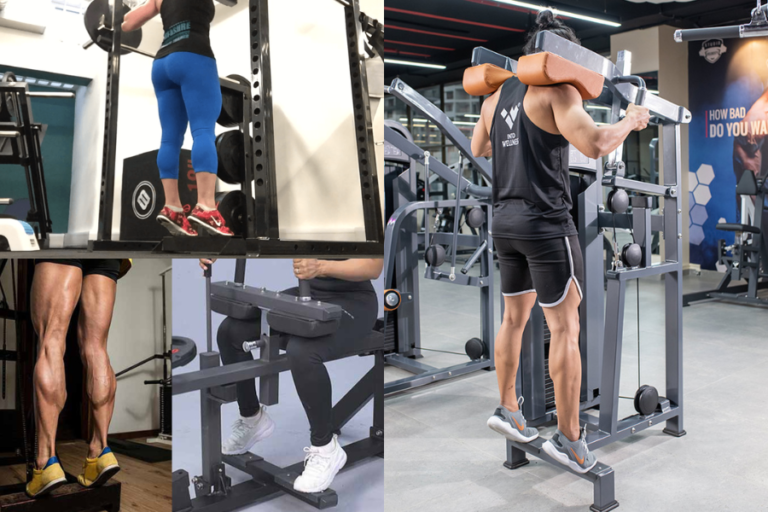
A strong lower body starts with strong calves. The right calf exercises do more than make your lower legs look defined. They support your ankles, protect your Achilles tendon, and give you the power and stability you need for walking, running, and jumping.
In this guide, you will learn exactly which calf exercises build the most muscle, how to perform them correctly, and how to put them together into a simple routine that fits your schedule.
Understand your calf muscles
Before you start training, it helps to know what you are working.
Your calf muscle group, often called the triceps surae, is made up of three muscles, the gastrocnemius, the soleus, and the smaller plantaris. Together they connect into the Achilles tendon at the back of your heel and support posture, balance, and nearly every step you take, including walking, running, and jumping.
The two main muscles you will focus on in your calf exercises are:
- Gastrocnemius, the larger muscle you can see just under the skin. It has more fast-twitch fibers and is key for explosive movements like sprinting and jumping.
- Soleus, a flatter muscle that sits underneath the gastrocnemius. It has more slow-twitch fibers and is crucial for endurance and postural support, especially when you stand or walk for long periods.
When you design your calf workouts, you want to hit both. Straight-leg movements emphasize the gastrocnemius. Bent-knee and seated movements focus more on the soleus.
Why calf exercises matter for performance and injury prevention
Your calves do much more than push you up on your toes.
According to Coast Sport, strong calf muscles improve ankle strength and stability, help your ankles handle more load, and reduce the risk of ankle sprains, especially in high-impact sports like netball. The same guidance explains that powerful calves provide the final push to propel you forward and upward when you run or sprint, which improves speed and endurance and helps reduce calf pain and fatigue.
Good calf strength is also linked to a lower risk of:
- Calf tears and strains
- Sprained ankles
- Plantar fasciitis
- Shin splints
- Various tendinopathies of the ankle, foot, and knee
- Some stress fractures
Your calves also act as both the gas and the brake when you run. Dallas foot doctors at Metroplex Foot & Ankle describe how your calves power you up hills and then help control your speed going downhill to prevent falls.
For runners, the demands are even higher. Research notes that your calf muscles can absorb an internal force of up to eight times your body weight with every step, which makes calf strength crucial for reducing the risk of calf strains and Achilles tendonitis in marathon training.
Warm up and stretch your calves safely
Calf exercises are more effective and safer when your muscles are prepared.
Dynamic stretching is a good start. Before intense activity, you can use movements like leg swings, walking lunges, and high knees to activate your calves and hamstrings and improve flexibility for injury prevention. Static stretching is best saved for after you have warmed up or at the end of a workout. Guidance recommends that you avoid stretching cold muscles and instead stretch after exercise or after a 5 to 10 minute warm up. If you feel pain while stretching, you should stop and consider speaking with a professional.
Regular calf stretching exercises, such as a wall calf stretch or using a foam roller, help keep the muscles supple and reduce the tightness that can lead to strains or overuse injuries. Combined with focused strength work, this is one of the simplest ways to maintain healthy calves over the long term.
Foundational bodyweight calf exercises
You do not need complex equipment to build impressive calf strength. These bodyweight calf exercises are a solid foundation and can be progressed gradually as you get stronger.
Standing double-leg calf raises
Double-leg calf raises are a classic exercise that targets both the gastrocnemius and the soleus using only your body weight. You can do them almost anywhere.
How to do them:
- Stand tall with your feet hip-width apart.
- Keep your knees and back straight and your core lightly engaged.
- Press through the balls of both feet to rise onto your toes as high as you comfortably can.
- Pause briefly at the top, then slowly lower your heels back down with control.
According to Mayo Clinic, you can also perform calf raises with a dumbbell in each hand. Nicole L. Campbell explains that you should stand with your feet shoulder-width apart, rise onto your toes, then return slowly to the starting position to engage the calf muscles effectively. Edward R. Laskowski, M.D., notes that this helps protect your Achilles tendon and calves from injury.
For most people, Mayo Clinic suggests one set of 12 to 15 repetitions is enough to gain benefits, especially if you are just starting. As you progress, you can increase the number of sets or add weight.
Single-leg calf raises
Single-leg calf raises increase the intensity by placing your full body weight on one leg at a time. This challenges your muscles more and also trains your balance.
How to do them:
- Stand next to a wall or sturdy surface for support if needed.
- Shift your weight onto one leg and lift the other foot slightly off the floor.
- With your standing leg straight, rise up onto the ball of your foot as high as possible.
- Slowly lower back down under control.
This variation requires good alignment of the ankle, knee, and hip. If you feel unsteady, use a chair or pole for stability. As you gain strength, you can hold a dumbbell in the same-side hand to increase the load.
Standing calf raises on a step
Using a step or sturdy platform increases your range of motion and muscle activation.
How to do them:
- Stand on the edge of a step with the balls of your feet on the surface and your heels hanging off.
- Hold a rail or wall if you need balance help.
- Push up onto your toes, lifting your heels as high as you can.
- Slowly lower your heels down below step level, counting to about 10 on the way down to emphasize control.
This longer movement path increases both stretch and contraction and can lead to greater strength and muscle growth. One recommendation is to start with three sets of 15 repetitions daily if your calves tolerate the load well.
Targeted seated and bent-knee calf exercises
To fully develop your calves, you also want to focus on the soleus, which works hard when your knee is bent.
Seated calf raises
Seated calf raises are one of the most effective calf exercises for the soleus, which is especially important for long-distance running and endurance activities.
How to do them:
- Sit on a bench or chair with your feet flat on the floor and knees bent at about 90 degrees.
- Place a weight, such as a dumbbell or barbell pad, across your thighs just above your knees, or use a dedicated calf raise machine at the gym.
- Keeping your toes on the ground, raise your heels as high as possible.
- Pause briefly, then lower your heels slowly back to the floor.
Because your knees are bent, the gastrocnemius is somewhat shortened and the soleus does more of the work. This makes seated raises a perfect companion exercise to standing variations.
Bent-knee standing calf raises
You can also emphasize the soleus while standing by slightly bending your knees.
How to do them:
- Stand with feet hip-width apart and bend your knees a little, as if you are starting a small squat.
- Maintain this knee bend while you press up onto your toes.
- Hold for a second at the top, then lower down slowly.
This is a good option if you do not have access to a seated calf raise machine but want more work for the lower part of your calves.
Power and functional calf exercises
Once you have a base of strength, you can add more dynamic movements to build power, balance, and real-world performance.
Farmers’ walk on toes
The Farmers’ Walk on Toes is a simple way to train strength, endurance, and balance at the same time.
How to do it:
- Hold a heavy dumbbell in each hand at your sides.
- Rise up onto your toes.
- Walk forward while staying on your toes and keeping your chest up.
- Continue for up to 60 seconds if you can, then rest and repeat.
One guideline suggests three rounds per day as a strengthening goal. If that is too much at first, start with shorter walks and build up.
Loaded toe walks
Loaded toe walks are similar to the Farmers’ Walk on Toes and are particularly useful for runners and athletes who need strong, stable calves for long periods.
How to do them:
- Hold dumbbells or use body weight if you are a beginner.
- Step up onto your toes and walk forward slowly for a set distance or time.
- Focus on staying tall, keeping your ankles from rolling outward or inward.
These walks challenge the muscles around your ankles and lower legs and improve both balance and strength, which is especially helpful for marathon runners who need stability and endurance over many miles.
Hopping drills
Hopping exercises mimic the functional demands of running and sprinting by stacking several explosive calf raises in a row.
How to do them:
- Stand on one leg with a slight bend in your knee.
- Use your calf to push off the ground in small hops in place or forward.
- Land softly on the same leg, minimizing ground contact time.
- Repeat for several hops, then switch legs.
You can progress by increasing speed, hopping higher, reducing the time your foot stays on the ground, or adding small obstacles to jump over. Because these are high impact, they are best for people with a solid base of calf strength and no current lower leg injuries.
If you are returning from a recent lower-body injury, you should talk with a healthcare provider before doing high impact calf exercises like hopping or heavy loaded work.
Common mistakes to avoid in calf exercises
Even simple calf raises can be less effective or risky if your form is off. A few key mistakes come up often:
- Moving too quickly so you bounce instead of lifting and lowering under control
- Folding forward at the waist instead of keeping your chest up, which throws off your balance
- Letting your ankles roll outward or inward on each rep
- Doing only a few repetitions once in a while rather than consistent sets a few times per week
- Skipping warm up and stretching so your calves stay tight
Guidance for standing calf raises suggests using slow, controlled movements, keeping your chest up, and adjusting your repetitions between about 10 and 30 depending on the load. If balance is an issue, use a chair, pole, or wall for support until your stabilizing muscles catch up.
How to build a simple calf workout
You can adjust the exact structure to your schedule, but the goal is consistency. For most people, training calves two or three times per week works well.
Here is a sample structure that balances strength, muscle growth, and endurance:
- Warm up: 5 to 10 minutes of light cardio, then dynamic stretches such as leg swings and walking lunges.
- Strength block:
- Standing double-leg calf raises, 2 to 3 sets of 12 to 15 reps
- Seated calf raises, 2 to 3 sets of 12 to 15 reps
- Progression block:
- Single-leg calf raises or step calf raises, 2 sets of 8 to 12 reps per leg
- Farmers’ walk on toes or loaded toe walks, 2 rounds of 30 to 60 seconds
- Cool down: Gentle wall calf stretch and, if you have one, foam rolling for a few minutes.
For marathon runners and other endurance athletes, guidance often suggests two strength sessions per week with 2 or 3 different calf exercises each time, as part of a complete training plan that also includes cardio, flexibility work, and rest.
Everyday ways to strengthen your calves
Formal workouts are not the only way to train your calves. Many sports and activities naturally build lower leg strength. Running, especially uphill, soccer, basketball, tennis, step classes, and swimming all involve regular running, jumping, stepping, or moving through water. These movements strengthen and tone your calves and improve both strength and endurance as you play.
You can also add small habits into your day, such as rising onto your toes while brushing your teeth, taking the stairs more often, or doing a quick set of calf raises during a break. Over time, these micro sessions support the structured calf exercises in your workout and help keep your lower legs strong and resilient.
Start with one or two exercises from this list today, focus on slow, controlled movement, and build up gradually. With consistent effort, your calves will become stronger, more powerful, and much more capable of supporting everything else you want your body to do.
About the Author