Understand your oblique muscles
If you are planning an oblique workout to target your side abs, it helps to know what these muscles actually do. Your obliques are the muscles that run diagonally along each side of your torso. They are divided into two main groups:
- External obliques sit closer to the surface. They help you twist, bend to the side, and compress your abdominal cavity, which is essential for everyday movements and core strength.
- Internal obliques lie underneath the externals. They stabilize your trunk, assist with bending and rotating, and help flex your torso and support your spine.
Together, these muscles help you rotate, bend, and stabilize your spine during almost every activity, from walking and carrying groceries to throwing a ball or lifting weights. When you only train your “six pack” muscles and ignore your obliques, you can end up with weaker side support, less spinal stability, and a higher risk of lower back or shoulder issues, as highlighted in Dynamic Chiropractic.
An effective oblique workout trains both internal and external obliques, and it should include:
- Rotation and anti rotation
- Side bending and resisting side bending
- Both bodyweight and, if you choose, loaded exercises
Why an oblique workout matters
A focused oblique workout does more than sculpt your waist. Strong side abs support almost everything you do.
Improve posture and spinal stability
Your obliques help hold your spine in good alignment and resist unwanted movement. According to physical therapist Candace Harding and Peloton Instructor Olivia Amato, stronger obliques improve spinal stability and posture, which can reduce your risk of lower back pain by promoting better alignment and preventing extra strain on your spine, neck, and shoulders.
When these muscles are strong you are less likely to:
- Slouch forward at your desk
- Let your pelvis tilt forward
- Overload your lower back during daily tasks or workouts
Reduce lower back pain
Targeted oblique exercises such as Russian twists and side planks support proper spinal alignment and share the workload across your torso. That means your lower back is not forced to do all the stabilizing on its own. Over time, this can help reduce existing discomfort and lower your chances of future pain.
Enhance balance and athletic performance
Obliques are key for rotation and side to side control, which shows up in activities like:
- Walking or running on uneven ground
- Changing direction in sports
- Standing on one leg
- Jumping and landing
When your obliques are strong, you can control these movements better, which improves balance and helps protect you from falls or awkward landings.
Support breathing and endurance
Your obliques work with your diaphragm and other core muscles to control your breathing. When you pair oblique exercises like Russian twists with controlled breathing, you strengthen the muscles involved in respiration and improve how efficiently you move air in and out of your lungs. Over time this can support better endurance during workouts or daily activities.
Shape and define your waistline
Oblique workouts can help tone and define the muscles along your sides. Consistent training, combined with a healthy diet and regular cardio, can reduce the appearance of love handles and bring out a more sculpted waist. Research points out that oblique training does not make your waist bulky or boxy. Instead, it provides definition and a balanced, strong looking core.
How often to train your obliques
You do not need long sessions to benefit from an oblique workout. The Peloton team recommends adding 5 to 10 minutes of oblique focused core work, 3 to 4 times per week, to your routine. You can attach these short sessions to:
- The end of a cardio workout
- A strength training day
- A mobility or balance focused session
Aim for a mix of rotation, anti rotation, and side bending over the course of the week so you challenge your obliques in different ways.
Technique tips for oblique exercises
To get more from your oblique workout and stay safe, pay close attention to your form. Peloton experts and other coaches emphasize a few key points:
Brace your core
Before each rep, gently tighten your midsection like you are preparing for a light punch to the stomach. This bracing:
- Protects your spine
- Helps you control the movement
- Keeps the work in your abs instead of your lower back
Match your breathing to effort
Use controlled breathing instead of holding your breath:
- Exhale on the hardest part of the movement, such as twisting or lifting
- Inhale during the easier phase, such as returning to the start position
This pattern supports core engagement and helps you avoid getting lightheaded.
Protect your lower back and neck
To reduce strain:
- Keep a slight tuck of your pelvis to avoid arching your lower back
- Maintain a neutral spine rather than rounding or hyperextending
- Avoid yanking your head forward with your hands during crunch-style moves, and instead keep your fingertips lightly behind your ears
Move with control, not momentum
Fast, swinging reps may look intense, but they often reduce muscle activation and increase your injury risk. For most oblique exercises, you are better off with:
- Slow, steady reps
- A short pause at the hardest point of the movement
- A smooth return to the starting position
This helps your obliques actually do the work instead of letting momentum or other muscles take over.
Best bodyweight oblique exercises
You can build an effective oblique workout at home or in the gym with just your body weight. Start with 2 or 3 of the exercises below, and focus on clean, controlled repetitions.
Side plank
The side plank is one of the most effective ways to challenge your obliques through anti lateral flexion, which means resisting bending sideways.
How to do it
- Lie on your side with your legs extended and stacked, and your elbow directly under your shoulder.
- Engage your core and lift your hips so your body forms a straight line from head to heels.
- Keep your shoulders, hips, and feet stacked, and avoid letting your hips sag.
- Hold for 20 to 30 seconds, breathing steadily, then switch sides.
Why it works
- Trains your obliques to keep your spine stable
- Targets deep stabilizers around your trunk and hips
- Can be progressed with variations like star planks or Copenhagen side planks (as highlighted in a 2024 Men’s Health article)
Russian twist
When done correctly, Russian twists effectively target both your internal and external obliques with rotational movement.
How to do it
- Sit on the floor with your knees bent and heels resting lightly on the ground.
- Lean back slightly while keeping your spine long, and brace your core.
- Clasp your hands in front of your chest.
- Slowly rotate your torso to one side, then back through center, then to the other side.
- Keep the movement controlled instead of swinging your arms.
Why it works
- Builds rotational strength through your midsection
- Can improve control for activities like throwing or swinging
- Can be progressed by holding a light weight or medicine ball
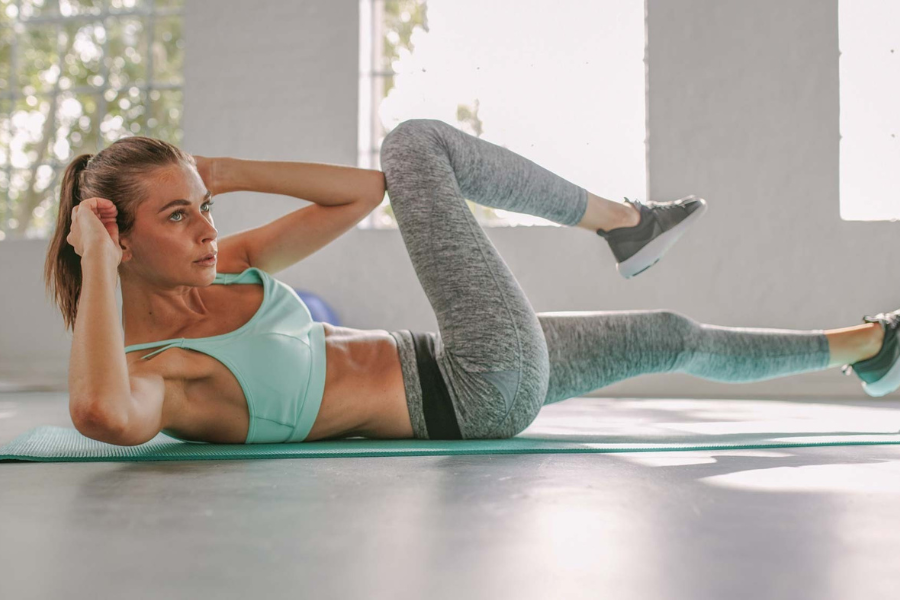
Bicycle crunch
Bicycle crunches challenge both the rectus abdominis and the obliques with a twisting, pedaling motion.
How to do it
- Lie on your back with your hands lightly behind your head and your legs lifted, knees bent at 90 degrees.
- Press your lower back into the floor to protect your spine.
- Extend one leg while bringing the opposite knee toward your chest.
- Rotate your torso so your opposite elbow moves toward that knee.
- Switch sides in a slow, controlled “pedaling” pattern.
Why it works
- Strengthens your side abs and front abs together
- Improves rotational strength for daily tasks like bending or reaching to the side
Mountain climber (oblique focus)
Standard mountain climbers are a full body stability move, and a slight twist can increase oblique activation.
How to do it
- Start in a high plank position with your hands under your shoulders and your body in a straight line.
- Brace your core and draw one knee toward the opposite elbow, rotating slightly through your hips.
- Return that foot to the starting position and switch sides.
- Move at a controlled pace so your hips do not bounce up and down.
Why it works
- Engages your obliques as you stabilize and rotate the hips
- Adds a cardio element to your oblique workout
Heel taps
Heel taps target the obliques through a small, controlled side bend.
How to do it
- Lie on your back with your knees bent and feet flat on the floor, hip width apart.
- Lift your head and shoulders slightly off the floor and brace your core.
- Reach your right hand toward your right heel in a sideways crunch.
- Return to center, then reach toward your left heel.
- Keep the motion small and focused on the side of your torso, not your neck.
Why it works
- Provides a low impact way to work the side abs
- Helps you learn to control lateral flexion without overbending
Best weighted oblique exercises
Once you are comfortable with bodyweight moves, you can add resistance to your oblique workout. This increases strength and helps build more defined side abs.
Woodchop with cable or medicine ball
The woodchop trains rotation through your whole torso in a powerful, athletic pattern.
How to do it with a cable
- Attach a handle to a high cable pulley.
- Stand sideways to the machine with feet shoulder width apart and hands on the handle.
- Brace your core and pull the handle down and across your body toward your opposite hip, rotating through your torso and hips.
- Control the movement as you return to the start position.
- Complete reps, then turn around and repeat on the other side.
You can also perform a similar motion by holding a medicine ball and “chopping” from high to low in a diagonal path.
Why it works
- Strengthens rotational power for sports and daily activities
- Trains your obliques to generate and control twisting forces
Suitcase carry
A suitcase carry is a loaded carry where you hold a weight on one side, which forces your obliques to keep you upright.
How to do it
- Hold a dumbbell or kettlebell in one hand at your side.
- Stand tall with your shoulders level and your core braced.
- Walk forward slowly for 20 to 40 seconds without leaning toward or away from the weight.
- Switch hands and repeat.
Why it works
- Challenges your obliques as anti lateral flexors
- Builds real life strength for carrying bags or groceries
Pallof press
The Pallof press, mentioned in the 2024 Men’s Health article, is a classic anti rotation exercise.
How to do it
- Attach a handle to a cable machine at chest height, or use a resistance band anchored at the same level.
- Stand sideways to the anchor point and hold the handle with both hands at your chest.
- Step out until you feel tension pulling you toward the anchor.
- Brace your core and press your hands straight out in front of you, resisting the urge to rotate.
- Hold for a second, then return to your chest with control.
- Complete reps, then turn around and repeat on the other side.
Why it works
- Strengthens your obliques by teaching them to resist twisting
- Improves stability for heavy lifts like squats and deadlifts
Kettlebell windmill (advanced)
The kettlebell windmill is a more advanced oblique exercise that combines stability, flexibility, and strength.
How to do it
- Press a light kettlebell overhead with one arm and lock out your elbow.
- Turn your feet slightly away from the kettlebell side.
- Keeping your eyes on the weight, push your hips out to the side under the kettlebell and slide your free hand down your leg toward the floor.
- Stop when you feel a stretch through your side and hamstrings, then drive through your hip to return to standing.
Why it works
- Trains your obliques through a combination of side bending and stability
- Challenges your shoulder and hip stability at the same time
If you are new to this move, practice the pattern without weight first.
A sample oblique workout you can try
Use the exercises above to build a simple, balanced routine. Here is one option you can adjust based on your fitness level.
Beginner friendly routine
Do this routine 2 or 3 times per week on nonconsecutive days.
- Side plank: 2 sets of 15 to 20 seconds per side
- Heel taps: 2 sets of 10 to 12 reps per side
- Russian twists (bodyweight): 2 sets of 10 reps per side
- Mountain climbers (slow): 2 sets of 20 total reps
Rest 30 to 45 seconds between sets. Focus on form rather than speed.
Intermediate routine
Try this once you feel comfortable with the basics.
- Side plank: 3 sets of 25 to 30 seconds per side
- Bicycle crunch: 3 sets of 12 to 15 reps per side
- Russian twists with light weight: 3 sets of 10 to 12 reps per side
- Suitcase carry: 2 rounds of 20 to 30 seconds per side
- Pallof press: 2 sets of 8 to 10 reps per side
Rest 45 to 60 seconds between sets. Maintain control on every rep.
Common oblique training mistakes to avoid
Even a well designed oblique workout can fall short if your technique is off. Watch out for these frequent errors.
Only training “side bends”
Traditional dumbbell side bends are a common go to, but they are not always the most effective or safest choice. When you hold a dumbbell in each hand, the weights can cancel each other out, which reduces tension on your obliques. Very deep side bending can also put your spine in a risky position if your form is not precise.
If you choose to do side bends, consider:
- Using a single dumbbell or a cable setup so your obliques actually have to resist the load
- Staying within a comfortable range rather than dropping as low as possible
Cable side bends are often a better option because you can stay in an active range of motion and keep the focus on your obliques and hip stabilizers.
Moving too fast and using momentum
It is tempting to rush rotational moves like Russian twists or bicycle crunches. The problem is that speed often shifts the work away from your abs and into your hips or lower back.
Slow down and:
- Keep your lower back stable against the floor when needed
- Pause briefly at the hardest point of each rep
- Focus on feeling your obliques contract and relax
Combining extreme flexion and rotation
Your spine is capable of bending and twisting, but combining a lot of both at once under load can increase injury risk. This is one reason some coaches recommend limiting heavy weighted crunches with big twists.
To stay safer:
- Use controlled, moderate ranges of motion
- Emphasize exercises that resist rotation or side bending, such as side planks, suitcase carries, and Pallof presses
- Keep your movements smooth and avoid jerking
Putting it all together
An effective oblique workout does not require complicated equipment or long sessions. A few minutes of focused side ab exercises, several times a week, can:
- Improve posture and spinal stability
- Reduce lower back strain
- Boost balance and athletic performance
- Support better breathing and endurance
- Shape and define your waistline
Start by choosing 3 or 4 exercises from the lists above, mix in both rotational and anti rotational moves, and commit to consistent practice. As your strength and control improve, you can add resistance, explore new variations, and build a core that not only looks strong but supports everything you do.
About the Author