Why tricep training matters for athletes
If you play a sport that involves throwing, pressing, striking, or stiff‑arming, a smart tricep workout for athletes is not just about bigger arms. Strong triceps protect your shoulders, improve lockout strength, and help you produce force more efficiently in almost every upper body movement.
For overhead athletes like baseball or softball players, volleyball and tennis athletes, and track and field throwers, the triceps act as an important “brake” to slow your arm down and protect your shoulder from the constant high‑volume overhead stress. When you skip tricep work, you increase your risk of overuse injuries, especially in the shoulder and elbow.
In many ways, training your triceps as an athlete is similar to how runners train hamstrings. Both muscles act as crucial decelerators, so strengthening them helps you handle repetition and overextension without breaking down.
Understand your triceps
Before you build your tricep workout for athletes, it helps to know what you are actually training. Your triceps have three distinct heads, and each responds best to slightly different angles and grips.
The three heads of the triceps
-
Long head
-
Runs from your shoulder blade (scapula) down to your elbow.
-
Helps with elbow extension and also stabilizes the shoulder.
-
Plays a big role as an eccentric decelerator in throwing.
-
Lateral head
-
The outer “horseshoe” that pops when you lock out a press.
-
Key for explosive pushing movements and lockout strength.
-
Medial head
-
Sits deeper, closer to your elbow.
-
Helps control and fine‑tune elbow extension, especially under lighter loads and in endurance work.
Overhead movements tend to emphasize the long head, while exercises with your elbows tucked at your sides, like pushdowns or dips, lean more on the lateral and medial heads.
Why strong triceps protect your shoulders
For overhead athletes, your triceps, rotator cuff, and scapular muscles work together to keep your shoulder healthy. The long head of the triceps attaches to your scapula, helps extend the elbow, and assists with shoulder stabilization. It also helps slow the arm down during throwing, which reduces stress on the glenohumeral joint and rotator cuff.
In a 2013 study summarized by Manske and Ellenbecker, researchers found that:
- 34% of rotator cuffs labeled as “painless shoulders” in overhead athletes already had tears on MRI.
- 79% of professional baseball pitchers without pain had abnormalities in the glenoid labrum.
Those numbers highlight a key point. Shoulder damage often builds up quietly over time. You may feel fine while underlying structures are already overloaded. Consistently strengthening your triceps, especially the long head, is one way to share the load and help protect those vulnerable tissues.
Key benefits of tricep training for athletes
More power in presses and throws
The triceps are responsible for the final part of any pushing movement, known as the lockout. In sports, that transfers directly to:
- Stronger bench and overhead presses in strength training.
- Faster, crisper throws with better control.
- More authority in stiff arms, hand fighting, and blocking.
Because triceps contribute heavily to elbow extension, they are central to performance in strongman, powerlifting, and pressing events that demand force and stability at the joint.
Better lockout and overhead stability
In movements like the jerk, push press, or snatch, you must snap your elbows into a stable lockout while your shoulders and thoracic spine hold the bar overhead. Strong, well‑coordinated triceps help you:
- Get to a firm lockout quickly.
- Reduce “soft elbows” that waste energy and invite injury.
- Maintain a solid overhead position without drifting forward.
Exercises like overhead extensions and the seated Miracle Gro variation are particularly helpful here because they lengthen and load the triceps in the same overhead positions you use in sport.
Injury prevention and durability
When your triceps are weak, other structures pick up the slack. That can show up as:
- Shoulder pain during or after throwing sessions.
- Elbow discomfort when you press, dip, or stiff arm.
- Early fatigue in overhead positions.
Isolating your triceps in training helps prevent serious imbalances and keeps them synced with your lats and shoulders. This coordination pays off in movements like:
- Locking out a jerk or push press.
- Pummeling and hand fighting in wrestling and football.
- Mantling and pressing down on holds in climbing.
Principles of a smart tricep workout for athletes
Instead of just adding random pushdowns at the end of your session, build your tricep training around a few simple principles.
Train all three heads
You want overhead, tucked‑elbow, and different grip positions across your week. For example:
- Long head focus
- Overhead extensions
- Seated Miracle Gro
- Lateral head focus
- Pronated (palms‑down) pushdowns
- Close‑stance push‑ups
- Skull crushers
- Medial head focus
- Supinated (palms‑up) pushdowns
- Reverse grip bench press
Targeting all three heads gives you better size, strength, and control, and helps your arms stay balanced.
Use multiple rep ranges
To perform at your best, you need strength, power, and endurance. You can train all three with a mix of:
- Heavy sets of 3 to 6 reps for strength and lockout power.
- Moderate sets of 6 to 12 reps for hypertrophy and general strength.
- Higher‑rep sets of 12 to 20+ reps for endurance and tendon health.
Hypertrophy guidelines for athletes often suggest 3 to 6 sets of 6 to 12 reps at around 60 to 80% of your one‑rep max, with about 60 seconds rest, done at least twice per week for optimal growth without burning you out.
Train triceps at least twice per week
You can build serious strength and size with a frequency of two focused tricep sessions per week, especially if you already press in your main training. A good pattern is:
- Day 1: Heavier, compound focus
- Day 2: Lighter, isolation and volume focus
This approach lets you accumulate quality work and still recover.
The ultimate tricep workout for athletes
Below is a full tricep workout for athletes designed to build muscle, boost lockout strength, and transfer directly to your sport. You can run it 1 to 2 times per week depending on your schedule and experience.
Exercise 1: Close grip bench press
Why you should do it
The close grip bench press is a foundational tricep exercise for strength athletes like powerlifters and strongman competitors. It targets the long head of the triceps, which contributes heavily to both size and strength and has strong carryover to your regular bench and any pushing movement.
How to do it
- Lie on a flat bench with your feet planted.
- Grip the bar with your hands about shoulder‑width apart or slightly closer.
- Unrack the bar and keep your elbows close to your sides as you lower it under control toward the lower chest.
- Pause briefly, then press up forcefully, locking out your elbows without hyperextending.
Sets and reps
- 3 to 5 sets of 4 to 6 reps, resting 2 to 3 minutes between sets.
Focus on slow, controlled lowers and strong, fast extensions to train both strength and power.
Exercise 2: Dips (weighted if possible)
Why you should do it
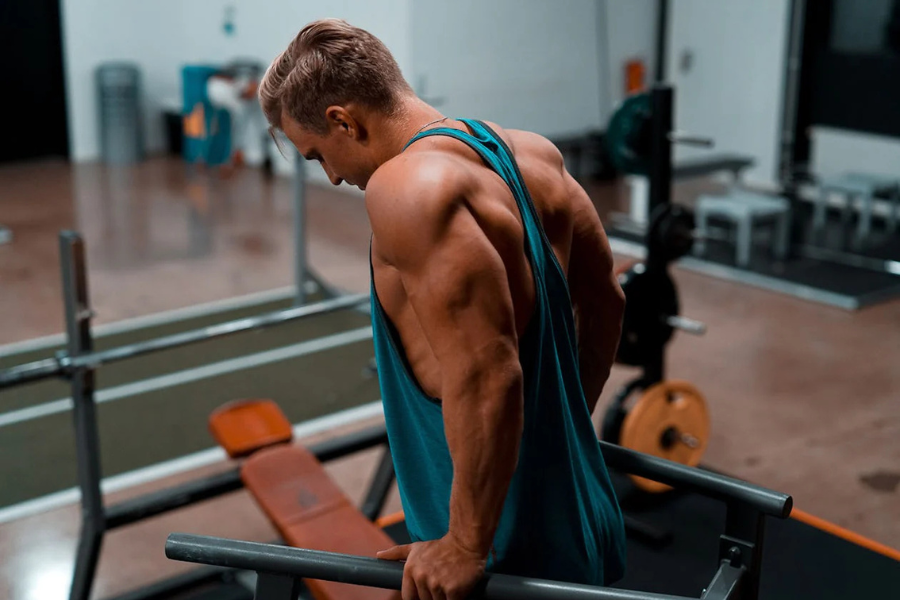
Dips are not a pure isolation movement, but they build serious tricep mass and strength. They improve lockout, explosive elbow extension, and have clear transfer to:
- Bench press lockouts.
- Stiff arms in football.
- Pushing off opponents in wrestling or rugby.
- Pressing out of deep positions in gymnastics or calisthenics.
How to do it
- Use parallel bars or sturdy dip handles.
- Support yourself with straight arms, then lean slightly forward.
- Lower your body by bending your elbows until your upper arms are at least parallel to the ground.
- Drive back up to full elbow extension without locking out harshly.
Programming example
- 4 sets of 4 heavy weighted reps if you are advanced enough.
- Then 2 drop sets of 12 to 17 bodyweight reps.
Include dips weekly for strength athletes. If you cannot yet do bodyweight dips comfortably, use an assisted machine or band support.
Exercise 3: Seated Miracle Gro
Why you should do it
The seated Miracle Gro exercise trains your triceps in an overhead position, which is crucial for overhead athletes. It stretches the long head deeply, strengthens the triceps, and improves shoulder stability and lockout, with great transfer to shot putting, pitching, and overhead lifts like the jerk.
How to do it
- Sit on a bench with back support, similar to a military press bench.
- Hold a dumbbell with an open palm grip, allowing it to rest in your hand rather than being tightly squeezed.
- Start with the dumbbell above your head, then slowly lower it behind your head, allowing a deep stretch in the triceps and shoulders.
- Extend your elbows to bring the weight back overhead, keeping your rib cage down and core engaged.
Sets and reps
- 4 to 5 sets of 7 to 9 challenging reps.
- Follow with 2 drop sets of around 20 reps with lighter weight.
Move slowly in the bottom position to protect your shoulders and focus on a strong but smooth press out.
Exercise 4: Standing cable overhead tricep extension
Why you should do it
Standing cable overhead tricep extensions help you coordinate your triceps with your thoracic spine and shoulder musculature. They are especially useful if you are an internally rotated athlete, such as a wrestler or weightlifter, because they:
- Encourage thoracic extension.
- Train cocontraction around the shoulder joint.
- Reinforce strong, stable overhead lockouts for presses, snatches, and jerks.
How to do it
- Attach a rope or handle to a high cable.
- Stand with your back to the machine and step forward so the cable is pulling slightly behind you.
- Support your back against a pad or brace yourself in a slight forward lean.
- Start with your elbows bent and hands behind your head.
- Extend your elbows to push your hands up and slightly forward into an overhead position.
Sets and reps
- 3 to 4 sets of 10 to 15 reps, resting 60 to 90 seconds.
Focus on keeping your ribs down and your elbows stable so the triceps, not your lower back, do the work.
Exercise 5: Ghostface kickbacks into close grip bench (pre‑fatigue method)
Why you should do it
This is a powerful combination that uses pre‑fatigue to target fast twitch fibers in your triceps. You first isolate the triceps with band kickbacks, then immediately challenge them with a multi‑joint movement. This method:
- Increases fast twitch muscle fiber recruitment.
- Stimulates strength and hypertrophy gains with less total heavy loading.
- Builds explosive elbow extension speed that benefits almost every upper body sport.
Part 1: Ghostface kickbacks
- Attach a band to a low anchor.
- Hinge slightly at the hips with a neutral spine.
- Keep your upper arm aligned with your torso and bend your elbow to about 90 degrees.
- Extend your elbow straight back until your arm is fully straight, then return under control.
Do 15 to 20 reps per arm.
Rest 30 to 60 seconds, then go straight into close grip bench.
Part 2: Close grip bench press
- Use a shoulder‑width or slightly narrower grip.
- Lower the bar slowly with a controlled eccentric.
- Press up quickly and forcefully, focusing on explosive extension.
Sets and reps
- 3 to 4 rounds of:
- 15 to 20 band kickbacks.
- Immediately followed by 6 to 10 reps of close grip bench.
Keep the bench loads moderate on this combo, not maximal. The goal is quality, explosive reps after pre‑fatigue, not grinding sets.
Weekly tricep training template for athletes
Here is one way to structure your tricep training across a typical week. You can plug this into your existing program.
| Day | Focus | Exercises | Notes |
|---|---|---|---|
| Day 1 | Heavy strength and lockout | Close grip bench, weighted dips | Longer rest, lower reps, focus on power and stability |
| Day 2 | Overhead and isolation | Seated Miracle Gro, standing cable overhead extensions, ghostface kickbacks into bench | Higher reps, focus on control, shoulder position, and tricep pump |
If your sport already includes a lot of pressing, keep total tricep volume moderate at first and gradually build up. Aim for 3 to 6 working sets per exercise, 2 sessions per week, and adjust based on how your elbows and shoulders feel.
Home tricep workout for athletes
If you train at home or when you are traveling, you can still build strong triceps with bodyweight and minimal equipment.
Bodyweight tricep options
-
Diamond push‑ups
-
Place your hands close together so your thumbs and index fingers form a diamond.
-
Keep your elbows close to your body and lower your chest toward your hands.
-
Push back up while maintaining a straight line from head to heels.
-
Bench or chair dips
-
Place your hands on the edge of a sturdy bench or table behind you.
-
Slide your hips off and walk your feet forward.
-
Lower your body by bending your elbows, then press back up until your arms are straight.
Light weight or banded options
-
Tricep overhead extension
-
Stand with feet shoulder‑width apart.
-
Hold a light weight or band overhead with both hands.
-
Lower it behind your head while keeping your elbows pointing forward.
-
Extend your elbows to straighten your arms again.
-
Tricep kickbacks
-
Support one hand and knee on a bench.
-
Hold a dumbbell in the opposite hand with your elbow bent to 90 degrees.
-
Extend your lower arm backward until it is straight, then return under control.
You can apply the same training principles at home:
- Vary rep ranges.
- Train at least twice a week.
- Progress by adding reps, reducing rest, or using more challenging variations.
How to progress your tricep training safely
To keep your tricep workout for athletes productive over the long term, progress gradually and pay attention to how your body responds.
Adjust one variable at a time
You can make progress by changing:
- Load: Add small amounts of weight to presses and dips over time.
- Volume: Add a set or a few reps once an exercise feels too easy.
- Density: Shorten rest periods slightly to increase training stress.
- Difficulty: Move from assisted to bodyweight dips, then to weighted.
Avoid changing all four at once. Adjusting one or two variables at a time helps you recover and track what is actually working.
Watch shoulder and elbow signals
Because the triceps cross the elbow and can influence shoulder mechanics, it is worth listening to any early warning signs:
- Persistent elbow pain during lockout.
- Sharp shoulder discomfort in overhead extensions.
- Lingering soreness that does not fade with light movement and recovery work.
If any of these show up, back off the volume slightly, swap overhead work for cable or banded variations, or reduce the load while you give the joints time to adapt.
Putting it all together
A well‑designed tricep workout for athletes goes beyond aesthetics. By targeting all three heads with a mix of heavy compound movements, overhead stability work, and strategic isolation, you:
- Build muscle that actually helps you perform.
- Improve lockout strength in pressing, throwing, and stiff‑arming.
- Support shoulder health in high‑volume overhead sports.
Start by adding one or two of the exercises above into your current program, then build toward the full weekly structure. As your triceps get stronger and more resilient, you will feel the difference every time you press, throw, or fight for position in your sport.
About the Author