Understand unilateral bicep exercises
Unilateral bicep exercises work one arm at a time instead of using both arms together. By training each side separately, you put an equal spotlight on both arms, which helps you:
- Spot strength and size imbalances
- Prevent your dominant side from doing all the work
- Build more balanced, symmetrical arms over time
Because unilateral bicep exercises do not let your stronger side silently help out, they are especially useful if you notice one arm looks or feels different from the other.
You can use dumbbells, cables, kettlebells, or even your own body weight. The key is simple: one side works while the other rests.
Why train one arm at a time
Unilateral training does more than just even out your arms. When you add single arm work to your strength routine, you gain a few extra advantages.
Correct strength and size imbalances
Most people have one side that is stronger. In bilateral exercises like barbell curls or pullups, your stronger arm can quietly take over. Over time, this can lead to:
- Uneven arm size
- Nagging aches on one side
- Technique breakdown as one side works harder than the other
Unilateral bicep exercises remove that shortcut. Each arm has to pull its own weight, so you can:
- Add more volume to the weaker side
- Notice when one arm struggles with a weight the other can handle
- Progress each arm at its own pace
Some coaches recommend doing the same weight and reps on both sides. Others prefer slightly more work on the weaker side. The research you have here reflects that this is still debated, so you may want to experiment and see what feels better for your body and your goals.
Build more strength from each limb
Research in The Strength & Conditioning Journal notes that strength produced by individual limbs during unilateral exercises can sometimes exceed the combined strength you see in bilateral work. In other words, you may be able to:
- Squeeze more force out of each arm
- Reduce something called a bilateral force deficit
- Potentially see better carryover to sports and daily tasks that are often one sided, like throwing, carrying, or swinging
Other meta-analyses on athletes have also found that unilateral training can improve single leg force, unilateral jumping, and sprinting more than bilateral training in some cases, likely due to better neuromuscular control and coordination.
Support injury rehab and joint comfort
If you are dealing with an injury or coming back from one, unilateral bicep and arm exercises can help you train around the issue.
- You can load the healthy side while carefully rebuilding the injured side.
- A neural process called cross education means training one side can still help maintain strength on the untrained, injured side.
- Single arm variations often allow more natural joint paths and a greater range of motion, which can reduce discomfort. For example, single arm tricep pushdowns let your arm move slightly to the side, which can ease elbow strain compared to fixed bilateral pushdowns.
Strength coaches also highlight that unilateral exercises reduce the load on joints compared with heavy big lifts, while still letting you train hard, which can help keep your elbows and shoulders feeling better over the long term.
Engage your core and improve control
Any time you push or pull with one side, your core has to step up to keep you from twisting or tipping. That is why unilateral bicep exercises often feel surprisingly demanding through your midsection.
Benefits here include:
- Better trunk stability
- Improved balance and control when you move or change direction
- A more integrated feeling of strength from your hands to your torso
Exercises like single arm rows, landmine presses, and single arm floor presses all challenge your core in ways that traditional two arm work does not.
Easy unilateral bicep exercises to start with
You do not need an advanced routine to get big results from unilateral bicep work. A small set of simple, well chosen exercises will cover most of what you need.
Below, you will find beginner friendly options first, followed by slightly more advanced choices when you are ready to level up.
Single arm dumbbell bicep curl
This is your basic starting point. It is simple, effective, and easy to learn.
What it works
- Primary: biceps
- Secondary: forearms, grip, shoulders, triceps for control
Single arm curls help you improve:
- Elbow flexion strength
- Elbow joint stability
- Overall arm definition and control
How to do it
- Stand tall with your feet hip width apart, a dumbbell in one hand, palm facing forward.
- Brace your core and keep your elbow close to your side.
- Curl the weight up toward your shoulder without swinging your torso.
- Squeeze at the top for a brief pause.
- Lower the weight with control back to the start.
- Complete all reps on one arm, then switch sides.
Tips
- Use a weight that lets you move smoothly without jerking.
- Keep your shoulders relaxed instead of shrugging as you curl.
- If you notice a big strength gap, you can do extra sets or a few extra reps on the weaker arm.
Hammer curl (single arm)
Hammer curls use a neutral grip, which means your palm faces your body. This slight change in hand position shifts the emphasis and helps build fuller looking arms.
What it works
- Long head of the biceps
- Brachialis
- Brachioradialis (a key forearm muscle)
How to do it
- Hold a dumbbell at your side with your palm facing your thigh.
- Brace your core and keep your elbow close to your ribs.
- Curl the weight up while keeping your palm facing inward.
- Pause briefly at the top, then lower slowly.
- Repeat for the desired reps on one arm, then switch.
Tips
- Do not let your wrist bend backward. Keep it in line with your forearm.
- Think about pulling up with your forearm and upper arm together, rather than just your hand.
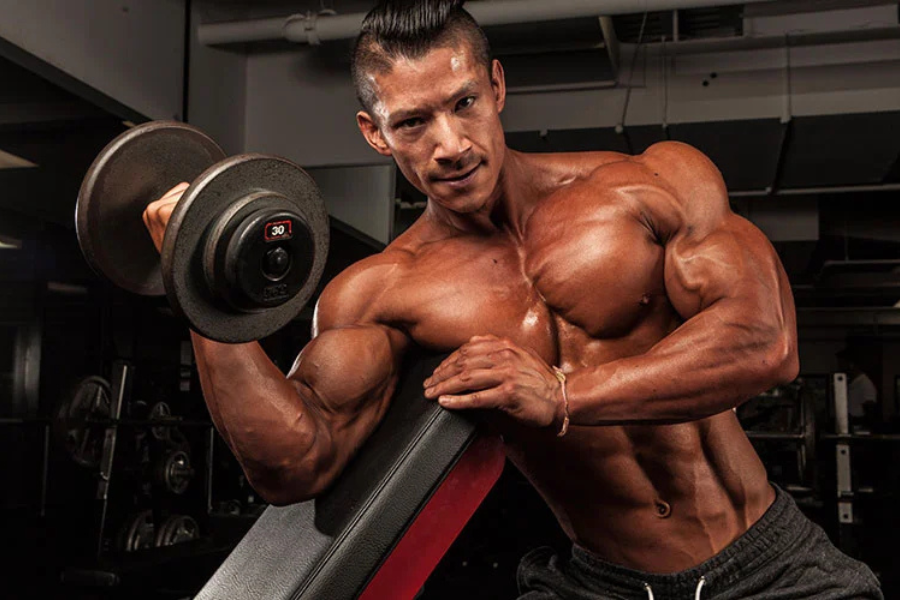
Concentration curl
Concentration curls are a classic bodybuilding choice for a reason. They isolate the biceps more than almost any other curl and they focus heavily on the short head of the biceps.
Research updated in early 2024 notes concentration curls as one of the most effective isolation movements for hypertrophy when used after heavier compound exercises.
What it works
- Mainly the short head of the biceps
- Also improves mind muscle connection and control
How to do it
- Sit on a bench with your feet flat on the floor.
- Hold a dumbbell in one hand and rest the back of that arm against the inside of your thigh, just above the knee.
- Let the dumbbell hang straight down, palm facing inward.
- Curl the weight up toward your shoulder without moving your upper arm off your leg.
- Squeeze at the top, then lower slowly to a full stretch.
- Complete all reps, then switch arms.
Tips
- Use lighter weights and strict form.
- Think about curling with your bicep only, not with momentum.
- Place these later in your workout to finish off your biceps.
Single arm high cable curl
If you have access to a cable machine, the single arm high cable curl is a powerful way to train the biceps through a different angle.
This movement puts your arm in a slightly externally rotated position and mainly targets the short head of the biceps, while your shoulders and core work to stabilize.
How to do it
- Set a cable to about head height and attach a single handle.
- Stand side on to the machine and grab the handle with the outside hand.
- Step away so there is tension on the cable, then raise your elbow so your upper arm is roughly parallel to the floor.
- Curl the handle in toward your head while keeping your upper arm fairly still.
- Squeeze at the peak, then slowly extend the arm back to the start.
- Complete reps on one side, then turn around and repeat with the other arm.
Tips
- Think of drawing your pinky slightly up as you curl to enhance bicep involvement.
- Keep your torso stable and avoid leaning or twisting.
Some research suggests bilateral training may be superior for overall strength in certain contexts, but unilateral options like this cable curl remain valuable for improving muscular imbalances and refining arm symmetry.
Single arm row variations
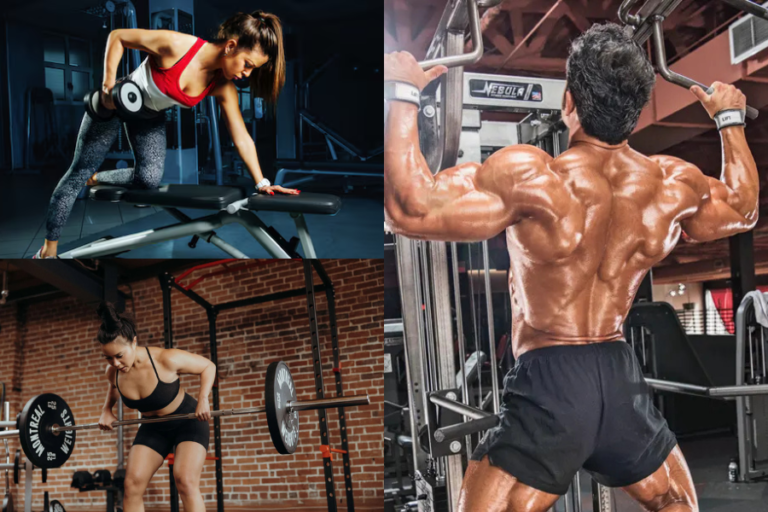
Rowing exercises are not usually labeled as “bicep moves,” but they train the biceps hard along with your back and rear shoulders. Using single arm row variations lets you strengthen your pulling muscles while giving each arm focused attention.
Single arm dumbbell row
How to do it
- Place one knee and the same side hand on a bench for support.
- Hold a dumbbell in your free hand with your arm extended toward the floor.
- Brace your core and pull the weight up toward your hip, keeping your elbow close to your body.
- Pause briefly, then lower under control.
- Finish all reps on one side, then switch.
Why it helps your biceps
Every time you flex your elbow to pull the weight toward you, your biceps assist your back muscles. This gives you bicep work plus extra back strength in one move.
Single arm chest supported cable row
This is a more controlled variation that reduces cheating.
Benefits
- You can adjust cable height to hit different back areas.
- Chest support reduces torso swing, so the working arm muscles have to do more of the job.
If you tend to yank the weight on normal rows, this option helps you focus on clean, consistent pulling, which is good news for your biceps and your shoulders.
Single arm floor press
The single arm floor press is usually seen as a chest and triceps exercise, but it also involves the biceps as stabilizers and builds upper body control.
Women’s Health UK describes this as an effective unilateral move for chest, shoulders, and arms, especially for building stability and managing imbalances.
How to do it
- Lie on your back on the floor with knees bent and feet flat.
- Hold a dumbbell in one hand at chest level, elbow resting on the floor.
- Brace your core and press the weight straight up until your arm is extended.
- Lower slowly until your triceps lightly touch the floor.
- Repeat for 4 sets of about 12 reps per side if that fits your program and ability.
The single arm setup challenges your core to prevent you from rolling, and it trains each arm separately so you can see if one side struggles more than the other.
Single arm landmine shoulder press
While this is mainly a shoulder and core exercise, it is another useful unilateral upper body movement that carries over to pressing strength.
Single arm landmine presses provide a rotational core challenge and often feel more comfortable for people with limited shoulder mobility compared with straight overhead dumbbell or barbell presses.
Better shoulder and pressing strength can indirectly help your bicep training, since stable shoulders make curling and rowing safer and more efficient.
How to program unilateral bicep exercises
You do not need to build your entire workout around single arm moves. Instead, think of them as a focused tool you add to your routine.
Choose your main focus
Before you start, decide what you care about most:
- Fixing a clear imbalance
- Building arm size and shape
- Protecting joints and improving control
- Supporting rehab from an injury
Your main goal influences how much unilateral work you include and how hard you push each side.
Use smart sets and reps
From the research you have here, a common guideline for unilateral bicep isolation work such as concentration curls and single arm high cable curls is:
- 3 sets
- 8 to 12 reps per arm
- About 1 minute of rest between sets
You can pair these with heavier compound movements like rows, chinups, or presses earlier in your workout.
A simple structure might look like this:
- Heavy compound pull (for example pullups, barbell rows)
- Unilateral row variation (single arm dumbbell row or chest supported cable row)
- Unilateral isolation (single arm curls, hammer curls, concentration curls, or high cable curls)
Balance volume between sides carefully
When you try to fix an imbalance, you have a few options:
-
Equal volume for both arms
-
Same weight and reps each side
-
Maintains differences but keeps both sides progressing
-
Extra volume for the weaker arm
-
Same work on the stronger side
-
Plus an extra set or a few extra reps on the weaker arm
-
Aims to help the weaker side catch up
-
Match strong side to weak side performance
-
You let the weaker arm decide the weight or reps
-
The stronger arm only does what the weaker arm can match
-
This might slow progress on the stronger arm but can close the gap faster
The research reflects a real debate here. There is no single correct answer, so you may want to try one approach for several weeks, track the results, and adjust.
Watch out for “junk volume”
Doing more work is not always better. Junk volume is the extra sets and reps you add that are so easy or unfocused that they barely help you progress.
To avoid it:
- Keep most of your sets challenging but doable, leaving a small number of reps in reserve.
- Do not pile on light, half effort curls at the end of a workout just to feel busy.
- Focus on quality contractions and full range of motion instead of chasing a pump alone.
Who should prioritize unilateral bicep work
You will benefit from unilateral bicep exercises in most programs, but some situations make them especially helpful.
You notice one arm is smaller or weaker
If one sleeve feels tighter than the other or if one arm fails earlier on curls, single arm work belongs near the top of your list. You can:
- Test both arms with the same weight
- Start your sets with the weaker arm while you are fresh
- Give the weaker side slightly more total work over time
Pay attention to small shifts. Even a little extra strength or control on the weaker side is a sign you are on the right track.
You are returning from an injury
If a doctor or physical therapist has cleared you for strength training, unilateral exercises can help you rebuild gradually.
- You can train the healthy arm fully.
- You can slowly reintroduce load on the injured arm.
- Cross education from training the healthy side can help the injured side keep more of its strength.
Start conservatively and focus on comfort and control rather than heavy weights. If pain spikes suddenly, stop and reassess.
You want better athletic performance
Many sports skills, such as throwing, sprinting, swinging, and changing direction, rely on single limb strength and coordination.
Meta analyses show that unilateral training can improve single leg force, unilateral jump ability, and linear sprint performance compared to bilateral training over periods of 6 to 12 weeks. While these results focus on the lower body, the same idea of single side control applies to your arms and upper body.
Better single arm strength and stability can support:
- Stronger throws and swings
- More powerful contacts or tackles
- Better control when you reach, grab, or hang on with one arm
You care about joint health and longevity
Unilateral options often allow:
- Lighter loads on each joint
- More natural movement paths
- More control and less cheating with momentum
Strength coaches describe this as a way to “bulletproof” your body without constantly relying on heavy barbell lifts.
If you have chronic joint pain or are new to training, it is wise to master basic two limb exercises first. Once you can move well and control your body, you can gradually add more single arm work for extra stability and balance.
Putting it all together
To make unilateral bicep exercises work for you, keep things straightforward:
- Train each arm separately so both sides pull their own weight.
- Pick a few simple moves like single arm curls, hammer curls, and rows.
- Use 3 sets of 8 to 12 reps for isolation work, resting about a minute between sets.
- Experiment with slightly more volume for your weaker side if you want to close a noticeable gap.
- Pay attention to form, control, and how your joints feel before you worry about adding more weight.
You do not need a fancy plan or a huge list of exercises. Add one or two of these unilateral bicep movements to your routine this week, notice how each arm performs on its own, and adjust your training based on what you learn. Over time, that steady, focused approach is what delivers the big results you are looking for.
About the Author