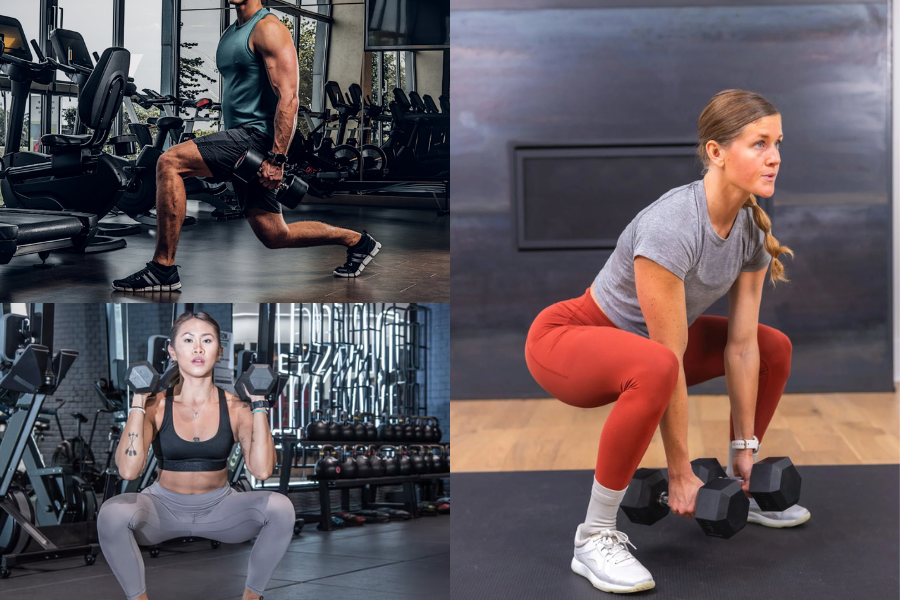
A quad workout with dumbbells is one of the simplest ways to transform your legs at home or in the gym. With just a pair of weights and a little floor space, you can challenge your quadriceps, build strength, support your knees, and improve how you move day to day.
Below, you will learn how your quads work, why dumbbells are so effective for leg training, and exactly which exercises and workouts to use for stronger, more defined thighs.
Understand your quad muscles
Your quadriceps femoris sit on the front of your thighs. This muscle group has four parts that work together to straighten your knee and help control your hip:
- Vastus lateralis on the outer thigh
- Rectus femoris down the front of your thigh
- Vastus medialis on the inner thigh
- Vastus intermedius under the rectus femoris
All four heads are important for leg extension and knee stability, which you rely on every time you walk, run, climb stairs, or get up from a chair. Targeting each head properly helps you build balanced strength instead of overdeveloping just one area of your thighs, as explained in Iron Bull Strength’s 2024 guide to dumbbell quad exercises.
When you build your quad workout with dumbbells around different angles and stances, you can emphasize each head and support healthier, stronger knees.
Why choose a quad workout with dumbbells
Dumbbells are more than a backup option when the squat rack is busy. They offer some unique advantages for your quad workouts.
Each leg has to pull its own weight
With barbells, your stronger side can quietly take over. Dumbbells do not allow that. Each hand holds its own weight, so each leg must work independently. This helps you correct muscle imbalances faster and build more symmetrical thighs, a benefit highlighted in both 2021 and 2024 quad training guides from Iron Bull Strength.
Over time, this can also lower your injury risk, because you are not always letting one side compensate for the other.
More freedom of movement
A dumbbell squat lets your shoulders, hips, and ankles move in a more natural path compared to a fixed bar on your back. This extra freedom can be especially helpful if you:
- Have tight shoulders or limited mobility
- Feel uncomfortable with a barbell on your spine
- Work out at home with limited equipment
The Dumbbell Squat in particular is noted for giving you more movement freedom and improving squat stability, which can be ideal if you have mobility issues or are rebuilding strength.
Easy to progress, wherever you train
You can train your quads hard with a light set of dumbbells by slowing your tempo, increasing reps, or using unilateral moves like lunges and split squats. This makes a quad workout with dumbbells practical at home, in a hotel gym, or in a crowded weight room.
Dumbbell training also boosts your grip strength as a bonus. Stronger hands and forearms can eventually help you lift heavier loads overall.
Best dumbbell exercises for stronger quads
The key to an effective quad workout with dumbbells is picking movements that hit your quads from slightly different angles. Below are tried and tested options, grouped by their main focus.
Dumbbell squats and front squats
1. Dumbbell Squat
This is your main builder for overall quad size and strength. It emphasizes the rectus femoris along the front of your thigh.
How to do it:
Stand with your feet about shoulder width apart. Hold a dumbbell in each hand at your sides or rest them on your shoulders. Keep your chest tall, push your hips back slightly, and bend your knees to lower until your thighs are at least parallel to the floor. Drive through your feet to stand back up.
Dumbbell Squats mainly target the thigh muscles and are praised for improving squat stability while giving you more comfort and movement freedom than a barbell squat.
2. Close-stance Dumbbell Front Squat
Move your feet closer together and hold the weights at your shoulders like front racks. This narrower stance increases the load on your outer quads, especially the vastus lateralis.
Close-stance front squats are highlighted in 2024 quad guides as one of the best ways to emphasize the outer thigh using just dumbbells.
Lunge variations for quad focus
3. Dumbbell Lunge
The Dumbbell Lunge is often ranked as the top quad exercise with dumbbells, because it works your thighs while also building balance and hip stability.
Step one foot forward, lower until both knees are bent to about 90 degrees, then push back to the start. Keep your front knee stacked over your ankle and your torso upright. You can perform them in place or as walking lunges.
4. Bulgarian Split Squat
Place your back foot on a bench or step and hold dumbbells at your sides. This elevated rear foot position throws the work onto your front leg, which lights up the quads and glutes. It is one of the most effective unilateral quad builders and appears consistently in top ten dumbbell quad exercise lists.
5. Dumbbell Reverse Lunge and Side Lunge
Reverse Lunges, where you step backward instead of forward, tend to be gentler on the knees while still challenging your quads. Side Lunges, where you step out to the side and bend one knee, put more spotlight on your inner thigh and vastus medialis, which supports kneecap tracking.
Split Squats, Dumbbell Side Lunges, and Reverse Lunges are all recommended to develop the vastus medialis and help stabilize the knee joint.
Hack squats, step ups, and pulses
6. Dumbbell Hack Squat
Hold the dumbbells behind your hips with your arms extended and perform a squat. This back-loaded position increases the stress on your outer quads. Dumbbell Hack Squats are frequently paired with close-stance front squats to thoroughly work the vastus lateralis.
7. Dumbbell Step Up
Stand in front of a bench or sturdy box. Step up with one foot, drive through your whole foot to stand tall, then lower under control. This move targets the vastus intermedius and rectus femoris while also demanding balance and hip stability. It is a staple in comprehensive quad programs that train you for real life tasks like climbing stairs or hills.
8. Dumbbell Lunge Pulses
Get into a lunge position and move up and down in a small range of about 3 inches instead of standing up fully. This keeps constant tension on the front quad and creates a serious burn in a short time. Lunge pulses are described as a highly effective way to intensely target the quads in 2021 guidance from Iron Bull Strength.
Goblet squats and thrusters
9. Goblet Squat
Hold a single dumbbell vertically against your chest. Squat down, keeping your elbows inside your knees and your chest upright. This position encourages good form, lets you sit deeper into the squat, and works the entire quad group, including the vastus intermedius beneath the rectus femoris.
10. Dumbbell Thruster
A Thruster combines a squat and an overhead press. Start with the dumbbells at your shoulders, perform a full squat, and as you stand, press the weights overhead. This full-body movement hits your quads, glutes, shoulders, and core, and improves balance and coordination. The Thruster is highlighted as a home friendly move that builds strength, balance, and flexibility for all fitness levels.
Sample quad workouts with dumbbells
You can tailor your quad workout with dumbbells to your experience level. Below are three sample structures you can adapt, using the exercises you just learned.
Beginner: Build foundations and confidence
If you are new to strength training, start with 2 quad focused days per week, separated by at least one rest or light activity day.
Try 2 to 3 sets of 10 to 12 slow, controlled reps for each move:
- Bodyweight Squat, then progress to Goblet Squat
- Dumbbell Squat
- Static Dumbbell Lunge or Reverse Lunge
- Dumbbell Step Up
Focus on smooth movement, stable knees, and a full but comfortable range of motion. Many 2024 guides recommend beginning with some bodyweight work to activate your quad muscles before loading them with dumbbells, especially if you have been inactive or are returning from a break.
Intermediate: Superset for intensity
Once you are comfortable with basic form, you can increase the challenge with supersets. This means doing two exercises back to back with little or no rest.
Perform 3 rounds of each superset, resting 60 to 90 seconds between rounds:
-
Superset A
-
Close-stance Dumbbell Front Squat, 8 to 10 reps
-
Dumbbell Hack Squat, 10 to 12 reps
-
Superset B
-
Bulgarian Split Squat, 8 to 10 reps each leg
-
Dumbbell Lunge Pulses, 12 to 15 small reps each leg
Finish with Goblet Squats for 2 sets of 15 slow reps to flush the quads.
Using supersets like these is a method Iron Bull Strength recommends for intermediate lifters who want more intensity without dramatically increasing weight or workout length.
Advanced: Inner and outer quad focus
For more experienced lifters, you can split your workout to emphasize inner and outer quads in the same session. This improves definition and balance.
- Outer quad focus
- Close-stance Dumbbell Front Squat, 4 sets of 6 to 8
- Dumbbell Hack Squat, 3 sets of 8 to 10
- Inner quad and knee stability
- Split Squat or Bulgarian Split Squat, 3 sets of 8 to 10 each leg
- Dumbbell Side Lunge, 3 sets of 10 each side
- Overall quad and conditioning finisher
- 3 rounds of:
- Goblet Squat, 12 reps
- Dumbbell Thruster, 10 reps
Advanced programs like this, which separate inner and outer quad emphasis, are recommended in the 2024 Iron Bull Strength resource to help you fine tune leg development once you have a strength base.
How often to train quads with dumbbells
Most people make good progress with 1 to 2 dedicated leg days per week. A simple format looks like this:
- Day 1: Quad focused with dumbbells
- Day 2: Hamstrings and glutes, plus some calf work
You can add a few quad moves to full body sessions as well, but try to give your legs at least 48 hours between intense quad workouts. This recovery window supports muscle growth, joint health, and consistent performance, which are all highlighted benefits of structured leg training.
Form, safety, and progression tips
A quad workout with dumbbells is only effective if you move well. A few guidelines will keep you progressing safely:
- Choose a weight that challenges the last few reps but does not force you to lose form
- Keep your knees tracking roughly over your middle toes, not collapsing inward
- Brace your core before each rep to support your spine
- Control the lowering phase instead of dropping quickly into the bottom of the squat or lunge
- Increase difficulty gradually by adding reps, sets, or weight, not all three at once
If your knees feel uncomfortable, shorten your range of motion, slow down the tempo, and favor reverse lunges or split squats over deep forward lunges. As your strength and control improve, you can gradually deepen your movements.
A simple rule of thumb: your quads should feel worked and tired after the session, but your joints should not feel sharp pain during it.
Putting it all together
With a well planned quad workout with dumbbells, you do not need a full gym to transform your legs. You can target each head of the quadriceps, balance out strength between sides, and support better performance in anything from walking and hiking to running and sports.
Pick 3 or 4 of the exercises above, start with a beginner or intermediate structure that feels realistic, and commit to two leg focused sessions per week. In a few weeks, you will likely notice stronger, more stable knees and quads that feel ready for whatever your day brings.
About the Author