A strong sprint finish, sharper cuts on the field, and fewer lower leg injuries all have one thing in common: well trained calves. When you build smart, consistent calf workouts for athletes into your routine, you boost speed, improve stability, and create a more resilient foundation for every sport you play.
Below, you will learn how your calf muscles actually work, why they matter for performance, and how to train them with simple but effective exercises.
Understand why your calves matter
Your calf muscles do far more than help you look athletic in shorts. The calf muscle group, often called the triceps surae, includes the gastrocnemius, soleus, and the smaller plantaris. Together they pull your heel upward so you can walk, run, and jump, and they help you stay upright and balanced with every step you take.
For athletes, strong calves are especially important because they support the ankle and knee joints during explosive movements like sprinting, jumping, cutting, and landing. Research has linked dynamic calf strength to sprint performance and short burst speed, which means better calves can directly translate into better times and sharper acceleration on the field or court.
Pulled calf muscles account for a noticeable share of injuries in sports like professional soccer and football, roughly 12 to 13 percent, so building strength here is about prevention as much as performance.
Know your two key calf muscles
You train more effectively when you know what you are targeting. The two main calf muscles you need to focus on are the gastrocnemius and the soleus.
The gastrocnemius is the larger, visible muscle that crosses both your ankle and your knee. It is heavily involved in powerful, explosive actions and is a key supporter of the knee joint. The soleus sits underneath and crosses only the ankle joint. It works harder when your knee is bent and provides crucial ankle support in that position.
Both muscles are critical for athletes. If you only train the big, obvious gastrocnemius and neglect the deeper soleus, you leave a gap in your strength that can show up as fatigue, calf tightness, or ankle issues during long practices and games.
How strong calves boost performance
When you think about performance, it helps to connect specific calf functions to what you feel during training and competition.
Stronger calf muscles can help you:
- Push the ground away more forcefully when you sprint, which improves acceleration and top speed
- Maintain ankle stability when you cut, pivot, or land from a jump, which supports your knees and hips
- Handle repetitive loading in running and jumping without the same level of fatigue or soreness
Research on young basketball players has shown that increasing calf size and strength can improve both vertical jump and speed performance. Another study highlighted that dynamic maximum calf strength is a key factor for short sprint performance in athletes. Together, these findings support what coaches see every day: when you build better calves, you give yourself a better base for almost every movement you perform in sport.
Train with purpose, not just volume
You do not need complicated routines to strengthen your calves, but you do need intention. For most athletes, training calves two to three times per week is enough to see progress while still leaving room for recovery and your main sport work.
A few practical guidelines help you progress safely:
- Use slow, controlled movements so the muscles do the work instead of bouncing through your tendons
- Take your ankle through a full range of motion on each rep, from full stretch to full contraction
- Increase load gradually, typically 10 to 15 percent every couple of weeks, rather than making big jumps
- Stay hydrated and pair your strength work with regular calf stretching and occasional foam rolling for better recovery
Think like a bodybuilder when you train calves. Focus on feeling the muscle working and building controlled tension, instead of just moving weight up and down as fast as you can.
Core calf exercises for athletes
You can build very effective calf workouts for athletes around a small group of tried and tested movements. These exercises are simple to learn, easy to progress, and target both the gastrocnemius and soleus.
Standing calf raises
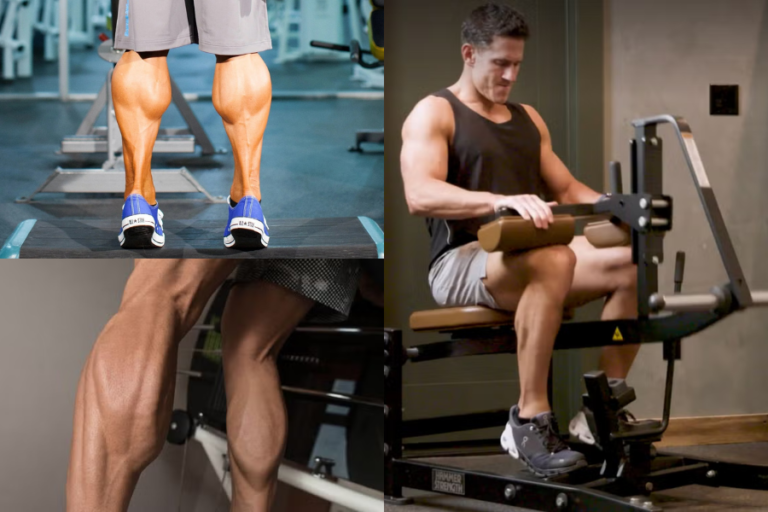
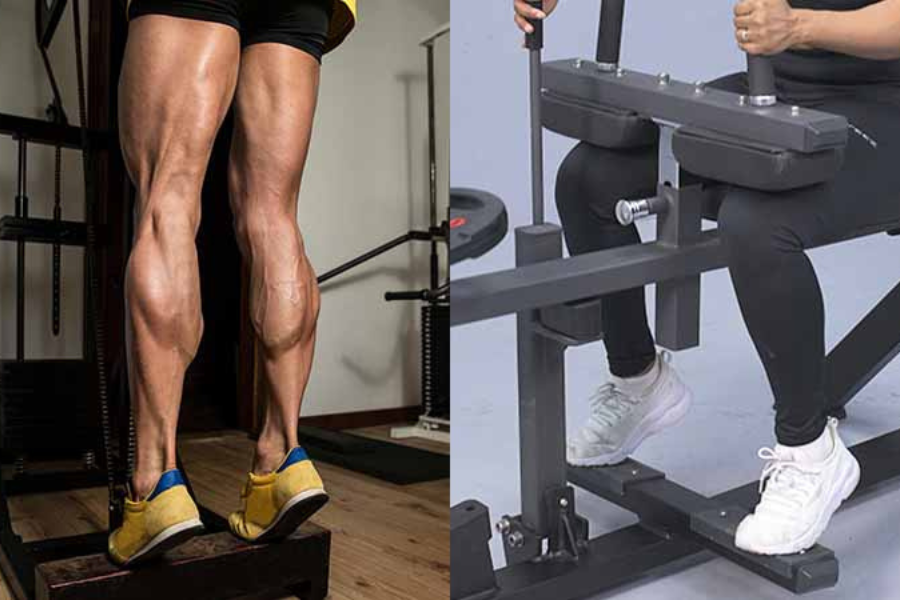
Standing calf raises are one of the best ways to train the gastrocnemius, especially when your goal is power and explosiveness.
You can use a standing calf raise machine, a smith machine, a squat rack, or even bodyweight on a step. The key is to let your heels drop slightly below the platform at the bottom, then rise as high as possible onto your toes.
For athletes, a typical guideline is 4 to 6 sets of 20 or more reps, sometimes as many reps as possible depending on your program. Start with double leg raises, then progress to single leg raises to increase intensity as you get stronger.
Seated calf raises
Seated calf raises shift more of the work to your soleus, because you train with your knee bent at roughly 90 degrees. This deeper muscle is especially important for endurance and long duration efforts like distance running or late game fatigue.
If you have access to a seated calf raise machine, use it. If not, you can improvise with a bench, a step, and a weight resting on your thighs. Aim for a full stretch at the bottom and a strong squeeze at the top on each rep.
Because the soleus is built for endurance, slightly higher rep ranges work well here too. You might perform 3 to 5 sets of 15 to 25 controlled repetitions.
Lying banded calf flexion and extension
Resistance bands give you a joint friendly way to work the calves through different angles. Lying on your back or sitting with your leg extended, loop a band around your forefoot and slowly flex and extend your ankle against the resistance.
By adjusting your knee angle you can emphasize the gastrocnemius with a straighter leg or the soleus with a more bent knee. This makes band work a versatile option for warm ups or finishers.
A practical starting point is 3 to 5 sets of 15 to 20 slow reps. Lighter bands work well early in a session as activation, and heavier bands are better at the end when you want to fully fatigue the muscles.
Straight leg and bent knee calf raises
Sometimes simple bodyweight variations are exactly what you need, especially if you train at home or on the field.
You can think of these as two separate patterns:
- Straight leg calf raise, targeting the gastrocnemius
- Bent knee calf raise, targeting the soleus
On a step or flat ground, perform each version slowly and with intent. Straight leg raises are more explosive and powerful, while bent knee versions build that deep, fatigue resistant strength. Mixing both into your weekly training keeps development balanced.
Sample calf workout for athletes
Use this sample session as a template and adjust sets, reps, and frequency based on your sport, season, and overall training load.
Perform this workout 2 times per week on nonconsecutive days. Add it after your main strength work or as a short standalone session.
-
Lying banded calf flexion and extension
3 sets of 15 to 20 reps per leg, light band, focus on control -
Standing calf raises
4 sets of 20 reps
Use bodyweight or external load, pause for 1 second at the top of each rep -
Seated calf raises
3 to 4 sets of 15 to 20 reps
Move slowly, especially in the lowering phase, and reach a full stretch each time -
Farmer’s walk on toes
2 to 3 sets of 20 to 30 seconds
Hold light to moderate weights, rise onto your toes, and take small, controlled steps
Rest 45 to 75 seconds between sets. If your calves are new to focused strength work, start at the low end of the volume range and gradually build up across a few weeks.
Everyday ways to strengthen your calves
You do not have to be in the gym to challenge your calves. Many sports and daily activities provide a natural training effect.
Running, basketball, soccer, tennis, and hiking, especially uphill, all involve repetitive calf action. Every step, jump, and quick change of direction asks your calves to absorb impact and generate force. If you already play a running or jumping sport, you are stimulating your calves regularly, which means your strength work just needs to complement what you are doing, not overwhelm it.
You can also add small habits into your day, like brief heel raise sets while brushing your teeth or gentle loaded toe walks at the end of a run. These little touches help build endurance and coordination in the muscles that support your ankles and knees.
Reduce injury risk with smart calf training
Calf strength training does not just build speed and power. It also protects your lower legs from common overuse issues.
Well developed calf muscles support the ankle and lower leg, which can help reduce the risk of:
- Ankle sprains in sports with lots of twisting and jumping
- Shin splints by better supporting the muscles and tendons along the front of your lower leg
- Achilles tendon stress from weak calves that shift too much load into the tendon
Because your calves can absorb internal forces of several times your body weight when you run, building their strength and resilience is a smart long term investment. Pair your strength sessions with regular stretching, light mobility work for the ankle joint, and a gradual approach to increasing your running or jumping volume.
If you are currently injured, or feel sharp pain rather than normal training fatigue, check in with a qualified medical or sports professional before adding more calf work. Strength exercises are most effective as a preventative tool and as part of a guided rehab plan, not as a fix you do on your own once pain is already significant.
Bringing it all together
When you program calf workouts for athletes thoughtfully, you give yourself a stronger base for every stride, jump, and change of direction. Focus on both the gastrocnemius and the soleus, use slow and controlled movements, and commit to 2 or 3 targeted sessions each week.
Start with a simple mix of standing calf raises, seated calf raises, and a banded or bodyweight variation. Track your reps and load, increase gradually, and pay attention to how your calves feel during your sport. Over time you should notice better push off, more stable landings, and fewer nagging aches in your lower legs.
About the Author