Understand what an advanced shoulder workout is
If you already lift regularly and want to feel stronger and sharper up top, an advanced shoulder workout can help you break through plateaus. Instead of just pressing a bar overhead and hoping for the best, you focus on every part of your shoulder, along with the muscles that stabilize it.
Your advanced shoulder workout should target:
- Deltoids
- Anterior (front)
- Lateral (side)
- Posterior (rear)
- Rotator cuff
- Traps and rhomboids
- Serratus anterior
Guides like the Gymshark advanced shoulder training overview stress hitting these muscles from multiple angles for strength, stability, and size, and not just chasing a pump in one exercise pattern.
You will see terms like hypertrophy rep ranges of 8 to 12 reps at roughly 70 to 80 percent of your one rep max. This is where you get most of your muscle growth, as long as you use good form and keep adding weight or reps over time.
Protect your shoulders first
Intense shoulder work comes with a catch. The joint is mobile but not naturally very stable. Before you pile on advanced exercises, you need a routine that keeps your shoulders healthy.
Warm up with intent
A good warm up does more than swing your arms around for a few seconds. The Advanced Orthopedics Institute recommends stretching and warming up the arms, shoulders, head, and neck before tougher cardio or strength work like running or weightlifting.
Before your advanced shoulder workout, try:
- 3 to 5 minutes of light cardio
- Arm circles in both directions
- Gentle neck rotations
- Shoulder rolls forward and backward
- Band pull aparts or light cable face pulls
You want your shoulders to feel loose, not tired.
Build in rotator cuff work
Strong rotator cuff muscles help keep your shoulder centered and pain free. Gymshark’s guide highlights external rotation exercises, especially with the elbow bent to 90 degrees, as key for joint stability.
You can add:
- Cable external rotation at your side
- Side lying or prone external rotation with a light dumbbell or band
Keep these light and very controlled. The goal is activation, not max weight.
Respect posture and daily habits
How you move outside the gym matters. Advanced Orthopedics Institute suggests:
- Avoid overreaching for objects, move your feet instead of stretching your arm too far
- Use your legs, not your shoulders and back, to lift heavy items
- Maintain good posture when you sit, stand, or work at a desk
If you notice persistent pain or you cannot lift your arm overhead without discomfort, do not train through it. Advanced Orthopedics Institute recommends talking to a shoulder specialist if pain lingers or your movement is limited.
Structure your advanced shoulder workout
You have several ways to structure your shoulder training. Two common advanced approaches are:
- Pre exhaust with isolation work, then move to heavy presses
- Start with compound presses, then add detailed isolation work for each head of the deltoid
Coaches like Charles Glass, often called the Godfather of Bodybuilding, use a unique twist. His shoulder workout often places isolation exercises like lateral raises and rear delt work before presses. This pre fatigues the muscles so when you press, you recruit more fibers and feel a deeper burn.
Use hypertrophy friendly ranges
For advanced hypertrophy focused training, research supported programming often suggests:
- Sets: 3 to 5 per exercise
- Reps: 8 to 12 per set
- Load: about 70 to 80 percent of your 1RM
- Rest: roughly 45 to 60 seconds for a strong pump and continuous tension
Shorter rests, like the 45 seconds recommended in some of Charles Glass’ routines, keep your delts under tension and can increase the feeling of a solid pump and burn.
Try this advanced shoulder workout (free weights)
Use this sample free weight advanced shoulder workout once every 5 to 7 days. If you already train shoulders twice per week, you can alternate this with a lighter or more machine focused session.
1. Dumbbell lateral raise (lateral delts)
Lateral raises are a classic width builder for the side heads of your delts.
How to do it:
- Stand tall, dumbbells at your sides, palms facing in.
- Raise the dumbbells out to the sides until your elbows reach about shoulder height.
- Pause briefly, then lower with control, staying in roughly the middle 60 percent of your range of motion to keep constant tension.
Tips:
- Avoid swinging the weight up.
- Keep a soft bend in your elbows.
Sets and reps: 3 to 4 sets of 10 to 12 reps.
2. Single arm lateral raise with iso hold
To really sharpen your side delts, you can replace or follow standard raises with a single arm iso hold variation.
How to do it:
- Raise one arm out to the side and hold the dumbbell at shoulder height.
- While you hold that arm up, perform 8 to 10 controlled reps with the other arm.
- Switch sides and repeat.
This method increases time under tension and helps build wider, rounder shoulders by forcing each side to work on its own.
Sets and reps: 2 to 3 rounds per side.
3. Rear delt fly or single arm face pull
Rear delts are often undertrained, which can throw off shoulder balance. You can go with rear delt flyes on an incline bench or swap them for single arm face pulls.
Single arm face pull (cable or band):
- Set the cable or band around upper chest or face height.
- Grab the handle with one hand, step back to create tension.
- Pull your elbow back and slightly up, keeping it high so you feel your rear delt contract.
- Squeeze briefly, then return under control.
Working one arm at a time lets you create a stronger mind muscle connection. This can improve shoulder health and balance.
Sets and reps: 3 sets of 12 to 15 reps per side.
4. Bench assisted upright row
This variation, used in Charles Glass routines, shifts stress toward the front and side delts instead of your traps.
How to do it:
- Stand in front of an incline bench set fairly upright, chest lightly supported.
- Hold a barbell or EZ bar with a slightly wider than shoulder width grip.
- Pull the bar up along your body toward upper chest height, leading with your elbows.
- Stop before your shoulders roll forward, then lower slowly.
Sets and reps: 3 to 4 sets of 8 to 10 reps.
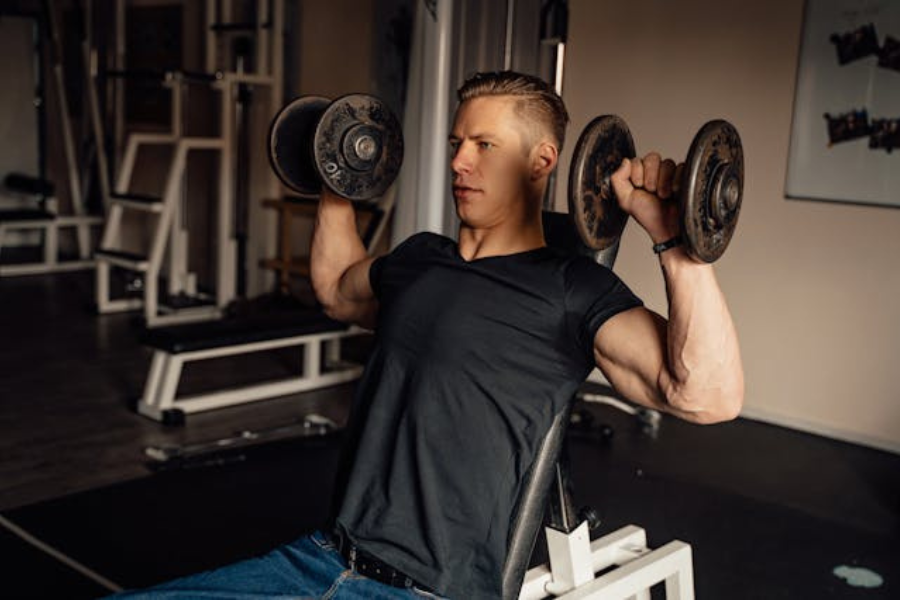
5. Seated dumbbell shoulder press
Once your delts are pre fatigued, presses will feel more demanding even at moderate weight. A seated dumbbell shoulder press will hit both the front and side delts.
How to do it:
- Sit upright on a bench with back support.
- Hold dumbbells at about ear level, palms facing forward or slightly in.
- Press up until your arms are almost straight, but do not lock out harshly.
- Lower until your elbows are roughly at 90 degrees and repeat.
Staying within the middle portion of the movement helps keep tension on the muscles and reduces joint strain.
Sets and reps: 3 to 4 sets of 8 to 12 reps.
Add advanced pressing and shrug variations
Once you have the basics down, you can work in more complex variations that challenge your stability and upper traps.
Standing barbell press with bands
Swapping a standard seated press for a standing barbell press with plates on bands increases the demand on your whole body. The bands create a bouncing effect so you must stabilize through your legs, core, and shoulders while pressing and lowering.
How to use it in your plan:
- Warm up with a regular standing press first.
- Add 3 sets of 6 to 8 reps with a lighter bar weight plus banded plates.
This is best suited to experienced lifters who are comfortable managing instability.
Cable shrug for upper traps
Cable shrugs can give you a stronger upper trap contraction than standard dumbbell shrugs because you pull slightly up and in against the pulleys.
How to do it:
- Stand between two low pulley stacks.
- Hold the handles at your sides with arms straight.
- Shrug your shoulders up and slightly in, then hold for a three second squeeze.
- Lower slowly and repeat.
Sets and reps: 3 sets of 10 to 12 reps.
Train all three heads of the delts
To build fully rounded, three dimensional shoulders, you want separate attention for each delt head, similar to Charles Glass’ five exercise approach.
You can think of it like this:
| Delt head | Main role | Example exercises |
|---|---|---|
| Anterior | Lifting the arm forward, pressing | Overhead press, bench assisted upright row, front cable press |
| Lateral | Lifting the arm out to the side | Dumbbell lateral raise, cable lateral raise |
| Posterior | Pulling the arm back, posture | Rear delt fly, single arm face pull, reverse cable crossover |
Aim for at least one solid exercise per head in your advanced shoulder workout. Over time you can add cable or machine variations like reverse cable crossovers or front cable presses to keep tension constant.
Use cable and machine variations for variety
Free weights are not your only option. Cables and machines can provide smoother resistance, help you isolate muscles, and reduce setup time, which is ideal when you are training hard and often.
Cable functional trainer
A cable functional trainer with shoulder attachments gives you constant tension and a full range of motion for many movements, including:
- Standing or seated cable shoulder presses
- One arm cable lateral raises
- Reverse cable crossovers
- Face pulls
Fitness recommendations for 2025 highlight this kind of trainer as one of the most adaptable pieces of equipment for shoulder work, suitable for everyone from beginners to athletes.
Popular shoulder machines and what they are good for
Here is how different machines can fit into your advanced shoulder workout:
| Machine | Best for |
|---|---|
| Seated shoulder press machine | Safe strength and muscle building for most lifters |
| Plate loaded shoulder press | Barbell like strength work without a spotter |
| Standing overhead press machine | Overhead pressing plus extra core engagement |
| Lateral raise machine | Clean, controlled side delt isolation |
| Rear delt / pec fly machine | Space saving front and rear shoulder isolation |
| Viking press machine | Explosive shoulder strength and real world power |
Selectorized and plate loaded shoulder press machines are especially useful if you want smooth, natural feeling presses with simple weight changes between sets.
Adjust for shoulder health and mobility
If your shoulders feel stiff or you have a history of irritation, you can still train hard, but you may want to choose joint friendly patterns.
Landmine press as a joint friendly option
The Landmine Press lets you press at a diagonal angle instead of straight overhead. This can reduce strain on the shoulder joint and is often suggested for people with mobility issues.
You will still work:
- Anterior and lateral delts
- Traps
- Pecs
- Triceps
Use moderate weight and controlled reps in the 8 to 12 range. Focus on keeping your ribcage down and pressing in a smooth arc.
Use body positions that calm the upper traps
A 2016 systematic review on scapular stabilizer training found that:
- Standing shoulder exercises between 60 and 120 degrees of elevation tend to increase upper trapezius activation
- Prone, side lying, and supine positions often reduce upper trap dominance and improve activation ratios for the middle and lower trapezius
For advanced shoulder workouts that also support scapular stability, this means you can:
- Include prone Y or T raises for mid and lower traps
- Use side lying or prone external rotation for rotator cuff and stabilizers
These positions help train the supporting muscles without letting your upper traps take over.
Program your training for progress
Your advanced shoulder workout will only help you feel stronger and sharper if you train with a clear plan and give yourself enough time to adapt.
Choose your weekly split
If your recovery is solid, you might:
- Train shoulders twice per week, as often recommended in hypertrophy focused programs
- Use one free weight focused day and one cable or machine focused day
- Or alternate a Charles Glass style pre exhaustion workout with a more traditional press first workout every 6 weeks for variety
Advanced programs like ATHLEAN X, created by physical therapist Jeff Cavaliere, combine these types of methods with progressive overload, starting light and increasing gradually. Cavaliere’s advanced shoulder technique is aimed at experienced lifters looking to break plateaus and has been used with professional athletes in leagues like MLB, NFL, and MMA.
Track and tweak
To keep progressing:
- Increase weight when you can hit the top of your rep range with clean form
- Add an extra set to key exercises during heavy training blocks
- Slightly shorten rest periods if you want more pump and conditioning
- Rotate in new variations like banded presses or different machine angles every 6 to 8 weeks
If your performance drops, your joints ache, or your motivation dips hard, pull back slightly on volume or intensity for a week.
Listen to your body and stay consistent
Advanced shoulder training should leave you feeling strong, stable, and more confident with your upper body. To keep it that way:
- Warm up your shoulders and neck before every session, as advised by Advanced Orthopedics Institute
- Avoid habits that strain your shoulders, like overreaching or lifting heavy objects with poor form
- Support your joints with a balanced diet and regular overall activity, which the Institute also links to better shoulder health
Combine these habits with a structured advanced shoulder workout that hits every angle, and you will give yourself the best chance to build bigger, stronger, and more resilient shoulders over the coming months.
About the Author