Understand chest strength basics
A focused chest workout for strength gives you more than a bigger bench. It supports better posture, stronger pressing in everyday life, and a solid base for sports and other lifts. When you train your chest for strength and power, you are not just chasing a pump. You are aiming for heavier loads, smart progression, and enough recovery so you can keep adding weight over time.
Your chest has three main parts that all need work if you want complete strength:
- Upper chest (clavicular head), fibers run up and diagonally
- Mid chest (sternal head), fibers run more horizontally
- Lower chest (abdominal head), fibers run down and inward
You build real strength by:
- Prioritizing heavy compound presses
- Using progressive overload
- Controlling rest intervals instead of rushing sets
- Giving your chest time to recover between hard sessions
Focus on key strength exercises
For a chest workout for strength, you will get the most results from a small group of heavy, multi-joint exercises. You can still add variety, but your main work should stay consistent long enough to progress.
Primary barbell lifts
Barbell bench press
This is your main strength builder. It lets you use the most weight and directly targets the mid chest.
- Use loads above 60 to 70 percent of your 1RM for strength.
- For peak strength, include some sets with very heavy loads above 90 percent of your 1RM.
- Work mostly in sets of 1 to 4 reps, finishing each set with about 2 to 4 reps still in reserve (around RPE 6 to 8). This lets you train heavy without burning out too fast.
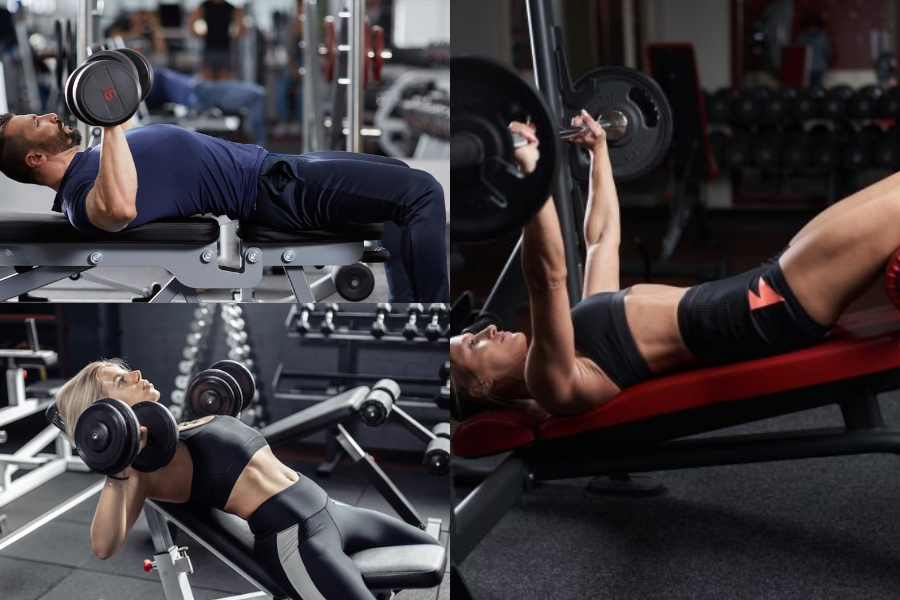
Incline bench press
Incline bench presses shift more stress to the upper chest. This creates a more balanced and powerful chest, not just a bigger mid section.
- Use a moderate incline, around 30 to 45 degrees.
- Work in the 4 to 8 rep range for a blend of strength and size.
Weighted dips
Weighted dips are a strong lower chest builder and also challenge your triceps and shoulders.
- Lean slightly forward to load the chest more.
- Lower with control and avoid bouncing at the bottom.
- Add small weight increases, like 5 to 10 pounds at a time, as you get stronger.
Supporting dumbbell and close grip work
You can use dumbbells and grip changes to support your main barbell work and fill in weak points.
Close grip bench press
Close grip bench presses hit your triceps harder but still stress the chest. They are useful if your lockout is a limiting factor.
- Use a semi-heavy weight that allows about 8 to 10 perfect reps.
- When you reach 10 clean reps, add a small amount of weight.
Flat and incline dumbbell presses
Dumbbells help your shoulders and stabilizer muscles, and they let each side of your body work independently.
- Choose a weight that lets you perform about 8 to 10 controlled reps.
- Focus on full range of motion and a strong squeeze at the top.
- Increase the weight once you can hit 10 clean reps without form breaking down.
Bodyweight and home options
If you train at home or have limited equipment, you can still run a chest workout for strength with some smart exercise choices.
Bodyweight variations that build chest strength include:
- Standard decline push ups for more upper chest focus
- Standard flat push ups for mid chest
- Standard incline push ups for lower chest
- Dips and eccentric dips to load the chest and triceps
You can also use dumbbells at home:
- Dumbbell weighted dips for progressive overload
- Ladder style dumbbell bench press to create high effort with lighter weights
- Eccentric floor fly for controlled hypertrophy work
Resistance bands can also add challenge through constant tension:
- Band resisted push ups
- Crossover push ups
- Chest press variations with a band anchored behind you
Use proven strength programming
The way you structure your sets, reps, and weeks will determine how much strength you actually gain. Instead of repeating the same workout at the same weight for months, give yourself a clear plan that changes the stress slightly over time.
Heavy singles and volume reps
One effective setup for late beginners and intermediate lifters alternates between volume weeks and heavy weeks:
- Volume work uses moderate loads and higher reps to build muscle and reinforce technique.
- Heavy work uses singles or low rep sets to teach your body to produce more force.
For example, a 10 week chest strength program can:
- Rotate between weeks focused on rep work and weeks that include heavy singles.
- Keep your main bench work once per week so you recover fully.
- Pair the bench press with close grip and dumbbell presses and incline work on alternating weeks to hit all areas of the chest.
Lifters using this type of structure have reported solid 1RM bench press gains over 10 week cycles, such as moving from 275 pounds to 290 pounds, and from 269 pounds to 307 pounds after a single cycle, with more progress in later cycles.
Example weekly structure
You can adapt these ideas into a simple weekly template.
Day 1, heavy focus
- Barbell bench press
- Warm ups, then 3 to 6 heavy sets of 1 to 4 reps at RPE 6 to 8
- Close grip bench press
- 3 sets of 6 to 8 reps
- Optional assistance, 2 to 3 sets each
- Row or pull variation
- Light shoulder work
Day 2, volume and hypertrophy
- Incline dumbbell press
- 3 to 4 sets of 8 to 10 reps
- Weighted dips
- 3 to 4 sets of 6 to 10 reps
- Fly variation or cable crossover
- 2 to 3 sets of 10 to 15 reps
Keep your weekly volume realistic. For maximal strength, 2 to 3 chest exercises per workout are usually enough, especially if the weights are heavy and you are pushing intensity.
Full body and beginner options
If you are new to lifting or on a full body program, you do not need a large menu of chest exercises.
- Start with 1 chest exercise per day.
- Use 2 to 3 sets of 8 to 12 reps per exercise.
- Focus on learning proper technique and avoid early specialization. This reduces injury risk and sets you up for long term strength gains.
Get your rest intervals right
How long you rest between sets affects what kind of results you get from your chest workout for strength.
Research on strength training and chest workouts suggests:
- Resting 3 to 5 minutes between sets when using loads between 50 and 90 percent of your 1RM lets you complete more reps across multiple sets. This supports higher training volume and better strength gains over time.
- Chronic strength adaptations, such as absolute strength increases, are greater with 3 to 5 minute rest intervals because you can sustain both intensity and volume.
- Muscular power is higher when you rest 3 to 5 minutes between sets compared to only 1 minute. That matters if you care about explosive reps and powerful pressing.
For maximal strength efforts:
- One minute may be enough for some repeated attempts, but 3 to 5 minutes is usually safer and more reliable. It gives you enough time for your nervous system and energy stores to recover so you can perform at your best.
For muscle size focused work:
- Moderate intensity sets with short rest intervals of about 30 to 60 seconds can be effective for hypertrophy. These shorter rests increase acute growth hormone levels and make the muscle work harder under fatigue.
You can combine both:
- Use 3 to 5 minutes of rest for your heaviest bench sets.
- Use 60 to 90 seconds of rest for lighter assistance and hypertrophy exercises like flyes and push ups.
Plan recovery and rest days
Strength is built when you rest, not just when you lift. Hard chest sessions create microscopic tears in your muscle fibers. During rest days, fibroblast cells help repair that tissue, and your muscles come back stronger and more resilient.
Weekly rest planning
To support strength gains and prevent overuse:
- Let each major muscle group rest for 1 to 2 days after a hard workout.
- Program your heavy chest session once per week, then add any lighter pressing or push work later in the week if your overall volume and recovery allow it.
- A pattern like chest, back, legs, arms, shoulders, with two rest days, can work as long as you respect fatigue and do not turn every day into a max effort session.
Rest days also help:
- Replenish glycogen stores in your muscles so you can push hard again next session.
- Reduce injury risk and overtraining.
- Keep your motivation higher because you are not constantly run down.
Nutrition on rest days
Your muscles still need fuel and building blocks when you are not in the gym.
- Aim for about 1.2 to 2.0 grams of protein per kilogram of body weight per day to support repair and growth.
- Keep your general caloric intake slightly above maintenance if your goal is to gain strength and size.
On rest days after a heavy chest workout, think of your meals as part of the training plan. The goal is to give your body what it needs to rebuild.
Break through common chest plateaus
If you feel stuck on your chest workout for strength, you are not alone. It is common to see progress on lifts like squats or deadlifts while your chest seems to stall.
Imagine this scenario:
- You press 60 pound dumbbells on incline and flat bench for 3 sets of 8.
- You do flyes and cable crossovers for 3 sets of 10.
- Your weights and reps have not moved for four months.
- Your calories are slightly above maintenance and you get around 100 grams of protein per day.
If this sounds familiar, a few key issues may be holding you back.
Problem 1: No progressive overload
Repeating the same weight and reps for months will not drive new strength gains.
Try:
- Adding a small amount of weight to one exercise each week, even if you have to drop the reps slightly.
- Using rep targets, for example, once you hit 3 sets of 10 at a given weight with solid form, increase the weight in your next workout.
- Cycling your rep ranges, such as spending a few weeks at 6 reps, then 8, then 10, and repeating.
Problem 2: Missing heavy work
If you never train with loads above 60 to 70 percent of your 1RM, your nervous system does not get the signal to become stronger.
You can:
- Add a barbell bench press day with sets of 1 to 4 reps at moderate to heavy intensity.
- Include occasional singles at a weight that is challenging but not a grinder, leaving a couple of reps in reserve.
This type of heavy work is a shortcut to increasing chest strength and then chest size.
Problem 3: Too much volume on the same day
Doing many similar pressing and fly variations in one session can drain your energy without improving strength.
Simplify your chest day:
- Start with 1 or 2 serious strength exercises, like barbell bench and weighted dips or incline bench.
- Add 1 to 2 assistance moves if you still have good energy.
- Cut back on the number of isolation movements if they are not leading to clear progress.
Problem 4: Recovery and technique gaps
If your rest, nutrition, or form is off, your strength will stall even with good programming.
Check your basics:
- Are you resting long enough between heavy sets? If you rush with only 60 seconds after heavy bench work, you are probably limiting your performance.
- Are you pausing the bar briefly on your chest and pressing with control, or bouncing reps? Controlled form leads to repeatable progress.
- Are your shoulders set back and down, with your feet planted, so you have a stable base?
Small improvements in these areas can unlock more weight without changing much else.
Sample strength focused chest workouts
Use these sample plans as starting points. Adjust sets, reps, and volume based on your experience and how quickly you recover.
Gym based strength workout
Workout A, strength heavy
- Barbell bench press
- Warm up, then 4 sets of 3 reps at a challenging but smooth weight
- Rest 3 to 5 minutes between sets
- Close grip bench press
- 3 sets of 6 to 8 reps
- Rest 2 to 3 minutes
- Weighted dips
- 3 sets of 6 to 10 reps
- Rest 2 minutes
- Optional, light chest fly or push up finisher
- 2 sets of 12 to 15 reps
- 60 seconds rest
Workout B, strength and size
- Incline bench press
- 4 sets of 6 to 8 reps
- Rest 2 to 3 minutes
- Flat dumbbell bench press
- 3 sets of 8 to 10 reps
- Rest 90 to 120 seconds
- Dips or push up variation
- 3 sets close to, but not at, failure
- Rest 90 seconds
Alternate these workouts with at least one full rest day between chest focused sessions.
Home or limited equipment workout
If you have only dumbbells and bodyweight:
- Ladder style dumbbell bench press
- Choose a weight you can press for about 12 reps.
- Do 4 reps, rest 15 seconds, do 5 reps, rest, continue adding 1 rep until you cannot complete the next step with good form.
- Eccentric floor fly
- 3 sets of 8 to 10 slow reps, lowering for 3 to 4 seconds.
- Decline push ups
- 3 sets close to fatigue, with strong technique.
- Dips between sturdy surfaces or chairs
- 3 sets of as many quality reps as you can do.
Rest 60 to 90 seconds between sets for these movements.
Put it all together
To build a powerful chest that is strong, not just pumped, keep your focus on a few basics:
- Center your chest workout for strength on heavy presses like the barbell bench, incline bench, and weighted dips.
- Train with loads above 60 to 70 percent of your 1RM, and include some very heavy sets above 90 percent when you are ready.
- Use longer rest intervals, about 3 to 5 minutes, for your heaviest sets so you can keep intensity high and build more strength.
- Add more moderate and short rest work for size, but do not replace your heavy sets with only pump style training.
- Respect rest days, fuel your body with enough protein and calories, and treat recovery as part of the plan, not an afterthought.
- Make progressive overload non negotiable, by increasing weight, reps, or total work over time.
Start by adjusting one part of your current routine, such as adding a heavy bench day or extending your rest between sets. Then track your numbers for a few weeks. When the weights start moving again, you will know your chest is finally getting the strength focused training it needs.
About the Author