Understand a machine back workout
A machine back workout gives you a structured way to train your lats, traps, and spinal muscles using gym equipment with fixed paths. Machines guide your movement, so you can focus on feeling the muscles work instead of worrying about balance.
In this guide, you will:
- Learn the main back machines and what they target
- Get a sample machine-only back workout you can follow
- See form tips and common mistakes to avoid
- Understand how and when to add free weights later
You will see the term “machine back workout” throughout, along with related movements like lat pulldowns, seated rows, and back extensions, so you can recognize them on the gym floor.
Know your key back muscles
Before you start pulling on cables and handles, it helps to know what you are trying to feel.
Your machine back workout will mostly target:
- Latissimus dorsi (lats): Large muscles on the sides of your back that create a V-taper look. Lat pulldowns and high rows hit these hard.
- Trapezius (traps): Upper and mid back muscles that help with posture and shoulder stability. Shrugs and rows load them directly.
- Rhomboids: Muscles between your shoulder blades that pull the shoulders back. Seated rows and rear delt machines work these.
- Rear deltoids (rear delts): Back of your shoulder. Rear delt machines and chest-supported rows target them.
- Spinal erectors (lower back): Long muscles along your spine. Back extension and some rowing patterns strengthen them.
A good machine back workout will touch all of these over the course of the week, not just your lats.
Compare machines and free weights
You can build a strong back with either machines or free weights. Each has tradeoffs, so you want to understand how they fit into your training.
Pros of machine back workouts
Machines are especially helpful if you are a beginner or coming back from a break.
- Guided path: Weight machines have fixed movement patterns and provide stability and guidance, which is highly beneficial while you are learning fundamental movement patterns safely and effectively as of 2024.
- Confidence for beginners: If heavy barbells feel intimidating, machines let you practice form with less risk, sometimes under professional supervision.
- Easier to isolate muscles: Chest-supported rows or rear delt machines keep your torso stable so you can focus on specific muscles.
- Adjustable resistance: Cable machines and pin-loaded stacks make it easy to change weight between sets.
Cons and limits of machines
Relying only on machines has some downsides.
- Limited range of motion: Overreliance on machines can limit your natural movement, and free weights generally provide superior muscle stimulation for the back muscles, as noted in Muscle & Fitness in 2025.
- Less stabilizer involvement: Machines reduce the need for stabilizing muscles, so your nervous system and smaller supporting muscles do not develop as quickly compared to free weights.
- Fixed positions and back pain: The fixed positioning required by most machines can be problematic if you have back pain. For example, the Smith machine has a fixed bar path that may not allow you to find a pain-free movement pattern.
Best approach over time
A balanced approach often works best:
- Start with a machine back workout to learn movement patterns and build base strength.
- Gradually add free weight exercises like barbell rows or dumbbell rows as your form and confidence improve.
- Keep some machines in your plan for isolation and higher-rep work.
Expert trainers at Sports West Athletic Club in Reno, NV suggest exactly this kind of progression, starting with machines then incorporating free weights for optimal strength and muscle growth.
Learn the main back machines
You do not need to use every machine in your gym. Focus on a small set that covers different angles of the back.
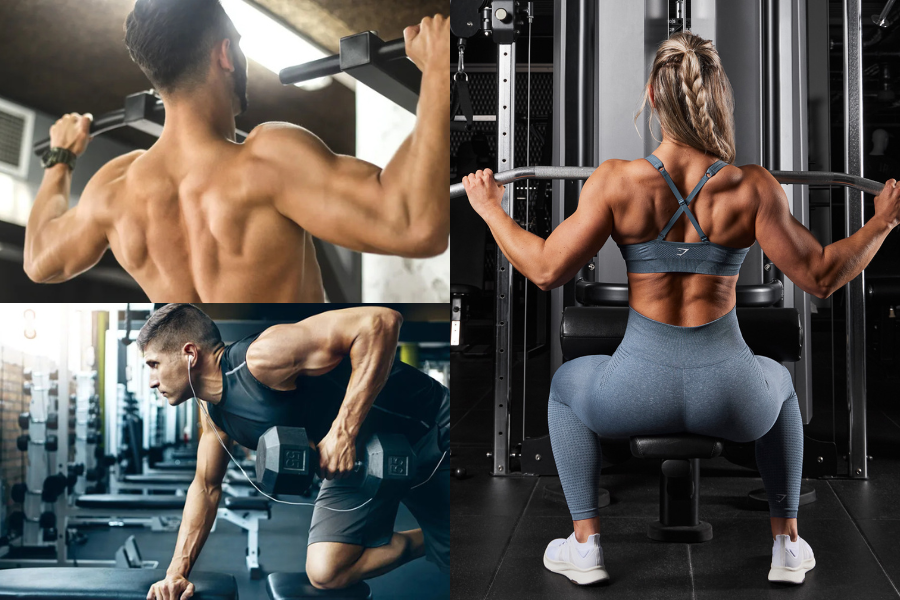
Lat pulldown machine
The lat pulldown is one of the most effective exercises in any machine back workout.
What it trains
- Primary: Latissimus dorsi
- Secondary: Teres major, traps, rear delts, biceps, forearms
How to set up
- Adjust the thigh pad so your legs are snug under it.
- Sit tall with your chest up and feet flat.
- Take a grip slightly wider than shoulder-width, palms facing away (overhand).
How to do it
- Start with your arms straight and your shoulders relaxed, not shrugged.
- Pull the bar down toward your upper chest, thinking about driving your elbows down and in.
- Pause briefly when the bar reaches chin or upper chest level.
- Slowly return the bar to the top, letting your lats stretch, without letting the weight slam.
Form tips
- Do not pull the bar behind your neck. This can strain your shoulders and spine.
- Avoid rocking your torso or using momentum.
- Think “pull with your elbows,” not with your hands, to keep tension in your back.
Common mistakes include arching the back aggressively, using the forearms instead of the lats, holding the bar too wide, pulling past the chin, and using momentum. These reduce effectiveness and increase injury risk.
Seated cable row
The seated cable row is a staple for building a thick, strong mid-back.
What it trains
- Primary: Scapular muscles (rhomboids, mid traps)
- Secondary: Lats, rear delts, biceps, forearms, erector spinae
How to set up
- Sit with a slight bend in your knees and feet on the platform.
- Keep your back straight and your core gently braced.
- Grab the handle, usually a V-handle or straight bar.
How to do it
- Start with your arms straight and shoulders reaching slightly forward for a mild stretch.
- Pull the handle toward your lower belly or navel, leading with your elbows, not your hands.
- Squeeze your shoulder blades together at the end of the row.
- Slowly extend your arms back to the start without letting your back round.
The seated row is particularly effective when you sit tall and avoid leaning back during the pull.
High row machine
The high row machine combines a pulldown and a row angle, which is excellent for the upper and outer back.
What it trains
- Primary: Latissimus dorsi
- Secondary: Lower and mid back, rear delts, traps
How to set up
- Sit facing forward with your chest against the pad if there is one.
- Adjust the seat so the handles are at about chest level or slightly above.
- Grab the handles with a firm grip.
How to do it
- Start with arms straight and shoulders relaxed.
- Pull the handles down and back in an arc, aiming your elbows toward your ribs.
- Pause with your shoulder blades squeezed together.
- Slowly return to the starting position under control.
Chest-supported row machine
The chest-supported row machine is very beginner friendly because it removes the temptation to swing or use your lower back.
What it trains
- Primary: Lats, rhomboids, mid and lower traps
- Secondary: Rear delts, biceps
Key benefits
- The chest pad provides torso stability, which reduces wobble and helps you maintain strict form.
- You can row heavier with less risk of lower back strain.
Focus on keeping your chest lightly pressed against the pad, driving your elbows back, and avoiding shrugging your shoulders toward your ears.
Back extension machine
The back extension machine targets the lower back and the muscles that support your spine.
What it trains
- Primary: Spinal erectors
- Secondary: Glutes, hamstrings
How to do it
- Sit or position yourself so your hips are aligned with the pivot of the machine.
- Start with your torso flexed forward at the waist.
- Slowly straighten your back until you are in line with your legs, not hyperextended.
- Lower under control and repeat.
Slow and controlled movement is crucial here. This exercise strengthens spine support muscles when you avoid jerking or swinging.
Rear delt and lateral raise machines
These are often grouped with shoulder machines, but they are useful in a machine back workout for posture and upper back balance.
Rear delt machine
- Trains the rear deltoids, rhomboids, and traps.
- You sit facing the pad, grab the handles, and open your arms in a reverse fly motion.
- Keep the weight light so your traps do not dominate the movement.
Lateral raise machine
- Targets the middle deltoid to build shoulder width.
- Although it is a shoulder exercise, stronger, broader shoulders support upper back aesthetics and posture.
- The machine encourages controlled movements with less momentum, which is helpful for beginners.
Assisted pull-up machine
If you cannot yet do bodyweight pull-ups, assisted variations let you practice the pattern.
How it works
- The machine uses a counterweight (or sometimes bands) to reduce how much of your bodyweight you are lifting.
- You can choose different grips: chin up, neutral grip, regular pull up, or wide grip.
Focus on:
- Keeping your shoulders down and away from your ears.
- Pulling your chest up toward the bar.
- Controlling the descent instead of dropping.
Over time you can reduce the assistance until you can perform unassisted pull-ups.
Smith machine rows and shrugs
The Smith machine locks the bar into a fixed vertical path. That has pros and cons.
Inverted rows
- You can set the bar at about waist height, lie under it, and pull your chest toward the bar.
- This variation works the lats, rhomboids, delts, biceps, and forearms while putting less emphasis on the lower back and can be a lower-back-safe option.
Shrugs
- Machine shoulder shrug and Smith machine shrug target the upper traps.
- The guided path provides stability and reduces strain on other muscles.
Be aware that the fixed bar path may not fit every body type or back condition, so if something feels painful rather than challenging, adjust or choose another exercise.
Avoid common machine back workout mistakes
Machines feel safer, but you can still waste a lot of effort with poor habits. Watch out for these.
Letting your biceps do all the work
When you pull with your hands instead of your elbows, your biceps and forearms take over. This is especially common on lat pulldowns and rows.
Try this cue:
- Imagine your hands are hooks.
- Focus on driving your elbows down or back.
- Think about squeezing your armpits or shoulder blades, not curling the weight.
Using too much momentum
If you are rocking, swinging, or jerking the weights, you are bypassing the muscle tension you want.
Slow, controlled reps:
- Improve your mind-muscle connection.
- Reduce injury risk.
- Make lighter weights feel harder, which is good for muscle growth.
Ignoring the lower back
Many lifters skip direct lower back training, relying only on standing exercises. According to the 2025 Muscle & Fitness guide, neglecting to isolate the spinal erectors is a frequent error, and targeted isolation exercises are necessary to maximize their size and strength.
Add at least one of these weekly:
- Back extension machine
- Seated back extension machine
- Light back extensions in a controlled range
Relying only on rowing machines
High rows, low rows, unilateral rows, and row/pulldown combos are useful, but many bodybuilders depend too much on these and ignore other patterns. According to Muscle & Fitness in 2025, a more complete plan includes vertical pulling (pulldowns or pull-ups), horizontal rows, and lower back work.
Letting grip strength limit your back
Grip fatigue often ends the set before your back is truly tired, especially on machines and free weights. As explained in Muscle & Fitness in 2025, weak grip reduces your ability to maximally stimulate your back muscles.
You can:
- Use slightly thicker handles or specific grip exercises on other days.
- Use straps sparingly on your heaviest sets so your back, not your hands, is the limiting factor.
Follow this sample machine-only back workout
You can run this machine back workout 1 or 2 times per week. Give yourself at least 48 hours between sessions that hit the same muscles.
Option A: Beginner-friendly routine
If you are new to lifting or returning from time off, start here.
- Lat pulldown machine
- 3 sets of 10 to 12 reps
- Rest 45 to 60 seconds between sets
- Focus on smooth, controlled form
- Seated cable row
- 3 sets of 10 to 12 reps
- Keep your back straight and avoid leaning back
- Chest-supported row machine or high row machine
- 3 sets of 10 to 12 reps
- Pause briefly with shoulder blades squeezed together
- Back extension or seated back extension machine
- 2 to 3 sets of 12 to 15 reps
- Use light to moderate weight with strict control
- Rear delt machine
- 2 to 3 sets of 12 to 15 reps
- Keep the weight light to keep traps from taking over
- Smith machine or machine shrugs (optional)
- 2 sets of 12 to 15 reps
- Avoid rolling your shoulders, just straight up and down
Option B: Intermediate machine workout
If you already lift consistently and want more variety and intensity, try this structure. It reflects the idea of combining machine work with progressive overload, similar to intermediate and advanced routines that use 3 sets of 10 to 12 repetitions with short rests.
- Assisted pull-up machine or wide grip lat pulldown
- 3 sets of 8 to 10 reps
- Use less assistance or slightly heavier weight over time
- Seated cable row
- 3 sets of 8 to 10 reps
- Heavier weight, still with solid form
- High row machine
- 3 sets of 10 to 12 reps
- Try different grip widths over the weeks
- Straight arm lat pulldown (cable)
- 2 to 3 sets of 10 to 12 reps
- Focus on keeping elbows slightly bent, arms mostly straight, and pulling with your lats
- Back extension machine
- 3 sets of 10 to 15 reps
- You can add a slight pause at the top for more tension
- Rear delt machine or reverse fly machine
- 3 sets of 12 to 15 reps
- Controlled tempo, no swinging
If you have extra time, you can add lateral raises to support shoulder and upper back aesthetics, especially if posture is a goal.
Progress your machine back workout safely
Machines make it easy to adjust the challenge. Here is how to keep improving without overdoing it.
Adjust reps and sets
A simple progression:
- Start with 3 sets of 10 to 12 reps on each main exercise.
- When you can complete all sets at the high end of the rep range with clean form, increase the weight slightly.
- If you are more advanced, you can move to 3 to 4 sets and use intensity techniques like drop sets, similar to advanced back plans that use 3 to 4 sets with a drop set on the last set.
Prioritize form over load
Even though machines feel secure, do not rush to stack the plates.
- Maintain a full but comfortable range of motion.
- Control both the lifting and lowering phases.
- Stop a set if you feel sharp pain, especially in your spine or shoulders.
Listen to your back, especially with fixed-path machines
Machines like the Smith machine or certain leg press and squat machines lock you into a single path. For people with back pain or post-surgery limitations, that can be an issue because they do not allow you to adjust your position easily to find a pain-free groove.
If a specific machine consistently hurts, try:
- Changing seat height or foot position.
- Switching to a different machine movement that trains a similar muscle group.
- Asking a trainer to check your setup.
Free weights allow more freedom to modify loading and form for pain avoidance, so as your confidence grows, plan to blend them in.
Fit machines into a long-term back plan
You do not have to choose between machines and free weights forever. You can use both in a smart sequence.
Phase 1: Learn and build confidence
Focus mostly on:
- Lat pulldown machine
- Seated cable row
- Chest-supported row or high row
- Back extension machine
- Rear delt machine
Your goal in this phase is to master technique, feel your back muscles working, and build consistency.
Phase 2: Mix machines with simple free weights
When your form feels solid, you can begin adding:
- Dumbbell rows
- Simple barbell or Smith machine rows (if your back tolerates them)
- Unassisted pull-up work, even if it is just a few reps at the start of your session
Keep some machine exercises for higher-rep sets and to reduce fatigue on stabilizer muscles.
Phase 3: Use machines strategically
As you get stronger, machines become a tool, not the whole program.
You might:
- Start your workout with heavy free weight rows or pull-ups.
- Move to machine rows and pulldowns for controlled volume.
- Finish with isolation work like rear delt and back extensions.
This combination helps you develop muscle size, strength, and coordination while still enjoying the structure and safety of your favorite machine back workout.
Key takeaways
- A machine back workout is an effective, beginner-friendly way to train your lats, traps, rhomboids, rear delts, and lower back.
- Lat pulldowns, seated cable rows, high rows, chest-supported rows, back extensions, and rear delt machines cover most of what you need.
- Focus on pulling with your elbows, moving slowly, and not letting grip or momentum limit your back training.
- Machines have limits, especially for range of motion and pain modulation, so plan to add free weights over time.
- Start with simple machine progressions, then gradually build toward a balanced program that fits your body and your goals.
If you are unsure where to start, pick 3 or 4 of the beginner exercises, keep the weights modest, and focus on controlled movement. You can add more complexity once your back feels stronger and your confidence in the gym grows.
About the Author