A hamstring workout without weights is one of the simplest ways to build strength, protect your knees, and support your hips, all with almost no equipment and very little time. You can do these moves in your living room, office, or hotel room, and still get a meaningful workout that fits a busy schedule.
Below you will find short, efficient routines plus clear instructions so you can start training safely today, even if you are new to strength training.
Understand your hamstrings and why they matter
Your hamstrings are a group of three muscles that run along the back of your thigh, from your hip to just below your knee. They are responsible for hip extension and knee flexion, which means they help you walk, run, squat, and bend comfortably. Peloton instructor Matty Maggiacomo explains that these muscles play a key role in daily movement and exercise performance.
When your hamstrings are weak compared to your quadriceps, you are more likely to feel knee strain and discomfort. This imbalance is especially common in women and can affect your running form and stability. Strengthening your hamstrings without weights is an easy way to balance things out and reduce your risk of pain and injury.
Plan your weekly hamstring training
You do not need a complicated program to get results. What you do need is consistency.
Research on bodyweight hamstring exercises suggests that doing about 10 to 16 sets per week can both reduce hamstring injury risk by around 49 percent and support muscle growth, even without weights. You can get these sets by:
- Doing a short hamstring circuit 3 times per week
- Or adding 2 or 3 hamstring moves to the end of your usual workouts
- Or dedicating one slightly longer lower body session to focused hamstring work
If your schedule is tight, aim for 2 sessions per week to start, each lasting 10 to 15 minutes. As you get used to the movements, you can add an extra round or another exercise.
Think of these workouts as basic maintenance for your legs, just like brushing your teeth is maintenance for your teeth.
Warm up in five quick minutes
Before you jump into your hamstring workout without weights, spend a few minutes getting blood flowing. This can be simple and low impact.
Try this quick warm up:
- March in place for 60 seconds, lifting your knees and swinging your arms.
- Bodyweight squats for 10 to 15 reps to wake up your hips and thighs.
- Standing leg swings for 10 swings per leg, front to back, with a wall or chair for support.
- Standing straight‑leg hamstring stretch by hinging forward from your hips, letting your upper body hang, for 20 to 30 seconds.
You should feel warm and a little looser but not tired. If anything feels sharp or painful, scale the movement back or skip it for now.
Beginner hamstring exercises without weights
If you are new to strength training or returning after a break, start here. These moves focus on form and control rather than intensity.
Good mornings
Good mornings are a simple hip hinge that teaches you how to move from your hips instead of your lower back.
- Stand with feet hip‑width apart and a soft bend in your knees.
- Place your hands lightly behind your head or across your chest.
- Push your hips back as if you are closing a door with your glutes, keeping your back flat.
- Hinge forward until you feel a gentle stretch in the back of your thighs.
- Press through your heels and squeeze your glutes to return to standing.
Start with 2 sets of 10 to 12 slow reps.
Bodyweight Romanian deadlifts
These are similar to good mornings, but you focus more on driving your hips back and feeling the hamstrings engage.
- Stand tall with feet under your hips and arms hanging by your sides.
- Keep your chest open and shoulders back.
- Push your hips back, slide your hands down the front of your thighs, and keep your spine neutral.
- Stop when your hamstrings feel tight but not painful.
- Return to standing, squeezing your glutes at the top.
Aim for 2 sets of 8 to 10 slow, controlled reps.
Glute bridges
Glute bridges mostly target your glutes, but they also work the hamstrings through hip extension and help you learn to engage the back of your legs.
- Lie on your back with knees bent and feet flat, hip‑width apart.
- Brace your core, then press your heels into the floor.
- Lift your hips until your body forms a straight line from shoulders to knees.
- Pause for 1 to 2 seconds at the top, then lower slowly.
Try 2 sets of 10 to 15 reps.
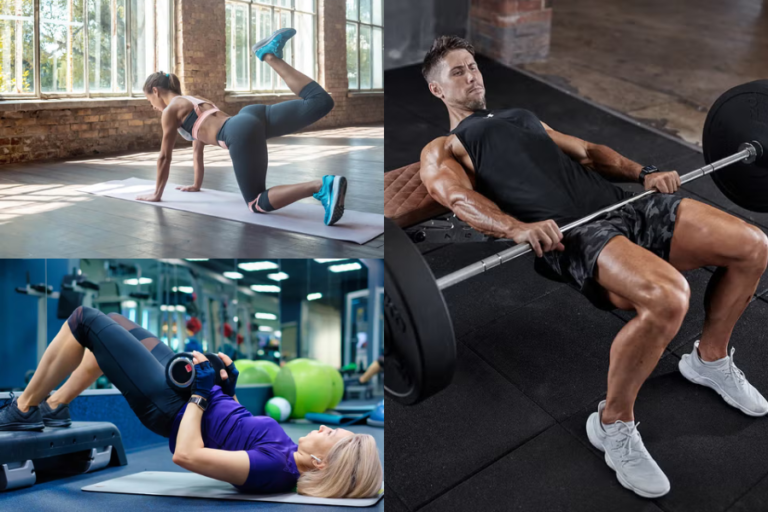
Donkey kicks
Donkey kicks focus on hip extension, which brings the hamstrings and glutes into play.
- Start on hands and knees, wrists under shoulders and knees under hips.
- Lift your right leg, keeping the knee bent at 90 degrees.
- Press your heel toward the ceiling without arching your lower back.
- Lower with control and repeat.
Complete 10 to 15 reps per leg for 2 sets.
Intermediate bodyweight hamstring moves
Once these basics feel comfortable, you can move to single‑leg and slightly more challenging variations that build balance and strength.
Reverse lunges
Reverse lunges are easier on your knees than forward lunges and they challenge your hamstrings and glutes along with your quads.
- Stand tall with feet hip‑width apart.
- Step your right foot back into a lunge, lowering until both knees are bent about 90 degrees.
- Keep your front knee stacked over your ankle and torso upright.
- Push through the heel of your front foot to return to standing.
Do 8 to 10 reps per leg for 2 to 3 sets.
Single‑leg Romanian deadlifts
Single‑leg RDLs are excellent for balance and for targeting each hamstring individually. You do not need weights for these to feel challenging.
- Stand on your left leg with a slight bend in the knee.
- Hinge at your hips, extending your right leg straight back.
- Keep a straight line from your head to your lifted heel and reach your hands toward the floor.
- Stop when your back is roughly parallel to the floor or when you feel your balance limit.
- Return to standing slowly.
Go for 10 to 12 reps per leg, keeping the movement slow, and try 2 to 3 sets.
Straight single‑leg bridges
This is a bridge variation that loads one leg at a time and hits the hamstrings harder.
- Lie on your back, knees bent.
- Extend your right leg straight so only your left foot is on the floor.
- Press through the left heel to lift your hips.
- Pause, then lower with control.
Perform 8 to 10 reps per leg for 2 sets.
Advanced hamstring exercises for bodyweight only
If you already train regularly and want a serious challenge that still fits a busy day, these moves will push your hamstrings without equipment. Take your time learning them and reduce your range of motion if needed.
Bulgarian split squats
These deeply target the front leg, including the hamstrings and glutes.
- Stand about two feet in front of a sturdy chair or bench.
- Place the top of your right foot on the chair behind you.
- Lower your back knee toward the floor, keeping your front knee tracking over your toes.
- Press through your front heel to return to standing.
Aim for 8 to 10 reps per side for 2 to 3 sets.
Jump squats
Jump squats add power and increase hamstring and glute engagement. Skip these if you have knee or joint issues.
- Start in a regular squat stance.
- Lower into a squat, keeping your chest lifted.
- Explosively jump upward, reaching your arms overhead.
- Land softly and go directly into the next squat.
Try 2 sets of 8 to 12 reps, focusing on soft, controlled landings.
Nordic hamstring curls (glute ham raises)
Nordic curls heavily target the hamstrings through eccentric control. They are challenging but effective. You can do a home version by tucking your feet under a heavy piece of furniture or asking a partner to hold your ankles.
- Kneel on a soft surface with your body upright and your feet anchored.
- Engage your core and glutes.
- Slowly lean your body forward from the knees, keeping your hips extended and back straight.
- Lower as far as you can control, then catch yourself with your hands and gently push back up.
Start with 3 to 5 reps and build up as you gain strength.
Sliding leg curls
Sliding leg curls mimic a hamstring curl machine using household items. According to a training guide highlighted by Muscle & Fitness on Rehab 2 Perform, this move challenges your hamstrings, glutes, and lower back using just a smooth surface and something under your heels to slide on.
You can use:
- Socks on hardwood or tile
- Paper plates on carpet
- Furniture sliders on almost any surface
To perform the curl:
- Lie on your back with legs straight and heels on your sliders.
- Lift your hips into a bridge position.
- Bend your knees and slide your heels toward your glutes, keeping hips lifted.
- Extend your legs back out slowly.
Do 2 sets of 8 to 10 reps. When that feels easy, try single‑leg curls or V‑curls where you bring your heels in and out in a V shape.
Simple routines for busy schedules
To make your hamstring workout without weights manageable, pair a few of the exercises above into short routines you can rotate through the week.
10‑minute beginner routine
Do this circuit 2 or 3 times per week:
- Good mornings, 10 to 12 reps
- Glute bridges, 12 to 15 reps
- Donkey kicks, 10 to 12 reps per leg
- Standing straight‑leg hamstring stretch, 20 to 30 seconds
Move from one exercise to the next with short rests. Complete 2 rounds if you are pressed for time or 3 if you have a little more space in your day.
12‑minute intermediate routine
Once beginner moves feel comfortable, try:
- Bodyweight Romanian deadlifts, 10 reps
- Reverse lunges, 8 to 10 reps per leg
- Single‑leg bridges, 8 to 10 reps per leg
- Hamstring stretch of your choice, 20 to 30 seconds
Repeat 2 or 3 times, resting 30 to 45 seconds between rounds.
15‑minute advanced routine
For a tougher challenge:
- Bulgarian split squats, 8 to 10 reps per leg
- Sliding leg curls, 8 to 10 reps
- Nordic hamstring curls, 3 to 5 reps
- Short sprinting, 15 to 20 seconds, if you have space outdoors or in a hallway
Rest 45 to 60 seconds between exercises and complete 2 rounds. Short sprinting is an excellent way to heavily engage your hamstrings with no equipment when you have a safe, open area to run.
Do not forget flexibility and recovery
If you sit for long periods, your hamstrings can feel tight even as you strengthen them. Building in a few stretches helps you move more comfortably and may reduce your risk of strain. According to Real Simple, helpful options include:
- Standing straight‑leg hamstring stretch or forward fold
- Downward Dog
- Half kneeling hamstring stretch
- Supine hamstring stretch while lying on your back
A good rule of thumb is to stretch after your workout for 5 minutes. Hold each stretch for at least 20 seconds and breathe steadily.
On rest days, gentle movement like walking, light cycling, or yoga will keep blood flowing to your muscles so they recover better between sessions.
Putting it all together
You do not need a gym or heavy weights to build strong, resilient hamstrings. With a short, focused hamstring workout without weights, you can:
- Support your knees and hips
- Improve your balance and running form
- Counteract long hours of sitting
- Stay consistent, even when your schedule is packed
Start by picking one of the beginner or intermediate routines and commit to it twice this week. Once it feels easier, add a round or swap in a more advanced move. Small, regular sessions will add up faster than you expect.
About the Author