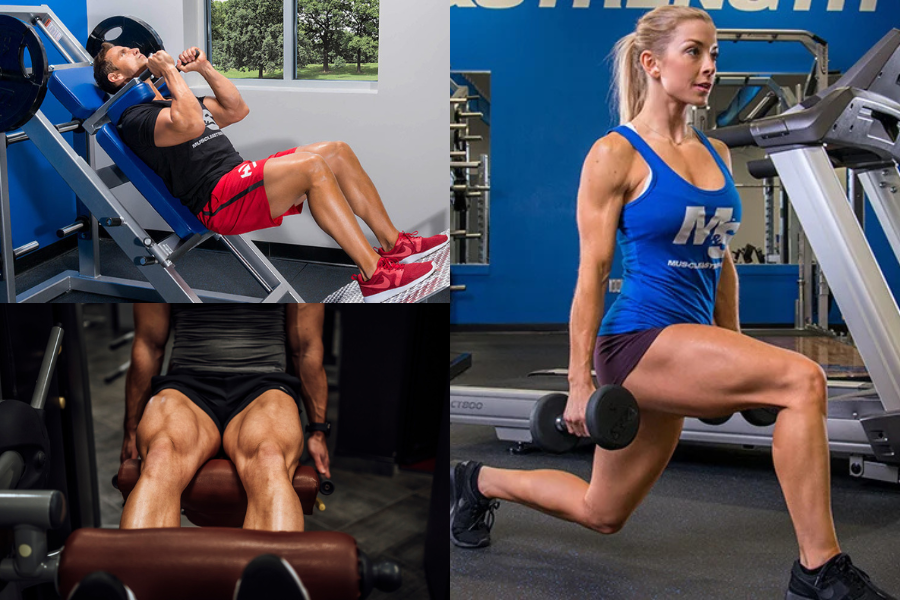
A solid pair of quad workouts does more than make your thighs look stronger. It supports your knees, improves your balance, and makes everyday tasks like climbing stairs or getting up from the couch feel easier. With a few simple quad exercises, you can build strength safely, even if you are just starting out.
Below, you will find beginner friendly explanations, gym and at home options, and tips to avoid common quad training mistakes, so you can work your quads with confidence.
Understand your quad muscles
Your quadriceps are the large muscles on the front of your thighs. They are responsible for straightening your knees and also help flex your hips when you walk, run, or kick.
The group is made up of four muscles: Rectus Femoris, Vastus Lateralis, Vastus Medialis, and Vastus Intermedius. All four need attention in your quad workouts if you want well rounded thighs and reliable knee support, as highlighted in guides from Gymshark.
When your quads are strong, you are better able to:
- Stabilize your kneecap and protect your knee joint
- Jump, kick, and change direction more powerfully in sports
- Walk, stand, and climb stairs with less effort, especially as you age
On the other hand, weak or tight quads can contribute to knee pain, poor posture, and difficulty with daily movement.
How often to train your quads
You do not need to work your legs every day to see results. In fact, your quads grow and get stronger when you rest after challenging them.
A practical structure is:
- Train quads 2 times per week
- Include at least 2 quad focused exercises per session
- Aim for a minimum of 10 hard sets per week across all quad exercises
For most strength and muscle goals, 3 to 4 sets of 8 to 12 reps per exercise works well, according to training recommendations summarized by Gymshark in 2024. Leave at least 48 hours between intense quad sessions so your muscles and joints can recover.
If you are new to strength training, start closer to 2 sets of 10 to 12 reps for each move, as suggested by Healthline’s beginner guidelines for quad exercises. You can then slowly add a set or a few reps over time.
Warm up before quad workouts
A short warm up prepares your knees and hips and reduces your chance of injury. You do not need anything fancy.
Spend 5 to 10 minutes on simple moves such as:
- Brisk walking or light cycling
- Leg swings front to back
- Gentle bodyweight squats with a shallow range of motion
Healthline recommends this type of warm up before starting quad exercises to increase blood flow and mobility. Once your legs feel looser and your heart rate is slightly elevated, you are ready for your main quad workout.
Quad workouts you can do at home
You can train your quadriceps effectively in a small space with little or no equipment. The key is to control each rep, bend your knees deeply, and focus on the front of your thighs doing the work.
Bodyweight squats
Bodyweight squats are a simple way to start training your quads.
- Stand with your feet about hip to shoulder width apart.
- Keep your chest lifted and look straight ahead.
- Bend your knees and hips to sit back and down, as if into a chair.
- Go as low as you can while keeping your heels down and knees comfortable.
- Push through the middle of your feet to stand back up.
Start with 2 sets of 10 to 12 reps. As you improve, you can add a third set or pause briefly at the bottom of each squat to increase difficulty.
Walking lunges
Walking lunges work each leg separately and build balance, coordination, and quad strength.
- Stand tall with your feet together.
- Step one foot forward and lower your hips until both knees are bent about 90 degrees.
- Keep your front knee roughly above your toes and your torso upright.
- Push through your front foot and bring your back leg forward into the next lunge.
Aim for 2 sets of 10 steps per leg. You can do these in place if you do not have room to walk by stepping forward and then back to the starting position.
Step ups
Step ups mimic climbing stairs and are very friendly for building quad strength that you will use every day.
- Stand facing a sturdy step, box, or low bench.
- Place one foot fully on the step.
- Push through that foot to lift your body up, bringing your other foot onto the step.
- Step back down with control.
Perform 2 sets of 10 reps per leg. Choose a step height that lets you feel your thighs working without straining your knee.
Wall sits
Wall sits build endurance in your quads without any movement, which can be easier on your joints.
- Stand with your back against a wall.
- Walk your feet forward and slide your back down the wall.
- Stop when your knees are bent around 90 degrees, as if you are sitting on an invisible chair.
- Keep your knees over your ankles and hold the position.
Healthline suggests holding for about 30 seconds for 2 sets, or as long as you can manage, with a short rest in between.
If you feel pain inside your knee joint, come out of the position and try a shallower bend next time. You want strong effort in your muscles, not sharp discomfort in your joints.
Beginner friendly quad exercises with weights
Once bodyweight moves feel manageable, adding weight can help you continue to progress. You still do not need a full gym. A pair of dumbbells or a single kettlebell is often enough to level up your quad workouts.
Goblet squats
Goblet squats are a great bridge between bodyweight and barbell squats. Holding the weight in front of your chest encourages better posture and takes some pressure off your lower back.
- Hold a kettlebell or dumbbell close to your chest with both hands.
- Stand with your feet slightly wider than hip width.
- Bend your knees and hips to squat down, keeping your chest tall.
- Go as low as you can without rounding your back.
- Drive through your feet to stand up.
Healthline recommends 2 sets of 10 reps with about 60 seconds of rest between sets for beginners.
If your ankles feel stiff or your heels want to lift, you can raise your heels on a small plate or wedge. Gymshark notes that elevating the heels increases knee flexion and shifts the emphasis more directly onto the quads, which is especially helpful if your ankle mobility is limited.
Split squats
Split squats help you address strength differences between legs and challenge your balance.
- Stand tall and take a step forward into a lunge stance.
- Hold dumbbells by your sides or place your hands on your hips if you are still learning the movement.
- Lower your hips straight down, keeping your front knee above your toes.
- Stop just before your back knee touches the floor.
- Press through your front foot to stand back up.
A beginner friendly routine is 2 sets of 10 reps per side, with about 30 seconds of rest, as suggested in Healthline’s quad training guidance.
Bulgarian split squats
Once regular split squats feel comfortable, Bulgarian split squats increase the stretch and load on your front quad.
- Stand about two feet in front of a bench or sturdy chair.
- Place the top of one foot on the bench behind you.
- Keep your chest up as you lower your back knee toward the floor.
- Allow your front knee to bend deeply, keeping it roughly aligned over your toes.
- Drive through your front heel to return to standing.
Healthline recommends 2 sets of 10 reps per side with short rest breaks for this exercise as part of beginner quad training. You can hold onto a wall or back of a chair for balance at first.
Gym based quad workouts for faster gains
If you have access to a gym, you can use barbells and machines to place more focused and heavier load on your quadriceps. This is useful if your goal is noticeable muscle growth or you want to increase your strength for sports.
Front squats
Front squats place the bar in front of your body, which encourages a more upright torso and shifts more of the work to your quads compared to back squats.
- Rest the barbell across the front of your shoulders.
- Keep your elbows high and chest lifted.
- Squat down, allowing your knees to travel forward so they stay in line with your toes.
- Aim for a controlled depth where your thighs are at least parallel to the floor.
- Drive up through your midfoot and keep your torso upright.
Gymshark highlights front squats as a key quad focused movement thanks to this upright position and increased knee flexion.
Heel elevated goblet or barbell squats
Heel elevated squats are one of the most reliable ways to feel your quads light up.
- Place your heels on a small plate or slant board.
- Use either a goblet hold or a barbell.
- Squat down while keeping your weight centered and your knees tracking over your toes.
Research summarized by Gymshark notes that elevating the heels increases knee bend and puts more load on the quads, as well as helping lifters with limited ankle mobility access a deeper squat position.
Hack squats and leg press
Machine based quad exercises can be very helpful when you want to train hard while keeping your lower back supported.
For both hack squats and leg press:
- Place your feet lower on the platform to increase knee flexion.
- Let your knees track with your toes rather than caving inward.
- Use a full range of motion, going as deep as you can while staying in control.
Gymshark explains that low foot placement on the leg press increases quad activation by forcing more knee bend and that many people limit growth by using a shortened range of motion and too much weight. Choose a weight that lets you perform slow, full reps instead of heavy half reps.
Do not forget recovery and balance
Your quad workouts become more effective when you pair hard effort with smart recovery and balanced training.
Stretching and foam rolling
Regular quad stretches help reduce tightness that can pull on your hips and lower back. A simple standing quad stretch, where you hold your foot behind you and gently bring your heel toward your glutes, can improve posture and balance by easing tension in the front of your thighs.
Foam rolling your quads for a couple of short rounds after training can also reduce muscle spasms and improve flexibility. Healthline suggests 2 sets of about 20 seconds of rolling with brief rests between rounds.
Do not overdo quad focused moves
It is possible to have too much of a good thing. A 2026 leg training guide from SQUATWOLF points out that overloading your training with quad dominant exercises while neglecting hamstrings and glutes can lead to muscle imbalances and chronic knee issues.
To stay balanced:
- Include hamstring and glute exercises like Romanian deadlifts or hip thrusts in your weekly plan.
- Avoid turning every leg exercise into a quad move by leaning too far forward or using poor squatting form.
- Respect recovery days so your joints have time to adapt.
Putting it all together
You do not need advanced skills or a full gym membership to benefit from quad workouts. Start with bodyweight squats, lunges, and step ups a couple of times per week. As you grow more comfortable, add goblet squats, split squats, or gym based moves like front squats and leg presses.
Focus on:
- Full, controlled range of motion
- Knees tracking in line with your toes
- A training schedule that you can stick with consistently
Over time, you will notice stronger thighs, more stable knees, and more confidence in everyday movements.
About the Author