Understand why barbell bicep exercises work
If you want bigger, stronger arms, barbell bicep exercises are one of the fastest ways to get there. Barbells let both arms work together so you can lift heavier weight than you typically can with dumbbells. Heavier loads mean more tension on the biceps, which is a key driver of muscle growth and strength.
When you curl a barbell correctly, you mainly train three muscles:
- Biceps brachii, the main “bicep” you see in the mirror
- Brachialis, a deeper muscle that adds thickness to your upper arm
- Brachioradialis, a forearm muscle that helps bend your elbow and stabilize your arm
You get fast results when you combine two things:
- Smart exercise choices that let you progress weight over time
- Clean technique that keeps the stress where you want it, on your biceps, not your lower back or shoulders
The barbell bicep exercises below focus on both.
Set up for safe, strong curls
Before you start loading plates, you want your basic setup right. Proper technique not only keeps you safer, it makes every rep work harder for you.
Nail your starting stance
For most barbell bicep exercises, you will use a similar base position:
- Stand with your feet about shoulder width apart
- Keep a slight bend in your knees, do not lock them out
- Brace your core as if you are about to be lightly poked in the stomach
- Keep your chest up and shoulders relaxed, not rounded forward
This stable stance helps you avoid swinging the weight and turning a bicep curl into a whole body heave.
Dial in your grip
On a straight barbell curl you will usually:
- Grip the bar with palms facing up (underhand or supinated grip)
- Place your hands just outside hip width or about shoulder width
- Keep wrists neutral, not bent backward or forward
A shoulder width grip gives you a strong position without stressing your wrists. A closer grip tends to emphasize the outer part of the biceps, while a slightly wider grip can shift some focus toward the inner head, but those differences are subtle compared to simply using good form and consistent tension.
Master the basic barbell bicep curl
The standing barbell curl is the classic move for bigger biceps. It allows you to handle more weight than almost any other curl variation and it targets both heads of the biceps brachii along with the brachialis and brachioradialis.
Here is how to perform it step by step:
- Stand tall with feet shoulder width apart and core braced.
- Hold the barbell with an underhand grip, hands just outside your hips. Arms should be straight, but elbows not hyperextended.
- Tuck your elbows close to your sides and keep them there.
- Without leaning back, curl the bar up by bending only at the elbows. Think about pulling your knuckles toward your shoulders.
- Pause at the top and squeeze your biceps. You should feel a strong contraction.
- Lower the bar in a slow, controlled motion over 2 to 4 seconds until your arms are straight again.
According to guidance from The Gym Group, pausing at the top and controlling the eccentric or lowering phase over a few seconds increases muscle engagement and can help stimulate more growth.
Common mistakes to avoid
- Swinging your hips or leaning back to get the bar moving
- Letting your elbows drift forward, which turns the movement into more of a shoulder exercise
- Dropping the bar quickly instead of controlling it down
- Using a weight so heavy that you cannot reach full extension at the bottom
If you are new to barbell bicep exercises, start with light weight. Focus on clean reps and full range of motion, then slowly add weight or reps as your technique improves.
Try these six effective barbell bicep exercises
Once you are comfortable with the standard curl, you can add variations that target different parts of your arms and keep your training fresh. Below are six barbell bicep exercises that deliver fast, noticeable results when you use them consistently.
1. Standing barbell curl
You just learned the setup, but it is worth repeating because this is your staple mass builder.
Why it works
- Lets you use relatively heavy weight for strong progressive overload
- Trains both heads of the biceps plus the brachialis and brachioradialis
- Fixed bar path encourages symmetrical movement and balanced development
How to program it
- 3 to 4 sets of 6 to 10 reps
- Rest 60 to 90 seconds between sets
- Place it early in your workout when your arms are fresh
Keep the last 2 reps of each set challenging but doable with good form. If you are swinging to finish every set, the bar is too heavy for now.
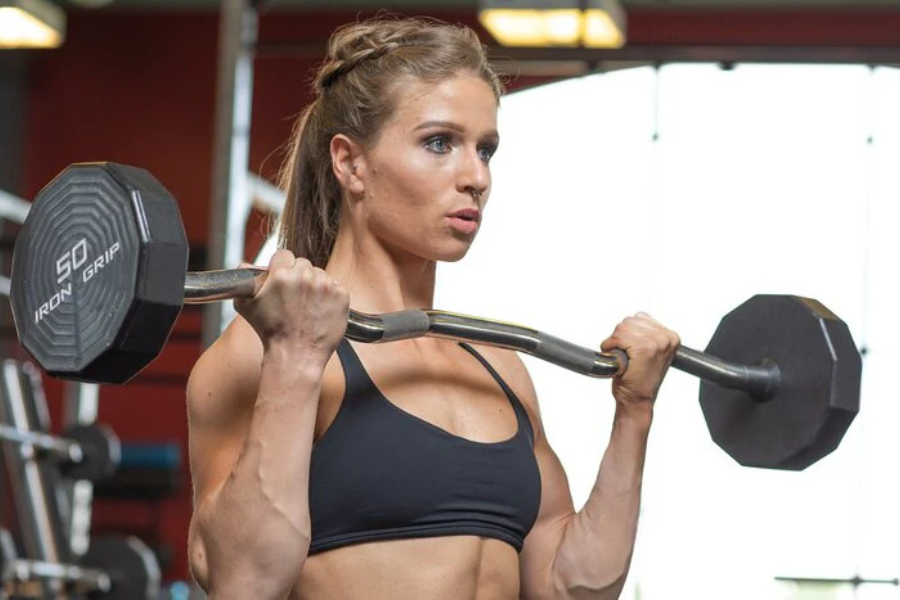
2. EZ bar curl
If straight bars bother your wrists, the EZ bar curl is a joint friendly alternative that still hits your biceps hard. The angled grips reduce wrist strain and can feel more natural for many lifters.
How to do it
- Stand with your usual stance and core braced.
- Grip the EZ bar on the inner or outer angled sections, palms facing slightly inward.
- Tuck your elbows to your sides.
- Curl the bar up without letting your elbows move forward.
- Squeeze at the top, then lower slowly for 2 to 4 seconds.
According to late 2024 guidance, the EZ bar curl puts less tension on your shoulder joint compared with a straight bar while still effectively targeting the biceps.
When to use it
- If straight bar curls hurt your wrists or shoulders
- As your main curl movement on some days and a secondary variation on others
Aim for 3 sets of 8 to 12 reps at a controlled tempo.
3. Barbell reverse curl
The reverse curl shifts emphasis to your forearms and the brachialis, which sits underneath your biceps and helps add thickness to your upper arm.
How to do it
- Grip the bar with palms facing down, about shoulder width apart.
- Keep elbows glued to your sides and wrists straight.
- Curl the bar up by bending at the elbows. Do not let your wrists collapse.
- Pause briefly at the top, then lower under control.
Research summarized in PeerJ notes that reverse curls significantly increase brachioradialis activation, which contributes to stronger elbow flexors and more complete arm development.
Why you should include it
- Builds gripping muscles that help with deadlifts, rows, and pull ups
- Balances your arm training so you are not only chasing bicep peak
Use slightly lighter weight than you do on standard curls. Go for 2 to 3 sets of 10 to 15 reps.
4. Barbell drag curl
The drag curl is a more focused variation that places extra tension on the long head of the biceps. This can help with that high “peak” many people want.
How to do it
- Stand with your normal stance and underhand grip.
- As you curl, pull your elbows back behind your body and “drag” the bar up your torso, keeping it close to your body the whole time.
- The bar should travel in a straight line up your shirt, not in an arc away from your body.
- Pause and squeeze at the top when the bar is near the lower chest, then slowly lower it back down along the same path.
Biomechanically, moving your elbows back increases the load on the outer fibers of the biceps, which can help with overall mass and shape.
Tips
- Use moderate weight so you can keep the bar close and elbows sliding backward
- Stop before your shoulders roll forward
Try 3 sets of 8 to 12 reps, focusing on the squeeze at the top.
5. Curls against the wall
Performing barbell curls with your back and hips against a wall takes momentum out of the equation. You cannot lean back, so your biceps have to do the work.
How to do it
- Stand with your heels about 6 inches from a sturdy wall.
- Place your head, upper back, and glutes lightly against the wall.
- Grip the bar with your usual underhand, shoulder width grip.
- Curl the bar up without letting your back or hips leave the wall.
- Lower slowly for 3 to 4 seconds.
Guidance from a November 2024 article notes that wall curls improve isolation and help maximize bicep activation because they remove body English and swinging.
When to use them
- As a strict form finisher after your heavier curls
- During a mechanical drop set, starting with strict wall curls, then stepping away from the wall and using a little body English to squeeze out a few extra reps
Keep sets in the 8 to 12 rep range and focus on control.
6. Lying incline “death” curls
Despite the dramatic name, these are simply barbell or EZ bar curls performed lying face up on a 45 degree incline bench. This position keeps constant tension on your biceps.
How to do it
- Set an incline bench to about 45 degrees.
- Lie back with your head and upper back supported and feet flat on the floor.
- Hold the bar with your usual curl grip and let your arms hang straight down toward the floor.
- Curl the bar up without letting your shoulders round forward.
- Lower slowly until your arms are fully extended and you feel a stretch in your biceps.
According to late 2024 guidance, this constant tension across a long range of motion is effective for hypertrophy and can help you feel a strong pump, especially in the bicep peak.
Programming idea
- 3 sets of 10 to 15 reps, lighter weight and slow tempo
- Use as a second bicep move after heavier standing curls
Choose the right weight and reps
Using the right load is just as important as choosing the right barbell bicep exercises. Too heavy and your form falls apart. Too light and your muscles are not challenged enough to grow.
General loading guidelines
The “standard” barbell weight sometimes quoted for curls is about 110 lb or 50 kg, but your ideal weight depends entirely on your current strength and goals.
You can use these simple targets:
- For size and strength gains:
- 3 to 4 sets of 6 to 10 reps
- Last 2 reps feel tough, but your form stays tight
- For more muscle endurance and a strong pump:
- 2 to 3 sets of 10 to 15 reps
- Slight burn in the last few reps, still controlled
If you cannot lower the bar slowly for at least 2 seconds, you are probably using too much weight. If you finish your set and feel like you could do 10 more clean reps, it is time to add a little more.
Make the most of the lowering phase
Multiple coaching sources, including The Gym Group and training articles from 2022, highlight how important the eccentric or lowering phase is for hypertrophy. You generate more force while lowering than lifting, which can stimulate more growth.
You can build this into your curls by:
- Lifting the bar in about 1 to 2 seconds
- Pausing briefly at the top
- Lowering for 3 to 4 seconds
Strength coach Jeff Cavaliere has even recommended using up to 4 seconds on both the lifting and lowering phases for some sets to increase biceps muscle activity and prevent the front delts and forearms from taking over. This slower tempo also forces you to pick a weight you can truly control.
Avoid common bicep curl mistakes
You do not need a complicated routine to see fast progress, but you do need to avoid a few frequent errors that hold people back.
Using momentum instead of muscle
If your barbell bicep exercises look like a mini backbend, you are using too much weight. Common signs of swinging include:
- Rocking your torso to get the bar moving
- Arching your lower back as the weight gets heavy
- Bending your knees and turning the curl into a half squat
This not only reduces tension on your biceps, it can also stress your lower back and shoulders. Drop the weight a bit, tighten your core, and think about moving only at the elbows.
Cutting the range of motion short
Heavy weights often lead to partial reps where:
- You never fully straighten your arms at the bottom
- You stop the curl long before you reach full contraction at the top
Training through a full, safe range allows your biceps to work harder and adapt more. Lower the bar until your arms are straight but not locked, then curl until you cannot move without your elbows drifting forward.
Overtraining your biceps
It is tempting to hit curls every day if you are chasing fast arm growth, but your muscles grow when you rest, not while you lift. Overdoing it can stall or even reverse your progress, especially if you are already training back with rows and pull ups, which also involve the biceps.
A simple guideline:
- Train biceps 2 times per week
- Use 3 to 5 total bicep focused exercises across the week, not in every session
- Leave at least 48 hours between intense bicep workouts
If your elbows feel sore, your pumps feel “flat,” or your strength is going down, pull back a bit on volume and intensity.
Build a simple barbell bicep routine
You can start seeing changes in your arms with a straightforward plan that fits around your other training.
Sample beginner friendly routine
Do this 1 to 2 times per week, ideally after your main compound lifts like rows, pull ups, presses, or deadlifts.
- Standing barbell curl
- 3 sets of 8 to 10 reps
- 60 to 90 seconds rest
- EZ bar curl or curls against the wall
- 2 to 3 sets of 10 to 12 reps
- 60 seconds rest
- Barbell reverse curl
- 2 sets of 12 to 15 reps
- 45 to 60 seconds rest
Focus on nailing technique for the first 4 to 6 weeks. Add small amounts of weight or a rep or two each week as long as your form stays solid.
Progressing as you get stronger
Once you are comfortable, you can rotate variations week to week. For example:
- Week A: Standing barbell curl, EZ bar curl, reverse curl
- Week B: Standing barbell curl, drag curl, lying incline curl
This keeps training interesting and gives each muscle a slightly different challenge while still centering your plan around proven barbell bicep exercises.
What to do if you do not have a barbell
If your gym is crowded or you train at home without a barbell, you can still hit your biceps effectively.
Guidance from The Gym Group notes that dumbbell curls are a solid alternative. You can use:
- Alternating dumbbell curls
- Hammer curls
- Incline dumbbell curls
The same posture and elbow positioning rules apply. Barbells allow you to go heavier and emphasize overall mass and strength, while dumbbells are excellent for ironing out left and right side imbalances.
Key takeaways
- Barbell bicep exercises are one of the most efficient ways to build arm size and strength because they let you lift heavier with both arms working together.
- Start with the standing barbell curl, then add joint friendly and target focused variations like EZ bar curls, drag curls, reverse curls, wall curls, and incline “death” curls.
- Use a controlled tempo, especially on the lowering phase, to keep tension on the biceps and reduce help from your shoulders and lower back.
- Choose a weight that challenges you while still allowing strict form and full range of motion.
- Train your biceps 2 times per week, avoid overtraining, and progress steadily for fast, sustainable results.
Try adding one or two of these barbell bicep exercises to your next workout. Pay attention to how they feel, especially the squeeze at the top and the slow lower, and adjust the weight so your last reps are tough but clean. With a few weeks of consistent practice, you will start to see and feel the difference in your arms.
About the Author