Advanced calf workouts can do more than build definition. When you train your calves with intention, you support your ankles, protect your knees, and add real power to your running, jumping, and change of direction.
Below, you will find how to structure advanced calf workouts that build strength, endurance, and explosiveness without overloading your joints. You will also learn how to warm up, choose the right loads, and progress safely.
Understand your calf muscles
Before you stack plates on the calf raise machine, it helps to know what you are training.
Your calves are mainly two muscles:
- Gastrocnemius: The larger, more visible muscle that helps with sprinting and jumping. It works hardest when your knee is straight.
- Soleus: A deeper muscle that supports posture and endurance. It works more when your knee is bent.
Research has shown that changing your knee angle shifts which muscle is most active. A 2014 study by Suzuki and colleagues found that plantar flexion with bent knees increases soleus activation and reduces gastrocnemius activity, which means bent knee calf exercises are important if you want balanced strength across both muscles.
Calf muscles also contain a high proportion of slow twitch fibers. A 2020 paper led by Brad Schoenfeld reported that calf growth is similar with different loads as long as you work with high effort. In practice, this means you can grow your calves with lighter or heavier weights, provided you push close to fatigue and keep your volume high.
Warm up for intense calf training
Advanced calf workouts ask a lot of your lower legs, so a good warm up is non negotiable. Your goal is to increase blood flow, gently load the tendons, and wake up the ankle joint.
Start with 3 to 5 minutes of light cardio like brisk walking or cycling. Then move into dynamic moves that target the calves directly, such as leg swings and high knees. These kinds of exercises help improve flexibility and activate the muscles before you put them under heavier load.
You can finish your warm up with a couple of easy sets of bodyweight calf raises, both straight leg and bent knee, using a slow tempo. This gives your Achilles tendon a chance to adjust before you move on to heavier resistance or plyometrics.
Use proper form to protect your joints
When you move to advanced calf workouts, small form mistakes get magnified. Good technique lets you focus on your muscles while keeping your joints safe.
Keep these points in mind on every rep:
- Stable core: Lightly brace your abs so your spine stays neutral, especially on standing raises or loaded carries.
- Aligned knees and hips: Your knees should track in line with your toes, not collapsing inward or bowing out.
- Controlled tempo: Lower your heels slowly and use a brief pause at the bottom. Avoid bouncing or using momentum, which shifts stress to your Achilles tendon rather than the muscle.
- Full range of motion: Let your heel drop below the step under control, then rise as high as you can onto your toes.
New York Bone and Joint Specialists point out that controlled resistance work like standing and seated calf raises helps build endurance and resilience in the calves, which in turn reduces fatigue and injury risk. That benefit depends on clean technique, so it is worth checking yourself in a mirror or filming a set from time to time.
Build strength with heavy calf raises
Once you have solid form, you can start treating calf training like any other serious strength work. Bodyweight alone usually is not enough for advanced calf workouts, especially if you are a runner or field sport athlete.
Guidelines from the American College of Sports Medicine recommend loads that allow about 8 to 12 good reps per set for strength and hypertrophy. In the calf context, that means using weight that brings you close to fatigue by the last rep while you still maintain clean form.
Find your 10 rep max (10RM)
A practical way to set your training load is to determine your 10RM, which is the maximum weight you can lift 10 times with good technique.
You can do this with:
- A standing calf raise machine
- A smith machine with a block
- A weighted backpack for single leg calf raises
Start with a conservative load, perform a set of 10, and adjust gradually until rep 10 feels very challenging but still controlled. This weight becomes your working load for strength sets.
Sample heavy strength block
Use this pattern 2 to 3 times per week on non running or low impact days:
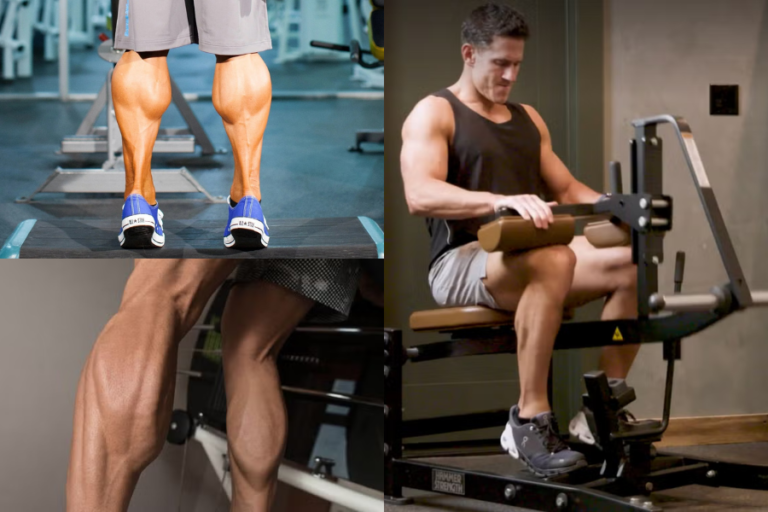
- Standing calf raise (straight leg, gastrocnemius focus)
- 3 sets of 10 reps at your 10RM
- 2 to 3 minutes of rest between sets
- Seated calf raise (bent knee, soleus focus)
- 3 sets of 10 reps at your 10RM
- 2 to 3 minutes of rest between sets
Increase the load by about 2 to 10 percent when the final reps no longer feel challenging. This gradual progression keeps the training stimulus high without jumping in too quickly.
Train both gastrocnemius and soleus
Advanced calf workouts only pay off when you train both major calf muscles consistently.
Straight knee exercises like standing calf raises and donkey calf raises primarily stress the gastrocnemius. Bent knee exercises at roughly 30 degrees of knee flexion, such as seated calf raises or deficit soleus raises, emphasize the soleus more strongly. Soleus work often feels more demanding and usually requires lighter loads at first, so do not be surprised if you start with less weight and build gradually.
Varying your foot position further fine tunes the stimulus. Research by Nunes and colleagues in 2020 found that:
- Toes out tend to stress the medial head of the gastrocnemius
- Toes in emphasize the lateral head
- Toes forward give a more balanced hit
You can rotate these angles across sets or across sessions to make sure no part of the calf is neglected.
Add advanced hypertrophy and endurance work
Once you have a solid base of strength, you can add higher volume work to drive growth and muscular endurance.
A common pattern for advanced calf workouts is to perform at least 15 to 20 intense reps per set, twice per week. Instead of focusing only on adding weight, you focus on effort, range of motion, and time under tension.
A sample hypertrophy pairing might look like this:
-
Standing calf raises
-
3 to 4 sets of 20 to 25 reps
-
Change foot angle each set, for example forward, out, in
-
Short rests of 60 to 90 seconds
-
Eccentric calf raises
-
Step up with two legs, lower slowly on one leg for a count of 3 to 4 seconds
-
3 sets of 8 to 10 lowers per side
Slow eccentrics help strengthen the tissues around the Achilles tendon and can improve resilience over time when done consistently.
Loaded endurance work also plays a role. For example, tiptoe farmer carries ask your calves to maintain contraction under load, which is especially helpful if you play sports that involve sustained time on your toes.
Try an efficient advanced calf circuit
If you are short on time, you can organize your advanced calf workouts into a compact circuit. One effective pattern that shows up in bodybuilding style programs uses six exercises performed back to back with minimal rest, then repeating the entire circuit multiple times.
A template might include:
- Handwalks, focusing on ankle and calf movement for 10 controlled reps
- Single leg standing calf raise, 10 reps each side with a full stretch and powerful rise
- Seated calf raise, 20 to 25 slow reps, squeezing at the top
- Eccentric calf raises, 8 to 10 reps per side
- Tiptoe farmer carry, 30 to 40 seconds
- Squat into calf raise, 10 to 12 reps focusing on smooth transition from squat to calf raise
Perform all six exercises in sequence, rest one minute, then repeat the circuit two more times. This structure packs a lot of stimulus into a relatively short session and is best done two or three times a week rather than daily.
Layer in plyometrics for power
Once you have a foundation of strength and control, you can progress to plyometric work. Plyometrics use the stretch shortening cycle, which means a quick pre stretch followed by an explosive contraction. This kind of training is excellent for power and speed.
A review by Davies and colleagues in 2015 reported that lower body plyometric programs lasting 6 to 24 weeks with volumes of 400 to 1700 jumps consistently improved vertical jump performance and sprint speed across different age groups. To tap into these benefits safely, you need good baseline strength and joint control first.
For calves, plyometric options include:
- Sprinter calf jumps
- Dumbbell calf hops
- Squat jumps and box jumps
- Jumping jacks performed explosively
Start with short bouts of 10 to 20 seconds or sets of 6 to 8 jumps focusing on quality, not quantity. Over time, you can add sets or introduce light weights.
High intensity plyometrics at 80 to 100 percent of your maximum voluntary effort recruit fast twitch fibers, which are critical for power. Because the rate and intensity of stretch matter more than the depth, keep landings soft and controlled instead of trying to jump from extreme depths.
Manage recovery and avoid overtraining
It is tempting to train your calves hard every day, especially if they have been a stubborn muscle group for you. However, overtraining your calves can lead to persistent soreness or issues like tendon irritation.
To stay on track:
- Train calves directly 2 to 3 times per week
- Separate heavy strength days and high impact plyometric days when possible
- Increase load or volume gradually
- Stop a session early if you feel sharp pain or unusual tightness in the Achilles tendon
Long term, consistency wins. Physical therapists frequently note that progressive strengthening is essential for activities like tennis or pickleball, but it takes patience and regular practice to build tolerance for high impact moves.
Gentle stretching and soft tissue work can also help. Wall calf stretches, bent knee soleus stretches, and occasional foam rolling support flexibility and may reduce the risk of strains when combined with smart training progression.
Put it all together
Advanced calf workouts work best when you treat them like any other structured program rather than an afterthought at the end of leg day.
A simple weekly structure might look like this:
- Day 1: Heavy standing and seated calf raises at 10RM, 3 sets of 10
- Day 2: Rest from direct calf work or light mobility only
- Day 3: High rep standing raises plus eccentric work
- Day 4: Rest or general lower body training without extra calves
- Day 5: Plyometric focus with sprinter jumps and dumbbell hops
You can adjust the days to match your schedule, but keeping a mix of strength, volume, and power work will give you well rounded results.
Start by picking one or two upgrades for your next session, such as finding your 10RM for standing calf raises or adding a short plyometric block at the end of your workout. As you build confidence, you can expand into the full structure and make your calves a real strength instead of a weak link.
About the Author