A smart plan for calf workout routines does more than build definition in your lower legs. Strong calves support your ankles, protect your Achilles tendon, and help you walk, run, and jump with more power and stability. With a little structure, you can build calf workout routines that target every muscle, not just the obvious ones.
Below, you will learn how your calf muscles work, which exercises hit each one, and how to put everything together into weekly routines that match your schedule and goals.
Understand your calf muscles
Before you decide which calf workout routines to follow, it helps to know exactly what you are training.
Your calves are not a single muscle. They are a group of three called the triceps surae: the gastrocnemius, the soleus, and the plantaris. The gastrocnemius is the larger, more visible muscle that gives your calves their rounded shape. It crosses both the knee and ankle so it helps with posture, walking, running, and jumping.
Underneath sits the soleus, which is smaller but highly endurance focused. It does a lot of work when you stand, walk, and balance, and it is especially active when your knees are bent. The plantaris is a thin muscle that assists movement around the knee and ankle and helps the bigger muscles do their job.
Balanced calf workout routines should train the gastrocnemius, the soleus, and even the muscles along the front of the shin, like the tibialis anterior. When you ignore one area, you increase your risk of imbalance and overuse injuries.
Key exercises for every calf muscle
Most effective calf workout routines are built around a few core movements. The difference is in how you perform them, your body position, and the range of motion you use.
Standing and single leg calf raises
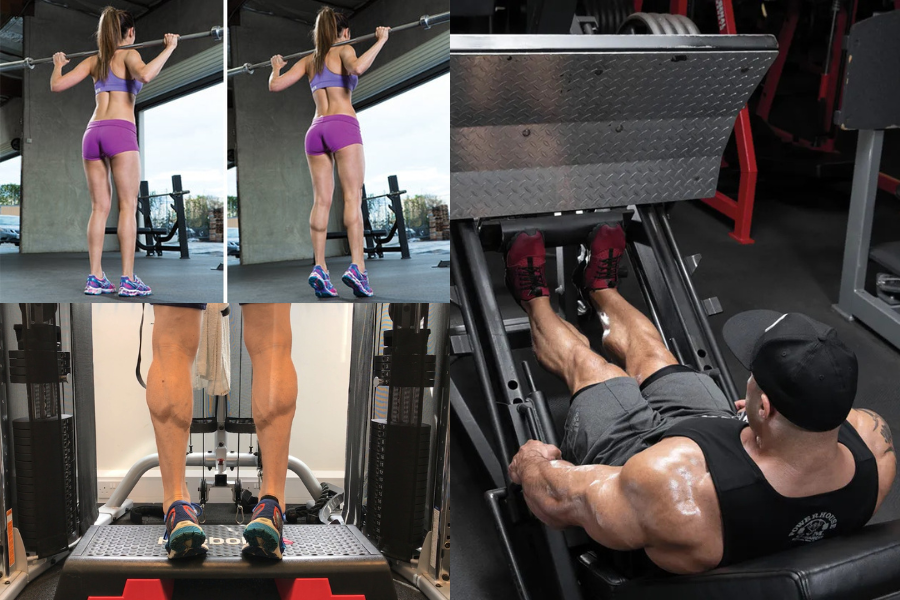
Classic standing calf raises are still one of the best ways to strengthen your lower legs. You stand with your feet about hip width apart, then press into the balls of your feet to lift your heels off the ground. This primarily targets the gastrocnemius and also challenges your balance and ankle stability.
Single leg calf raises increase the intensity by putting your full weight onto one leg. You can do these on flat ground or off a step so your heel can drop slightly below your toes. That extra stretch at the bottom helps build strength and mobility. Research suggests that single leg calf raises are highly effective for strength and balance when programmed as 2 sets of 15 repetitions with about 30 seconds of rest between sets.
You can scale both versions by holding dumbbells for added resistance, or by using a chair or wall for balance support if needed.
Seated calf raises for the soleus
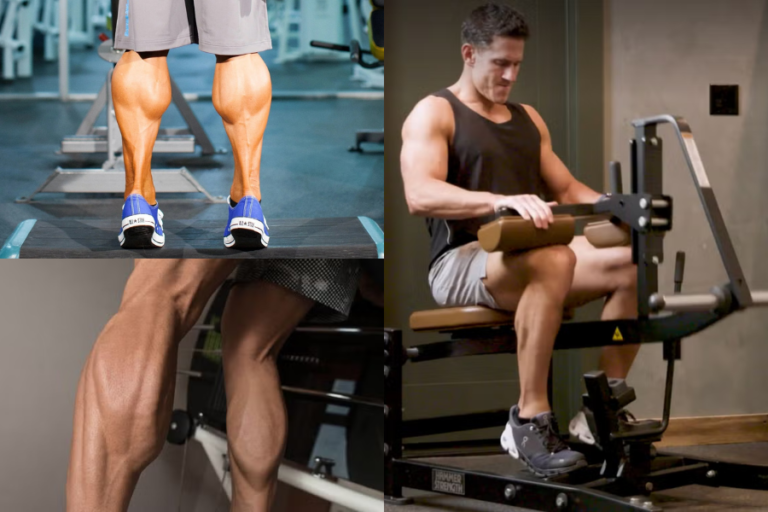
When you sit down, bend your knees, and then lift your heels, you shift more of the work to the soleus muscle. This is where seated calf raises shine. You can perform them with just body weight while seated in a sturdy chair, or use a dedicated calf raise machine at the gym.
In a typical seated calf raise, you position the balls of your feet on a platform, rest a pad or weight over your thighs, then raise your heels as high as possible before slowly lowering them. A bodybuilding classic, this move is often recommended for beginners because it allows you to focus on slow, controlled movement and a strong squeeze at the top.
A simple starting prescription is 2 sets of 10 repetitions on each side, with about 30 seconds of rest. Over time, you can work up to 3 sets of 8 to 15 repetitions with a two second hold at the top and bottom.
Dynamic and plyometric calf movements
Calf workout routines that only use slow, straight up and down reps miss an important piece of the puzzle. Your calves must also be able to work explosively when you run, jump, or change direction.
Functional moves like the One Leg Over the Line jump or a 3 hurdle drill challenge quickness, coordination, and lower body stability. For example, you might hop side to side over a line on one leg for 2 sets of 10 repetitions per side, or step laterally over three low hurdles for 2 sets each direction. These drills build reactive strength in the calves and ankles and translate well to sports.
Jump rope is another great option. It builds explosive lower body plyometric power while also providing a cardio workout that burns fat. A simple format is 3 to 4 rounds of 30 seconds of jumping, followed by 30 seconds of rest.
Using dumbbells in calf workout routines
You do not need a full gym to build strong calves. A pair of dumbbells can give you an effective, well rounded routine at home.
Dumbbell calf raises target both the gastrocnemius and soleus. The Mayo Clinic notes that strengthening these muscles with calf raises helps protect your Achilles tendon and calf from injury, which makes this exercise especially valuable for injury prevention.
To perform a basic dumbbell calf raise, you stand with feet shoulder width apart and hold a dumbbell in each hand at your sides. Keeping your back and knees straight, you lift your heels so you rise onto your toes, then slowly lower back down to feel tension in the calf muscles. If balance is an issue, you can rest one hand on a chair or pole.
Most people can start with one set of 12 to 15 smooth, controlled repetitions, and add more sets as strength improves. You can expand your routine with other moves like:
- Seated dumbbell calf raise in a chair or on a bench
- Farmer walk on tiptoes, where you walk forward on your toes while holding dumbbells
- Dumbbell jump squats and step ups, which challenge the calves in more dynamic ways
Whatever you choose, proper form and progressive overload matter more than fancy variations. Increase the weight slowly as you get stronger, and keep your movements controlled rather than bouncing.
How often to train your calves
Your calves are used all day when you stand and walk, so they are adapted to low intensity, short range work. That is why short, easy reps rarely produce much growth. You need enough intensity, range of motion, and volume to signal change without overdoing it.
A simple starting point is training calves 2 to 3 times per week. Each session can include 1 to 3 different calf exercises for 1 to 3 sets of 8 to 12 repetitions. Increase resistance by about 10 to 15 percent every couple of weeks, as long as your form stays solid and your joints feel good.
If your recovery is strong and you are used to training, some guidelines suggest you can work calves 3 to 6 times per week. Recovery should guide your frequency. You are ready to train again when your performance is back to normal or better and soreness is manageable.
Rest and recovery are just as important as the workouts themselves. Your muscles repair and grow when you are resting, not while you are lifting. Training calves 2 to 3 times a week with adequate recovery between sessions supports both performance and development.
Reps, range of motion, and progression
Because calf muscles have a mix of slow twitch and fast twitch fibers, they respond well when you mix up your repetition ranges instead of repeating the same set and rep scheme every session.
A balanced approach is to spend about half of your weekly sets in the moderate 10 to 20 rep range, then split the rest between heavier 5 to 10 rep sets and lighter 20 to 30 rep sets. Many people find that extremely heavy sets in the 5 to 10 rep range are less effective for calves, while moderate and higher reps with good control produce better results.
The quality of your range of motion is critical. Your daily walking already involves short, partial calf contractions, so your workouts should take the muscle through a longer range. Let your heel drop under control at the bottom, pause for up to two seconds in a deep but comfortable stretch, then drive up and squeeze at the top. Holding that deep stretch at the bottom can enhance hypertrophy and may reduce injury risk, but beginners should start with low volume because the soreness can be intense.
Progressive overload stays at the core of all effective calf workout routines. That might mean adding a few pounds to the weight, increasing reps within a target range, or adding an extra set over time. What rarely works is doing the same light, low range motion over and over without increasing the challenge.
Sample calf workout routines you can use
Here are two sample routines that target all major calf muscles. You can rotate them across the week depending on how often you train.
Try starting with just one of these routines per week, then add the second once your calves adjust. This reduces the risk of excessive soreness and makes it easier to gauge your recovery.
Routine A, strength and control
Focus: standing work for the gastrocnemius, plus some bent knee training for the soleus.
- Standing dumbbell calf raise
- 3 sets of 10 to 15 repetitions
- Two second pause at the bottom stretch on each rep
- Single leg calf raise on a step
- 2 sets of 12 to 15 repetitions per leg
- Light weight or body weight, use a handhold for balance
- Seated calf raise
- 3 sets of 8 to 12 repetitions
- Two second hold at the top and bottom
Rest about 45 to 60 seconds between sets. Use a weight that makes the last 2 repetitions challenging but does not force you to bounce or cut the range short.
Routine B, power and endurance
Focus: dynamic work plus endurance for the soleus and stabilizers.
- Jump rope
- 3 to 4 rounds of 30 seconds on, 30 seconds off
- Farmer walk on tiptoes
- 2 sets of 20 to 30 seconds walking on your toes with dumbbells
- Seated dumbbell calf raise
- 2 to 3 sets of 15 to 20 repetitions
- Use a lighter weight and smooth tempo
- Calf and ankle stretch
- 2 sets of 10 repetitions per side
- Hold each stretch for a slow count, then release
This routine helps you build calf strength while also improving your ankle mobility and endurance, which pays off in running, hiking, and everyday activities.
Common mistakes that hold your calves back
If you feel as if your calves never change, you are not alone. Genetics do shape calf size, particularly the anatomy of the gastrocnemius muscle. Some people naturally have fuller calves, while others have to work harder to make visible progress.
Even with less favorable genetics, you can still improve strength, shape, and function by avoiding a few common pitfalls.
One mistake is skipping calf training entirely or treating it as an afterthought. Sports rehab specialist David Grey has noted that many people focus on quads and hamstrings and neglect calf raises, which contributes to underdeveloped lower legs.
Another issue is using weights that are too light, especially if you are trying to move through a very deep range. If the weight does not challenge you, your body has no reason to adapt. Instead, focus on a strong bottom half of the movement, where the calf works hardest, and progress the load over time. Some coaches prefer standing calf raises over seated versions for development, and suggest using seated raises only occasionally as a complementary exercise.
Finally, doing more frequent low load sessions often does not help. Increasing the frequency of easy, low intensity calf raises does not provide the stimulus needed for growth. It is better to prioritize progressive overload, quality range of motion, and consistent training.
Bringing it all together
When you design your calf workout routines, think in terms of balance and purpose. Include:
- At least one standing exercise to hit the gastrocnemius
- One bent knee or seated move to emphasize the soleus
- Occasional dynamic drills like jumping rope or single leg hops to build reactive strength
Mix your rep ranges across the week, train 2 to 3 times per week to start, and gradually increase load as you get stronger. Stretching between sets and after workouts can improve mobility, enhance the muscle pump, and support recovery and growth.
Choose one small change to start today, such as adding a single leg calf raise at the end of your next workout, and build from there. Over the next few weeks, you will likely notice not only stronger looking calves, but also more confident steps, better balance, and smoother movement in nearly everything you do.
About the Author